Table of Contents
ToggleWhat Is the CPT Code for a Thyroid Ultrasound?
There is one CPT code most practices reach for when billing a thyroid ultrasound: 76536. But a second code, 76537, exists for a reason, and mixing the two up is one of the fastest ways to trigger a denial.
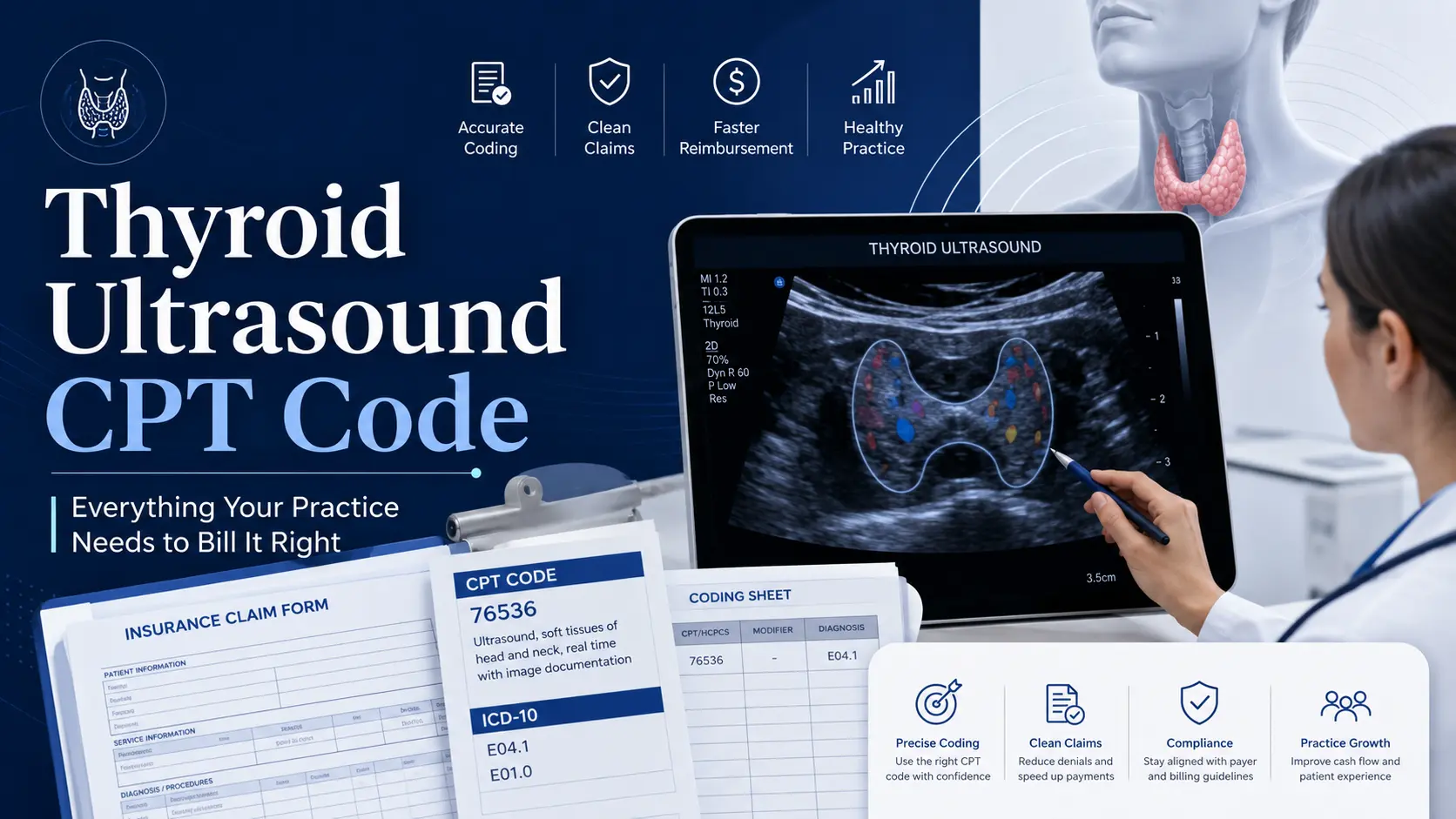
The primary CPT code for a thyroid ultrasound is 76536: “Ultrasound, soft tissues of head and neck (for example, thyroid, parathyroid, parotid), real time with image documentation.” This code covers a complete evaluation of the thyroid gland and surrounding soft tissue, including the parathyroid and parotid glands and cervical lymph nodes when clinically relevant.
A second, less commonly billed code, 76537, applies to a limited or follow up ultrasound. Practices use it when a provider is only rechecking a previously identified nodule rather than performing a full evaluation of the gland.
| CPT Code | Description | When to Use It |
| 76536 | Ultrasound, soft tissues of head and neck, real time with image documentation, complete | Full thyroid evaluation, new patient workup, initial nodule assessment |
| 76537 | Ultrasound, soft tissues of head and neck, real time with image documentation, limited or follow up | Rechecking a known nodule, targeted follow up scan |
Why This Matters for Reimbursement
Payers scrutinize 76536 closely because it is one of the most billed diagnostic imaging codes in endocrinology. Our medical coding team sees three recurring denial triggers on this code, and all three are preventable with the right documentation habits.
Documentation must show real time imaging with permanently stored images. A verbal description of the exam is not enough. The chart needs saved images that a reviewer can pull up months later.
The report needs structural detail, not just a conclusion. Payers want lobe measurements, isthmus size, and a clear characterization of any nodule: size, echogenicity, margins, and calcifications. Many practices also include TI-RADS scoring now, since it strengthens the medical necessity argument.
One unit per encounter, every time. CPT 76536 covers the entire head and neck as a single regional study. Billing the thyroid and the parotid gland as two separate line items in the same session is a bundling error, and it gets flagged.
Common ICD-10 Codes That Pair With 76536
Medical necessity for a thyroid ultrasound has to come from the diagnosis code, not the CPT code alone. The most frequently accepted pairings include:
- E04.9 — Nontoxic goiter, unspecified
- E04.1 — Nontoxic single thyroid nodule
- E05.90 — Thyrotoxicosis, unspecified
- E03.9 — Hypothyroidism, unspecified
- R59.9 — Enlarged lymph nodes, unspecified
A mismatched CPT to ICD-10 pairing is one of the top reasons diagnostic imaging claims get denied. Confirm the diagnosis actually supports imaging before the claim goes out the door, not after the denial comes back.
Modifiers: What Applies and What Does Not
Laterality modifiers like LT, RT, and 50 do not apply to 76536, because it describes a regional study rather than a paired organ. Where modifiers do matter:
- Modifier 25 on the same day evaluation and management code, when a distinct and separately documented E&M service happens alongside the ultrasound
- Modifier 59 or XU when a diagnostic ultrasound and a separate procedure, such as an ultrasound guided fine needle aspiration, are billed together with clearly distinct clinical objectives
If a fine needle aspiration is guided by ultrasound on the same lesion, CPT 76536 billed alongside it for that same lesion typically gets denied, since the guidance is already built into the aspiration code. Our revenue cycle management team flags this combination automatically before claims go out, which is one of the reasons Docscare clients hold a 99% clean claim rate.
A Quick Real World Example
A 38 year old patient comes in with a palpable neck lump and a family history of thyroid disease. The physician orders a full thyroid ultrasound. The sonographer images the entire gland, documents lobe measurements, and identifies a 1.2 centimeter nodule with defined margins. The radiologist interprets the images and issues a report.
This encounter bills as 76536, paired with an ICD-10 code such as E04.1 for the nodule finding. If the patient returns in six months for a repeat scan of that same nodule only, that follow up visit bills as 76537, not another 76536.
Verify Coverage Before You Bill
CPT 76536 is included in the Medicare Physician Fee Schedule, but Medicare Administrative Contractors set regional Local Coverage Determinations that can affect what documentation and diagnosis codes they accept. Check the CMS Medicare Coverage Database for your MAC’s current LCD before assuming a claim will pass.
medical coding services
Getting the CPT and ICD-10 pairing wrong is one of the most common reasons diagnostic imaging claims bounce back. Our AAPC certified coders review every thyroid ultrasound claim for correct code selection, documentation completeness, and payer specific requirements before it goes out.
The Bottom Line
76536 covers a complete thyroid ultrasound. 76537 covers a limited or follow up scan. Getting that distinction right, backing it with a diagnosis code that actually supports imaging, and documenting stored images with structural detail are the three things that keep this claim out of your denial pile.
medical coding services
Denials on diagnostic imaging codes add up fast when a practice is coding these claims in house without dedicated oversight. Docscare’s coding team holds a 99% first submission pass rate across specialties, including endocrinology and radiology adjacent billing.
FAQ
What is the CPT code for a thyroid ultrasound?
The standard CPT code for a complete thyroid ultrasound is 76536, which covers real time imaging of the thyroid and surrounding soft tissue with permanently stored images.
What is the difference between CPT 76536 and 76537?
76536 covers a complete thyroid ultrasound evaluation. 76537 covers a limited or follow up scan, typically used to recheck a previously identified nodule rather than evaluate the entire gland.
Can you bill 76536 and a fine needle aspiration code on the same day?
Usually not for the same lesion. CPT 10005, the ultrasound guided fine needle aspiration code, already includes imaging guidance, so billing 76536 separately for that same lesion is typically denied unless the two services address clearly distinct clinical objectives with appropriate modifiers.
Do laterality modifiers apply to CPT 76536?
No. CPT 76536 describes a regional study of the head and neck as a whole, so LT, RT, and 50 modifiers do not apply.
Which ICD-10 codes commonly justify a thyroid ultrasound?
Frequently accepted pairings include E04.9 for nontoxic goiter, E04.1 for a nontoxic single thyroid nodule, E05.90 for thyrotoxicosis, and E03.9 for hypothyroidism. Always confirm the diagnosis matches your payer’s Local Coverage Determination.