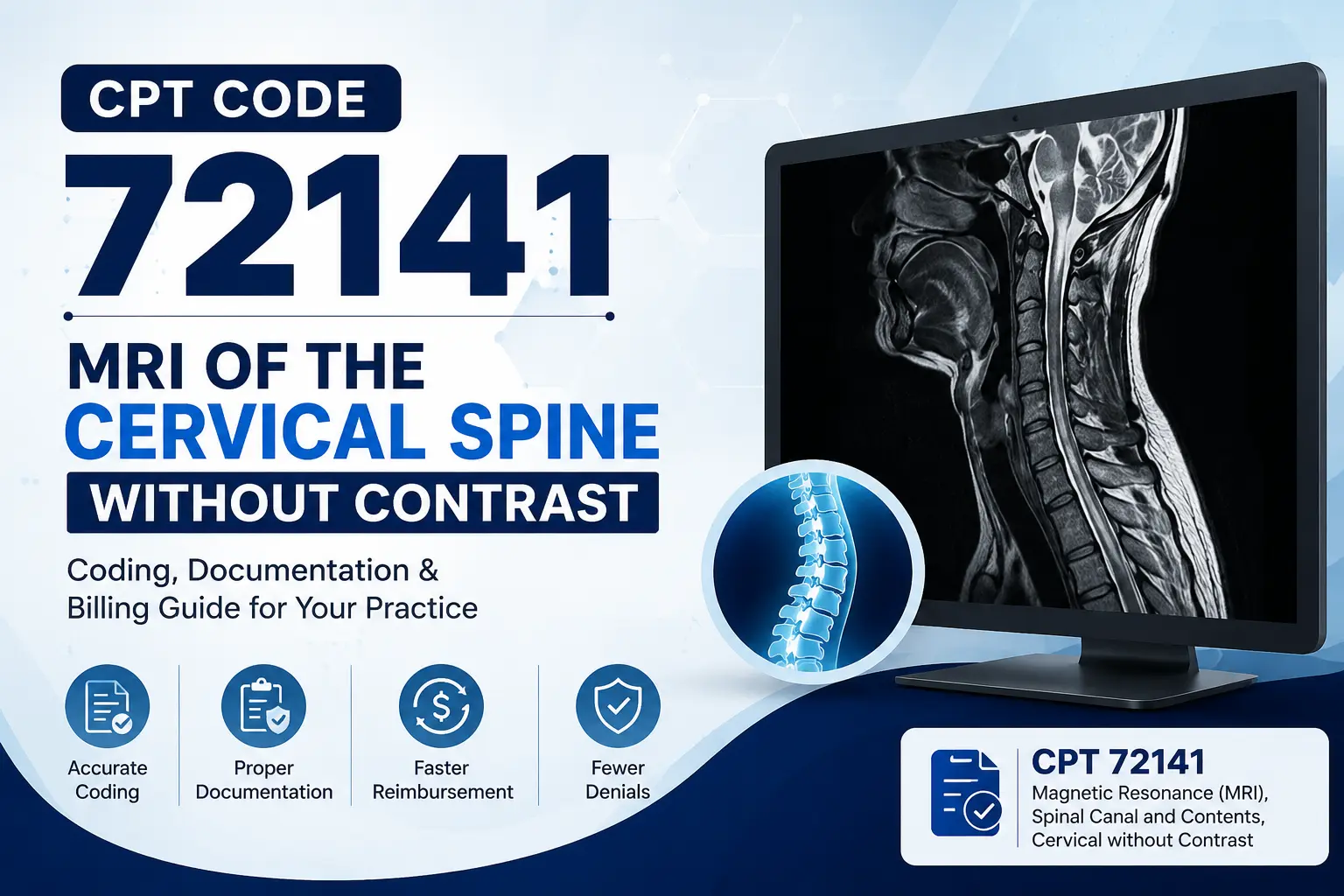
The 72141 CPT code reports a magnetic resonance imaging study of the cervical spinal canal and its contents, performed without contrast material. In plain terms, it’s a neck MRI with nothing injected to brighten the image. If you bill imaging for a radiology group or a practice that refers a lot of neck MRIs, this is one of the codes you’ll touch most, and one payers audit hardest.
Here’s what you’ll get below: the exact AMA descriptor, when to reach for this code instead of a sibling, the two modifiers that decide whether you’re paid the full amount, the ICD-10 links that carry medical necessity, and the documentation that gets a claim paid on the first submission. We built this for the coder double checking a chart and the practice manager chasing a rejection.
See how our AAPC certified coders keep clean claim rates at 99 percent.
Table of Contents
ToggleWhat does the 72141 CPT code mean?
The American Medical Association defines 72141 CPT Code as magnetic resonance imaging, spinal canal and contents, cervical, without contrast material. The study renders the vertebrae, intervertebral discs, spinal cord, nerve roots, and the soft tissue around them in high detail, all without a gadolinium based contrast agent.
Providers order it to investigate a specific set of neck problems. Common ones include herniated discs, spinal stenosis, suspected tumors, infection, and neurological symptoms like numbness, tingling, or weakness in the arms. The exam runs in a hospital, an outpatient imaging center, or a freestanding radiology facility.
The phrase “without contrast material” is doing real work in that descriptor. It’s the single detail that separates 72141 from its two closest neighbors, and getting it wrong is the fastest route to a denial or a downcode. That’s exactly the kind of check our outsourced medical coding services run before a claim ever reaches the payer.
When do you use 72141 instead of 72142 or 72156?
Contrast status decides the code. All three describe an MRI of the same anatomy. The only variable is whether contrast was administered, and when.
- 72141 reports the study when no contrast is used.
- 72142 reports the study when contrast is administered.
- 72156 reports the study when the radiologist runs the exam both without and with contrast in the same session.
Report 72141 only when the chart documents a non contrast protocol from start to finish. If the radiologist administered gadolinium at any point, 72141 is the wrong code, and billing it against a with contrast study invites a downcode or a takeback on audit.
Two more codes get confused with this one, and both trip up new coders. CPT 72148 covers an MRI of the lumbar spine without contrast, so the difference there is region, not contrast. And CPT 72125 is a CT of the cervical spine, a different machine and a different code family entirely. Different physics, different code.
| Cervical Spine MRI Codes Compared by Contrast and Region | |||
|---|---|---|---|
| CPT Code | Study | Contrast | Region |
| 72141 | MRI, spinal canal and contents | Without contrast | Cervical spine (neck) |
| 72142 | MRI, spinal canal and contents | With contrast | Cervical spine (neck) |
| 72156 | MRI, spinal canal and contents | Without and with contrast | Cervical spine (neck) |
| 72148 | MRI, spinal canal and contents | Without contrast | Lumbar spine (lower back) |
| 72125 | CT, cervical spine | Without contrast | Cervical spine (neck) |
Which modifiers does 72141 CPT Code need?
Modifiers on 72141 CPT Code split the payment between who read the scan and who owns the equipment. Get them right and the full fee lands. Get them wrong and you collect a fraction of it.
- Modifier 26 reports the professional component, the radiologist’s interpretation. Use it when your provider read the scan but did not own the equipment.
- Modifier TC reports the technical component, the equipment, supplies, and facility overhead. Use it when your facility performed the scan but a separate radiologist read it.
- No modifier is needed when you bill globally, meaning your practice performed the scan and interpreted it. The global charge covers both components.
The trap here is the split billing arrangement. When a hospital owns the scanner and an outside radiology group reads the film, each party bills its own component. Drop the modifier in that setup and you’ll either double bill the global fee or leave the technical payment on the table. Clean modifier logic is one reason practices move imaging claims to our medical billing services.
What documentation makes a 72141 claim pay?
Medical necessity carries this code. A cervical spine MRI is among the most frequently audited outpatient imaging services, and claims fail when the record doesn’t justify the scan or the code doesn’t match the protocol.
Your documentation needs four things working together:
- A signed order that specifies cervical spine MRI without contrast.
- A supporting ICD-10 diagnosis that explains why imaging was medically necessary. Neck pain, radiculopathy, cervical disc disease, numbness, or a documented neurological deficit all qualify when the note backs them up.
- The radiology report confirming the non contrast protocol, so the code matches the chart.
- Prior authorization where the payer requires it. Many commercial plans require pre authorization on advanced imaging, and a missing auth number is a hard denial regardless of how clean the rest of the claim is.
The link between the CPT code and the ICD-10 code is where most preventable denials happen. If you want the deeper breakdown, start with the difference between ICD-10 and CPT codes. When the diagnosis on the claim doesn’t support advanced neck imaging, the payer reads the study as not medically necessary and refuses it, even when the scan was clinically appropriate. The fix is a coder who checks that pairing before the claim goes out, not after it bounces back.
medical coding services
Denied cervical MRI claims usually trace back to one of two things: a modifier that didn’t match the billing arrangement, or a diagnosis that didn’t carry medical necessity. Our coding team scrubs imaging claims for modifier accuracy and ICD-10 pairing before submission, which is how we hold a 99 percent clean claim rate.
How much does Medicare pay for 72141?
Medicare reimburses 72141 through the Medicare Physician Fee Schedule, and the amount depends on which component you bill and where you are. The professional, technical, and global rates each carry a different fee, and every Medicare Administrative Contractor sets regional pricing, so the exact dollar figure shifts by locality.
Because those numbers move each year and vary by MAC, we won’t quote a flat rate here. Pull the current amount from the Medicare Physician Fee Schedule lookup for your region and your specific component, then confirm it against each commercial payer’s contracted rate. Commercial reimbursement for advanced imaging often differs sharply from the Medicare baseline. It also helps to know what a clean claim rate really measures before you benchmark your own.
Frequently asked questions
What is the 72141 CPT code used for?
It reports an MRI of the cervical spine (the neck) without contrast material. Providers order it to evaluate herniated discs, spinal stenosis, tumors, infection, and neurological symptoms in the arms or neck.
What is the difference between 72141 and 72142?
Contrast. 72141 CPT Code is the MRI without contrast. 72142 is the same cervical spine MRI performed with contrast material. Use 72156 when the study is done both without and with contrast in one session.
Does 72141 CPT Code need a modifier?
Only when billing is split. Add modifier 26 for the interpretation alone, or modifier TC for the technical component alone. Bill 72141 CPT Code with no modifier when your practice performed and read the scan as a global service.
Is 72141 an MRI or a CT?
It’s an MRI. A CT of the cervical spine without contrast is 72125, a separate code for a different imaging modality.
Does Medicare cover 72141 CPT Code?
Yes. It’s listed on the Medicare Physician Fee Schedule, and payment runs through your regional Medicare Administrative Contractor. Rates vary by locality and by which component you bill.
What diagnosis supports a 72141 claim?
Any ICD-10 code that documents medical necessity for cervical imaging, such as neck pain, cervical radiculopathy, disc disease, or a neurological deficit. The clinical note has to support the diagnosis you link.
medical coding services
Cervical MRI codes travel in packs, and one wrong contrast assumption or missing modifier turns a clean claim into a rework. Docscare’s coders handle radiology and imaging claims for small and mid size practices, pairing every CPT code with the right ICD-10 diagnosis and the correct modifier before it ships.