If you run billing for a cardiology practice, 78452 is one of the codes that quietly costs you money. The scan gets performed correctly. The report gets written. Then the claim comes back denied, or it pays less than it should, and nobody is sure why.
Table of Contents
ToggleHere is the short version, then the detail your team actually needs.
Quick Answer
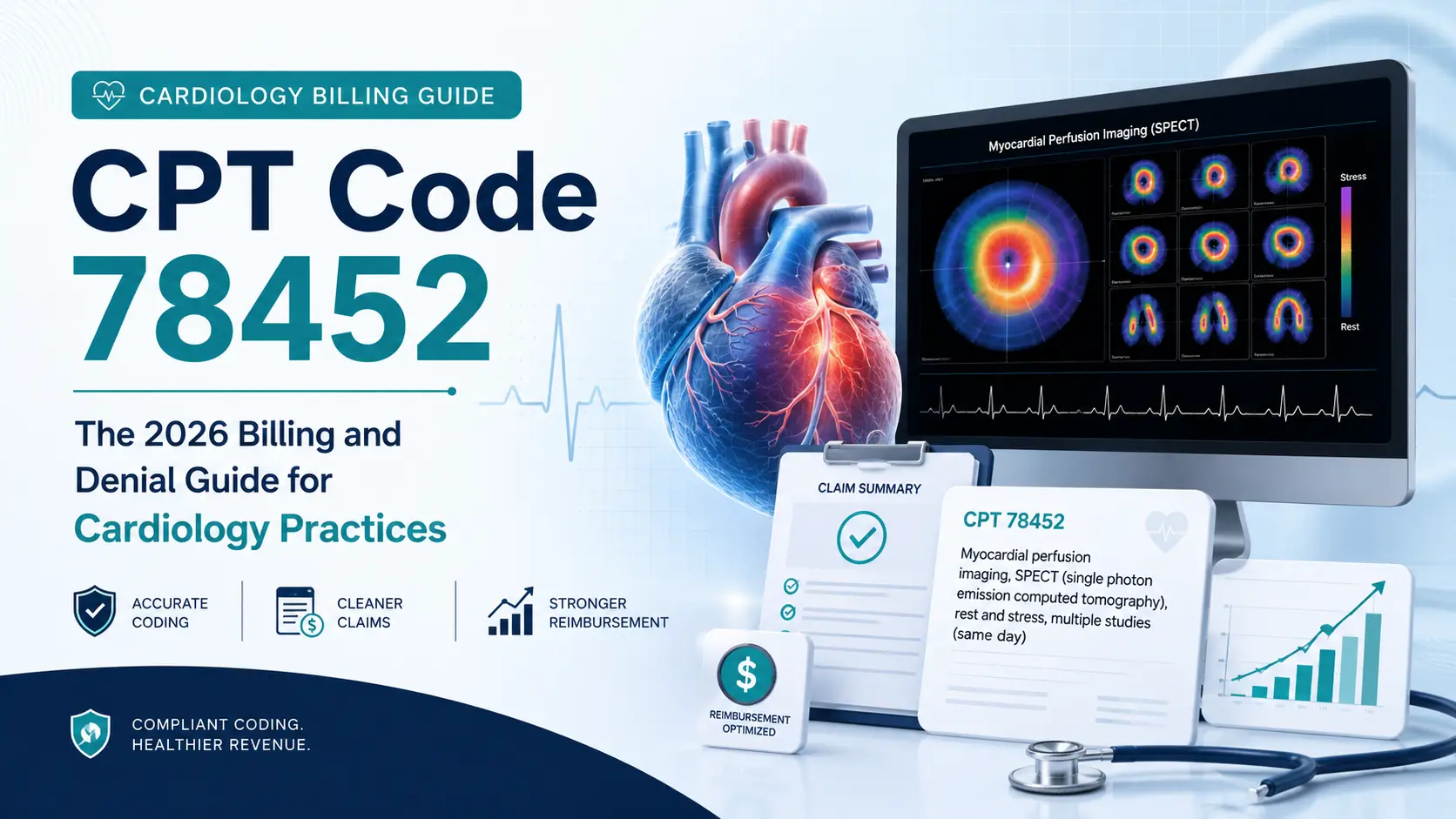
CPT code 78452 reports myocardial perfusion imaging by SPECT with multiple studies,
meaning both the rest and the stress acquisitions in one code. It is the higher-value
sibling of 78451, which covers a single study. Because 78452 already includes both
phases, you do not split it into two lines or append modifier 59 to bill each phase
separately. Getting that one rule right prevents most of the denials tied to this code.
Grab our free Cardiology Denial Checklist: the 12 documentation items that keep 78452 and stress-test claims clean.
What does CPT Code 78452 cover?
78452 covers a nuclear cardiology study that measures blood flow through the heart muscle using single-photon emission computed tomography. The provider captures images at rest and again under stress, either from exercise on a treadmill or from a pharmacologic agent such as regadenoson. Comparing the two sets shows where blood flow drops, which points to ischemia or prior infarction.
The code bundles more than the pictures. Attenuation correction, wall motion assessment, ejection fraction, and any additional quantification are all included when performed. You do not bill those elements separately.
Practices that outsource this work to a team fluent in nuclear cardiology, like our cardiology medical billing specialists, catch these inclusions before the claim goes out.
78451 vs 78452: the difference that triggers denials
This is the mistake we see every week. A practice bills 78451 when the report clearly documents both rest and stress images. That undercodes the service and leaves money on the table. The reverse also happens: billing 78452 when only one phase was performed invites a takeback on audit.
Match the code to what the report describes. One acquisition is 78451. Rest plus stress is 78452.
| Feature | 78451 (Single Study) | 78452 (Multiple Studies) |
|---|---|---|
| Acquisitions | One study, either rest or stress | Both rest and stress studies |
| Modality | SPECT | SPECT |
| Includes | Attenuation correction, wall motion, ejection fraction, and quantification | The same included services across both imaging phases |
| Reimbursement | Generally lower | Generally higher because it includes more imaging and interpretation |
| Common Error | Reported when both phases were performed, resulting in undercoding | Split into two lines or reported with modifier 59, which is incorrect |
Modifiers that apply to 78452
Most 78452 denials tied to modifiers come from one of two situations: a split-billing setup that was not coded, or a modifier added that the code does not need.
- Modifier 26 (professional component). Use when your physician interprets a study performed on equipment they do not own, such as a hospital scanner.
- Modifier TC (technical component). Use when your practice owns the equipment and performs the scan but a separate physician reads it.
- No modifier (global). Use when your practice both performs and interprets the study. This is the most common setup for an in-office nuclear lab.
- Modifier 52 or 53. Use 52 for a reduced study and 53 when a stress test is stopped for patient safety. Document the reason in the record.
Notice what is missing from that list. Modifier 59 to unbundle the rest and stress phases is not a valid use here, because 78452 already represents both phases. Appending it to force two payments is a compliance risk, not a billing tactic.
Denials stacking up on your nuclear studies? Our denial management services work every 78452 rejection within 72 hours, with root-cause coding review so the same denial does not repeat.
Why 78452 claims get denied (and how to stop it)
Coronary artery disease affects more than 20 million people in the United States, so payers scrutinize the studies used to diagnose it. Here are the denials we fix most often.
Medical necessity not supported
The claim needs an ICD-10 code that justifies the study. Link 78452 to a supporting diagnosis such as I25.10 (atherosclerotic heart disease), I25.2 (old myocardial infarction), or a symptom code like R07.9 (chest pain) when it drove the order. Sequence the diagnosis that best proves necessity first.
Bundling with the stress test
The classic denial: billing 78452 alongside 93015 (cardiovascular stress test) and getting the stress code rejected. When the stress is pharmacologic, the supervision code is usually 93017, not 93015. Match the supervision code to how the stress was induced.
Missing split-billing modifier
A hospital-based read without modifier 26, or an in-office technical service without TC when a separate physician interprets, produces a mismatch the payer rejects. Set the modifier from the ownership and interpretation arrangement, not from habit.
Prior authorization not on file
Many commercial plans require prior auth for advanced cardiac imaging. Confirm it before the scan, not after. Front-loading insurance eligibility verification catches these gaps while they are still fixable.
Reimbursement basics for 78452
78452 sits on the Medicare Physician Fee Schedule, so the allowed amount varies by your Medicare Administrative Contractor and geography. Medicare typically pays 80% after the deductible, with the patient responsible for the rest. Commercial rates depend on your contracts. Check current values on the CMS Medicare Physician Fee Schedule before quoting a number to a practice.
One reimbursement leak worth naming: the pharmacologic stress agent. When you use regadenoson (Lexiscan), the drug is billed separately with its own HCPCS code. Missing that line is quiet revenue loss on every stress study.
Descriptors and payment rules referenced here follow AMA CPT 2026 guidance.
How Docscare handles nuclear cardiology billing
We are an Austin-based boutique billing team with a 99% clean claim rate and a 99% first-submission pass rate. For cardiology specifically, that means our coders read the study report, match 78451 or 78452 to the acquisitions performed, apply the right component modifier, sequence the diagnosis for medical necessity, and confirm prior auth before the claim leaves. When a payer pushes back, we work the denial within 72 hours and fix the root cause so it stops recurring.
Your cardiology claims should pay the first time.
Docscare codes 78452, stress tests, and the full nuclear cardiology workflow with a 99% clean claim rate, so your practice collects what it earned. Book a 15-minute cardiology billing review and we will show you where your current claims are leaking.
Frequently asked questions
Is CPT Code 78452 covered by Medicare?
Yes. 78452 is on the Medicare Physician Fee Schedule. Medicare generally pays 80% of the allowed amount after the deductible, and the rate varies by your regional contractor. Coverage still depends on documented medical necessity.
What is the difference between 78451 and 78452?
78451 reports a single myocardial perfusion study, either rest or stress. 78452 reports multiple studies, meaning both rest and stress. If the report documents both phases, 78452 is the correct code and 78451 would undercode the service.
Which modifiers are used with 78452?
Modifier 26 for the professional component, TC for the technical component, or no modifier when your practice performs and reads the study. Use 52 for a reduced study or 53 for a stopped stress test. Modifier 59 to bill the phases separately is not appropriate, because 78452 already includes both phases.
Why do 78452 claims get denied?
The four most common reasons are weak medical necessity documentation, bundling conflicts with the stress test code, a missing or incorrect component modifier, and no prior authorization on file. Each is preventable with the right pre-claim review.
Can I bill 78452 with a stress test code?
Often yes, but match the supervision code to the stress type. Pharmacologic stress usually pairs with 93017, not 93015. Billing the wrong stress code is a frequent cause of the bundling denial on nuclear studies.
Is 78452 a PET scan code?
No. 78452 is a SPECT code. PET myocardial perfusion uses a different range, 78431 through 78434. Selecting a SPECT code for a PET study, or the reverse, causes denials.