Direct Answer
CPT code 78452 reports myocardial perfusion imaging by SPECT with multiple studies,
meaning both the rest and the stress acquisitions in one code. It is the higher-value
sibling of 78451, which covers a single study. Because 78452 already includes both
phases, you do not split it into two lines or append modifier 59 to bill each phase
separately. Getting that one rule right prevents most of the denials tied to this code.
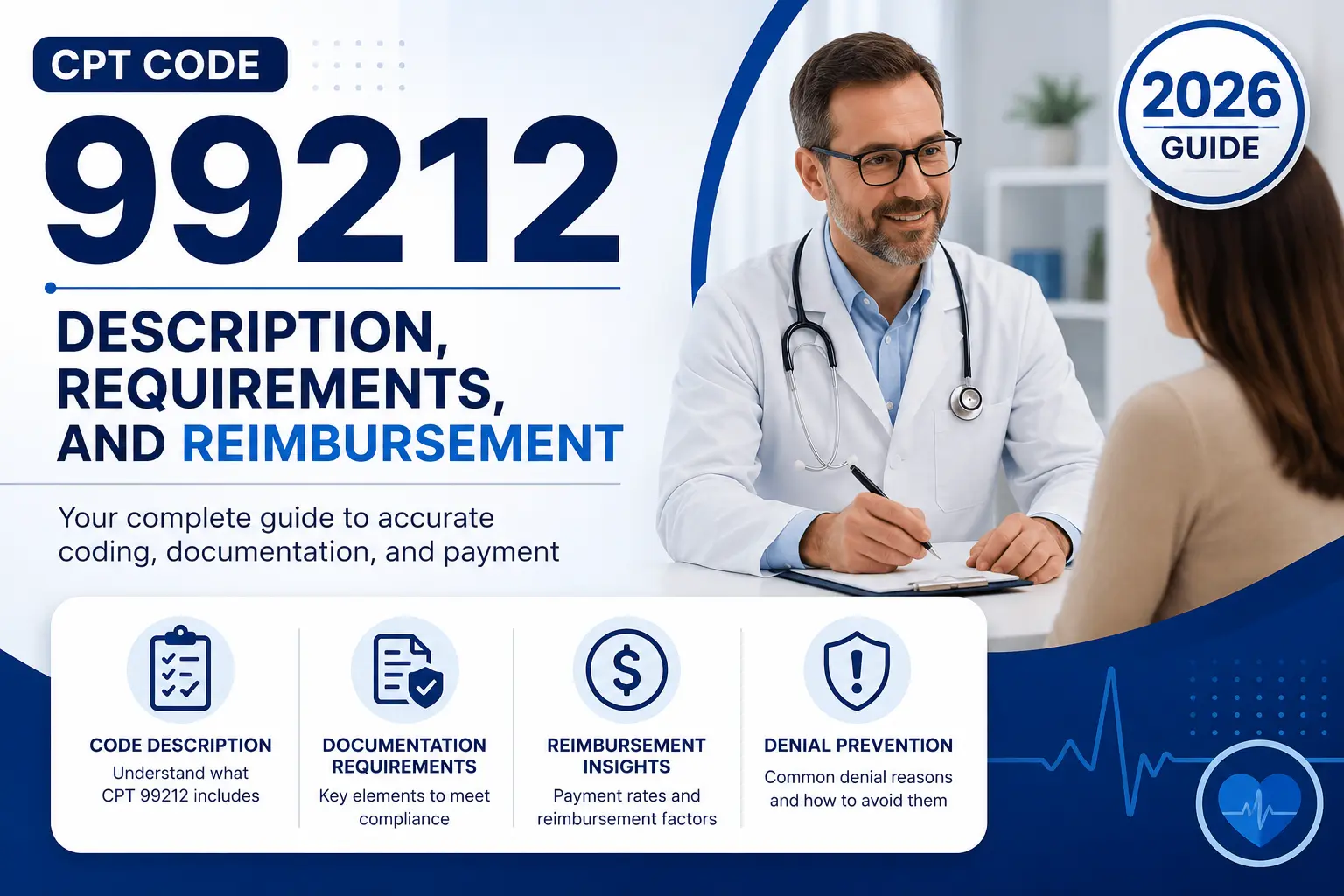
Every established patient visit gets a level. That level decides what the payer pays you. Pick a level too high and you invite an audit. Pick one too low and you leave money on the table on a claim you already earned. CPT Code 99212 is the code that trips up a lot of small practices, because it looks simple and gets coded on autopilot.
You run a three-provider family medicine group in Round Rock. A nurse rooms a patient, the physician spends nine minutes confirming a stable condition, and someone marks 99213 out of habit. That single overcode, repeated across a panel, is exactly what draws a payer’s attention. This guide walks the 99212 rules so your team codes the visit for what it actually was.
Table of Contents
ToggleFree resource
A one-page reference for 99211 through 99215: time thresholds, decision-making levels, and documentation prompts. Built for front-line coders.
01 / DEFINITION What CPT code 99212 actually describes
99212 is an evaluation and management (E/M) code for an office or outpatient visit with an established patient, meaning someone your practice has seen within the past three years. The American Medical Association owns the official CPT descriptor, so verify the exact wording in your current CPT manual. In plain terms, the code represents the second-lowest level of established patient visit.
Two things separate 99212 from the codes around it: the complexity of the medical decision making and the total time the provider spends on the visit. You qualify by meeting either one. You do not need both. This is the biggest shift from the pre-2021 rules, and plenty of practices still code as if history and exam bullets decide the level. They do not, not for office E/M codes.
02 / REQUIREMENTS How to qualify a visit for CPT Code 99212
Since January 2021, you code an established patient office visit one of two ways. Choose the path that fits the encounter, then document to match it.
Path one: medical decision making
99212 requires straightforward medical decision making (MDM). Under the AMA framework, MDM turns on three elements: the number and complexity of problems addressed, the amount and complexity of data reviewed, and the risk of the management plan. Straightforward MDM usually means one self-limited or minor problem, little or no data to review, and minimal risk from whatever you recommend.
Path two: total time
If time drives the visit, 99212 covers 10 to 19 minutes of total time on the date of the encounter. Total time counts your face-to-face work plus the non-face-to-face work you personally do that day: reviewing the chart before you walk in, ordering tests, documenting in the record, and coordinating care. It does not count staff time, and it does not count time spent on a different calendar day.
| Established Patient E/M Levels at a Glance | ||
|---|---|---|
| Code | Decision Making | Total Time |
| 99211 | Minimal, often without physician or QHP involvement | Not time-based |
| 99212 | Straightforward | 10–19 minutes |
| 99213 | Low | 20–29 minutes |
| 99214 | Moderate | 30–39 minutes |
| 99215 | High | 40–54 minutes |
03 / EXAMPLES When CPT Code 99212 is the right call
The code fits quick, low-stakes established visits. A few encounters that typically land at level 2:
- A patient returns to confirm a single stable, minor issue and needs no new testing.
- A brief follow-up on one prescription with no dose change and no new symptoms.
- A short recheck of a healing minor complaint where the plan is reassurance and routine follow-up.
The common thread is one minor problem, no meaningful data review, and low risk. The moment a second active problem enters, or you order and interpret tests, or you adjust therapy for something that could worsen, you have likely moved into 99213 territory. Accurate medical coding services hinge on catching that line in real time, not at month-end.
Stop leaking revenue on level selection
Get your E/M coding reviewed by AAPC-certified coders
Under-coded 99212s and over-coded 99213s both cost you. Our coders review your established patient visits, correct the level, and document the basis so the claim survives an audit. Improve coding accuracy without adding staff.
04 / MODIFIERS Modifiers you may attach to CPT 99212
Most 99212 visits need no modifier. Two show up often enough to know cold:
- Modifier 25. Append it when you perform a significant, separately identifiable E/M service on the same day as a minor procedure. The note has to support two distinct services.
- Modifier 95. Append it for a synchronous telehealth visit delivered over audio and video, when the payer recognizes 99212 as telehealth-eligible.
Payers scrutinize modifier 25 hard, because it unbundles a visit from a procedure. Use it only when the documentation genuinely stands on its own.
05 / REIMBURSEMENT What CPT 99212 pays
Reimbursement varies by payer, contract, and geography, so treat any single figure as a moving target. Under the Medicare Physician Fee Schedule, 99212 is a low-value E/M code, and commercial rates are typically set as a percentage of the Medicare allowable. For the current national allowable, check the official source rather than a secondhand number.
The dollars matter less than the pattern. A practice that habitually codes 99213 where the work was a 99212 builds audit risk that can claw back far more than the per-visit difference. A practice that habitually codes 99212 where the work was a 99213 quietly loses revenue on every panel. Level accuracy protects both sides of that equation, which is the whole point of disciplined revenue cycle management.
For the authoritative fee schedule and E/M policy, go straight to the source at the CMS Physician Fee Schedule and the AMA’s E/M guidance.
06 / DENIALS Why CPT 99212 claims get denied
Level-2 visits rarely get denied for being expensive. They get denied for sloppy support. The recurring causes:
| Common 99212 Denial Causes and Fixes | |
|---|---|
| Cause | Fix |
| Time billed with no time statement in the note | Record total time and confirm that all counted work occurred on the date of service |
| New patient billed as established | Confirm the three-year rule, including the same specialty and subspecialty within the group |
| MDM does not support a straightforward level | Clearly document the problem addressed, data reviewed, and management risk |
| Modifier 25 used without a separate E/M service | Apply modifier 25 only when the E/M service is significant, separate, and independently documented |
When these slip through, the claim lands in denial management instead of your bank account. A tight front-end coding process keeps 99212 claims clean on first submission, which is where a 99% clean claim ratio comes from. If you want a deeper look at why claims bounce, our breakdown of the top reasons insurance claims get denied maps the full pattern.
07 / RELATED 99212 in the wider coding picture
99212 lives inside the established patient E/M family, so it rarely stands alone in a busy practice. If your team is still adjusting to the current framework, our guide to how ICD-10 and CPT codes work together shows where diagnosis coding meets procedure coding on the same claim. For the full family of office visit codes and how the levels ladder up, start from our medical billing services hub.
Frequently asked questions
What is CPT code 99212 used for?
It reports a short office or outpatient visit with an established patient that involves straightforward medical decision making, or 10 to 19 minutes of total provider time on the date of service.
How many minutes is a 99212 visit?
When you code by time, 99212 covers 10 to 19 minutes of total time on the date of the encounter, including the provider’s own non-face-to-face work that day.
What is the difference between CPT Code 99212 and 99213?
99212 requires straightforward decision making or 10 to 19 minutes. 99213 requires low-complexity decision making or 20 to 29 minutes. A second active problem, new data review, or a therapy change often pushes the visit from 99212 to 99213.
Can CPT Code 99212 be billed for a new patient?
No. 99212 is for established patients only. A new patient office visit at a comparable level uses a different code from the new patient E/M range.
Does CPT Code 99212 need a modifier?
Usually not. You add modifier 25 when a separate, significant E/M is performed alongside a minor procedure on the same day, or modifier 95 for a payer-recognized audio-video telehealth visit.
Let Docscare handle your coding so your visits get coded right the first time
We are an Austin-based boutique billing and coding partner with a 99% clean claim ratio. Our AAPC-certified coders level your E/M visits accurately, defend the documentation, and keep denials off your desk. Book a short call and we will review a sample of your recent 99212 and 99213 claims.