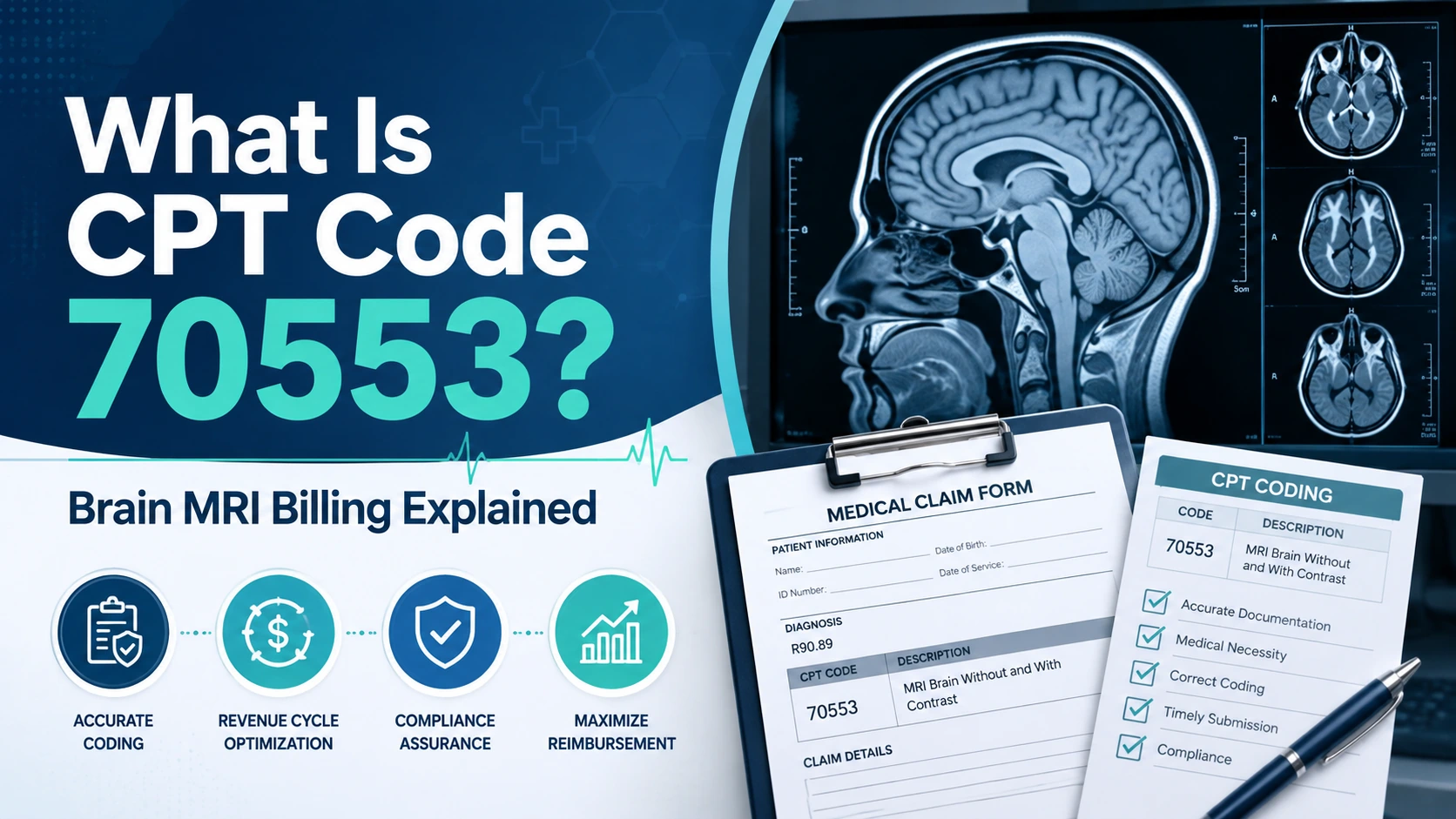
CPT code 70553 describes a magnetic resonance imaging study of the brain, including the brainstem, done without contrast and then again with contrast in the same visit. Radiologists order it when one pass through the scanner can’t answer the clinical question. Correct medical coding requires documenting both phases separately and never splitting the claim into 70551 and 70552.
Table of Contents
ToggleWhat Does CPT Code 70553 Actually Cover?
The American Medical Association classifies 70553 under Diagnostic Radiology Procedures of the Head and Neck. It covers one continuous MRI exam of the brain and brainstem: a baseline scan done without contrast, followed by an injection of gadolinium contrast material and a second set of images.
Physicians order this combined study when a baseline scan alone won’t settle the diagnosis. The most common indications we see on orders include:
- Progressive cranial nerve deficits
- New onset seizures
- Vertigo and ataxia workups where the cause isn’t obvious
- Suspected brain tumors or metastases
- Multiple sclerosis or other demyelinating disease
For pituitary gland or internal auditory canal imaging, most payers expect 70553 rather than a single phase code, since those structures usually need contrast to read clearly. Most coders we talk with underestimate how often that note gets missed on pituitary orders. It’s a small detail, and it’s often the reason a claim doesn’t pay the first time.
How Is CPT 70553 Different From 70551 and 70552?
The three codes differ only by contrast use. 70551 covers a brain MRI without contrast. 70552 covers a brain MRI with contrast alone. 70553 covers both phases in one session. You bill 70553, not 70551 plus 70552, whenever the ordered protocol includes both.
| CPT Code | Contrast Given | Typical Clinical Scenario | Billed With the Other Two? |
|---|---|---|---|
| 70551 | None | Headache screening, trauma without bleeding, or MS follow-up when a baseline scan already exists. | No, stands alone |
| 70552 | Yes, contrast phase only | Contrast requested from the start, with a prior baseline scan already on file. | No, stands alone |
| 70553 | Both phases in one session | Tumor workup, cranial nerve deficits, new seizures, or unclear etiology. | Replaces 70551 and 70552 billed together |
That last row trips up more practices than any other line in this table. If your documentation shows both phases happened in one visit, 70553 is the only correct code. Billing the other two side by side for that same visit is a coding error, not a reimbursement strategy, and payers catch it automatically. For another MRI billing comparison, read our guide to CPT code 73221.
What Modifiers Apply to CPT 70553?
Modifier choice depends on who’s billing what, and whether the study repeats on the same day. The five you’ll actually use:
- Modifier 26: the radiologist bills only the professional interpretation, while a separate facility bills the technical component.
- Modifier TC: the facility bills the technical component alone.
- Modifier 59: indicates a distinct procedural service when 70553 is billed alongside another imaging code that would otherwise trigger a bundling edit, and only when documentation supports two genuinely separate studies. CMS Medicare NCCI guidance.
- Modifier 76: a repeat 70553 performed by the same physician on the same day.
- Modifier 77: a repeat 70553 performed by a different physician on the same day.
What Documentation Does a Clean CPT 70553 Claim Need?
Four pieces of documentation decide whether 70553 pays on the first submission:
- A contrast administration record naming the agent, the dose, and the time it was given
- A radiology report that explicitly references both the phase before contrast and the phase after
- The ordering physician’s NPI on the claim
- An ICD-10 code that actually supports why contrast added diagnostic value, not just that an MRI was ordered
We’ve reviewed enough denial logs to say this plainly: missing contrast documentation is the single most common reason a 70553 claim gets bumped down to 70551. A radiologist orders both phases, the tech runs both phases, and the note only says “MRI brain with contrast.” That one missing sentence about the baseline scan costs the practice the gap between a 70551 payment and a 70553 payment, and nobody notices until the remit comes back weeks later.
How Much Does CPT 70553 Reimburse?
Expect roughly 300 to 330 dollars under the CMS Physician Fee Schedule Look-Up Tool for the global service. Your actual number depends on your Medicare Administrative Contractor and your geographic locality, so treat that figure as a planning estimate, not a quote.
Commercial payers vary more widely, since contracted rates differ by network and region. As the highest complexity code in the brain MRI triplet, 70553 typically carries a higher relative value than 70551 on its own, which is exactly why undercoding it costs more than it looks like on paper.
Why Do CPT 70553 Claims Get Denied?
Complex imaging claims run high denial rates across the industry, often in the 15 to 25 percent range for practices without a dedicated review step. Brain MRI with contrast sits near the top of that pile. Four causes account for most of it:
- Missing contrast documentation, which downcodes the claim before it ever reaches medical review
- Code splitting: billing 70551 and 70552 separately for a session that was actually a 70553 protocol, which trips an automatic bundling edit and returns as a CO-236 denial on the remittance
- Medical necessity denials, when the ICD-10 code on the claim doesn’t support why contrast was needed (a plain headache screening code paired with 70553 is a common flag)
- Place of service mismatches, billing a physician office code when the scan actually happened in a hospital outpatient department
Picture a small neurology group somewhere like Toledo. Two physicians, maybe 35 brain MRIs a month, one biller doing everything from scheduling to appeals. A CO-236 denial shows up on a Tuesday. The biller has never seen that code before, calls the payer, spends 40 minutes on hold, and learns the scan was billed as 70551 and 70552 separately instead of 70553. That’s an afternoon lost to a single claim, and it keeps happening every month until someone catches the pattern in the coding workflow itself, not just in the appeals pile.
The fix isn’t heroics on individual claims. It’s pre submission scrubbing against payer specific edits, real time eligibility checks before the scan gets scheduled, and a coordinated revenue cycle management process that tracks CARC and RARC patterns instead of fighting each claim as a one off. Effective denial management services identify recurring coding, authorization, and documentation problems.
How Do You Appeal a Denied CPT 70553 Claim?
- Request a peer to peer review with the payer’s medical director within about 72 hours of the denial when the issue is medical necessity. This is the fastest path to a reversal.
- File a formal written appeal within 14 days if the peer to peer doesn’t resolve it or doesn’t apply to your denial reason.
- Attach the contrast administration record and the full radiology report to the appeal itself, not just a cover letter.
Does CPT 70553 Require Prior Authorization?
Traditional Medicare Part B generally doesn’t require prior authorization for 70553. Medicare Advantage plans and most commercial payers route brain MRI orders through a radiology benefits manager, and that changes the picture entirely.
The prior authorization request has to name 70553 specifically. An authorization for 70551 won’t cover 70553 if the protocol changes mid scan, and the ICD-10 code on the request has to match the clinical indication that justifies contrast. A headache screening code attached to a 70553 request is one of the most common reasons these requests come back denied before the scan even happens.
Frequently Asked Questions About CPT Code 70553
What is CPT code 70553?
CPT code 70553 is an MRI of the brain, including the brainstem, performed without contrast and then again with contrast in one session.
What is the difference between CPT 70553 and 70551?
CPT 70551 covers a brain MRI with no contrast at all. CPT 70553 covers that same phase without contrast plus a second phase with contrast, in the same visit.
Can you bill 70551 and 70552 instead of 70553?
No. When both phases happen in one session, payers expect 70553 alone. Billing 70551 and 70552 separately for that session triggers a bundling edit and a CO-236 denial.
What modifier goes with CPT 70553?
It depends on who’s billing what. Use modifier 26 for the professional interpretation alone, TC for the technical component alone, and modifier 59, 76, or 77 in specific repeat or bundling scenarios.
Does CPT 70553 need prior authorization?
Usually not under traditional Medicare. Almost always yes under Medicare Advantage and commercial plans, and the request has to name 70553 specifically.
Why did my CPT 70553 claim get downcoded to 70551?
The most common cause is a radiology report that never explicitly documents the phase before contrast, even when it was performed. Payers can only pay for what the note proves happened.
How much does CPT 70553 pay under Medicare?
Roughly 300 to 330 dollars for the global service under the Medicare Physician Fee Schedule, though the exact number depends on your MAC and locality.
Book Your Free 30-Minute Billing Audit
A dedicated billing specialist will review your last 90 days of imaging claims at no cost and identify the denial patterns costing your practice the most.
Book Your Free Billing Audit →
No obligation • No upfront cost • Actionable billing insights