
Medical Billing Services In North Carolina
Docscare provides outsourced medical billing services in North Carolina for physician practices that want cleaner claims, faster reimbursement, and a partner who actually reads the state’s insurance statutes instead of running a national template with the city name swapped in. We combine medical billing, medical coding, and physician credentialing into a single engagement, and we hold a 99% clean claim ratio with a 30% average revenue increase across the practices we support. For solo and small-group practices from Raleigh to Charlotte to Asheville, that combination means fewer denials, shorter days in accounts receivable, and billing decisions that hold up against North Carolina’s specific payer rules.
What North Carolina Practices Are Up Against
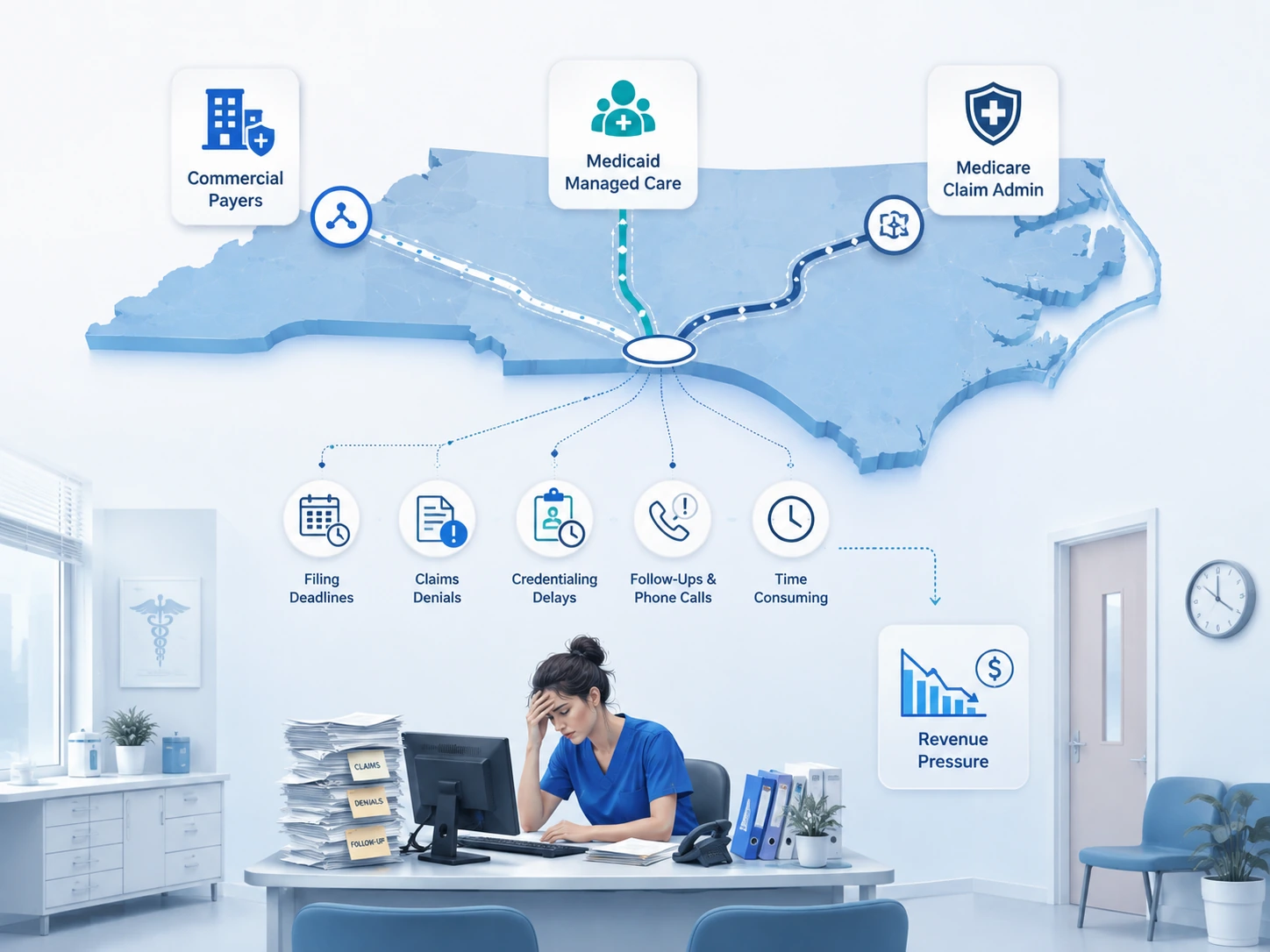
North Carolina’s payer landscape is not uniform. Blue Cross NC dominates commercial coverage in most counties, NC Medicaid runs through managed care organizations with their own submission quirks, and Medicare Administrative Contractor Palmetto GBA processes Part B claims for the state. A biller who only knows one of these systems ends up guessing at the other two.
Small and mid-size practices feel this the hardest. A two- or three-physician office rarely has a dedicated billing department, so claim follow-up competes with phones, scheduling, and patient care. When a biller misses a filing deadline or mishandles a prompt-pay dispute, the practice absorbs the loss directly instead of spreading it across a large administrative staff. Credentialing delays compound the problem: a new physician who is not yet enrolled with Blue Cross NC or NC Medicaid cannot generate reimbursable revenue, even while seeing a full patient panel.
North Carolina Laws That Apply to Billing for Medical Services
Billing compliance in North Carolina extends beyond federal HIPAA and CMS rules. State-specific requirements affect claim deadlines, patient balances, medical debt, prior authorization, and telehealth reimbursement.
The Prompt Pay Law
N.C.G.S. § 58-3-225North Carolina’s prompt claim payment statute generally requires an insurer to pay a claim or provide written notice explaining its denial within 30 calendar days after receipt. When only part of a claim is disputed, the insurer must pay the undisputed portion within the same period.
Provider contracts executed after July 1, 2001 cannot require claims to be filed in fewer than 180 days, although contracts may allow longer filing periods. Practices that do not monitor these deadlines lose valuable follow-up and appeal leverage.
Track claim receipt, payment, denial, and filing deadlines separately for every payer.
Balance Billing & Surprise Billing
Federal protectionNorth Carolina billing operations must comply with the federal No Surprises Act when patients receive protected emergency services or certain services from an out-of-network provider at an in-network facility.
In protected situations, the patient generally owes only the applicable in-network cost-sharing amount. The provider cannot transfer the remaining difference to the patient merely because the payer’s allowed amount is lower than the provider’s charge.
Flag protected claims before generating statements or beginning patient collection activity.
Medical Debt Relief Requirements
HASP programNorth Carolina’s Medical Debt Relief Program requires participating acute-care hospitals to relieve qualifying debt, apply stronger financial-assistance policies, limit aggressive collection practices, cap interest, and stop reporting qualifying medical debt to credit agencies.
All 99 eligible acute-care hospitals joined the initiative. The requirements apply specifically to participating hospitals—not automatically to independent physician practices—but they reflect increasingly strict scrutiny of medical debt and patient-facing collection language.
Keep financial-assistance screening and patient collection rules separate from standard insurance A/R recovery.
Prior Authorization Reform
House Bill 434House Bill 434 began as the CARE FIRST Act and was later titled “Lower Healthcare Costs.” It proposed changes involving prior authorization and other healthcare requirements.
The official legislative record shows that the House and Senate passed different versions. A conference committee was appointed, and the most recent recorded action was a change to House conferees on April 6, 2026. The bill should not be treated as enacted law unless its status changes.
Continue following current payer authorization rules while monitoring the bill’s official status.
Telehealth Reimbursement
Payer-specific rulesNC Medicaid’s telehealth program covers eligible virtual services under its clinical and billing policies. Covered codes, modifiers, provider requirements, and service-delivery rules must be confirmed against the current policy.
North Carolina does not impose one universal private-payer payment rate for every virtual service. Commercial reimbursement may therefore vary by contract and plan, making payer-specific fee schedule and authorization verification essential.
Verify covered codes, modifiers, authorization, place of service, and reimbursement rules before submitting each telehealth claim.
Medical Billing Services for Small Practices in North Carolina
Small and solo practices carry the same billing complexity as a large health system without the staff to absorb it. A missed prior authorization or a slow response to a payer’s additional-information request costs a five-provider practice roughly the same dollar amount, in real terms, that it costs a fifty-provider group. It just hurts far more relative to the smaller practice’s total revenue.
Docscare’s medical billing services for small practices in Colorado give solo and small-group practices a full billing department without the overhead of hiring one: no benefits, no training curve, and no coverage gap when a biller takes vacation. Pricing scopes to claim volume, so a five-physician family practice pays for the work that volume actually requires, not an enterprise package built for a hospital system.

Protect Earned Revenue
Claim denials and prompt-pay disputes eat into revenue that your practice is legally entitled to collect, and small practices rarely have the staff time to fight every one. Our Denial Management Services track North Carolina's 30-day claim decision requirement, flag underpayments, and follow through on appeals so denied claims do not quietly become written-off revenue.
Reduce Claim Denials →How Docscare Supports Medical Practices Across North Carolina
- Medical billing: Claim scrubbing, submission, and payment posting built around Blue Cross NC, NC Medicaid managed care, and Medicare requirements, with a 99% first-submission pass rate.
- Medical coding: AAPC-certified coders handle CPT, ICD-10, and HCPCS coding by specialty, with audit support if a payer challenges a claim.
- Physician credentialing: CAQH profile setup and maintenance, payer enrollment, and re-credentialing, timed so a new provider can start billing as soon as possible instead of waiting out a backlog.
- Revenue cycle management: Ongoing accounts receivable follow-up and reporting that tracks days in A/R against North Carolina’s prompt-pay deadlines, not just a generic 90-day benchmark.
- Denial management: Root-cause tracking on denials by payer and reason code, with appeals handled instead of just logged.
The Docscare Process
What to Expect When You Outsource Your North Carolina Practice's Billing
A structured transition designed to protect cash flow, reduce preventable denials, and give your practice clear visibility from the first claim onward.
-
Practice and Payer Review
We map your current payer mix, fee schedules, and any open credentialing gaps before touching a single claim.
-
Clean Transition
We take over claim submission and A/R follow-up on a set date, so nothing falls into a gap between your old process and ours.
-
Coding and Claim Scrubbing
Every claim is coded and checked against payer-specific edits before submission, which is where most preventable denials get caught.
-
Submission and Prompt-Pay Tracking
Claims go out electronically, and we track each one against North Carolina's 30-day response requirement.
-
Reporting and Adjustment
You get monthly reporting on collections, denials, and days in A/R, and we adjust the process as your payer mix or provider roster changes.
Ready to replace billing uncertainty with a clear, payer-specific process?
Talk to Our Billing Team →Why North Carolina Practices Choose Docscare
Most national billing companies write one page for every state and change the city names. Docscare builds North Carolina content and workflows around North Carolina’s actual rules: the 30-day prompt pay deadline, the balance billing protections layered on top of the federal No Surprises Act, and the fact that telehealth reimbursement is not guaranteed at parity with commercial payers here the way it is in some other states. Combine that with a 99% clean claim ratio, a 30% average revenue increase for the practices we support, and a boutique model that puts a direct point of contact on your account instead of a support ticket, and you get a billing partner sized for how small and mid-size North Carolina practices actually operate.

Frequently Asked Questions
If your question is not answered here, contact our billing team directly. Most questions get a same-day response.
What do medical billing services in North Carolina actually include?
A full-service arrangement typically covers claim coding, scrubbing, and submission, payment posting, denial follow-up, and accounts receivable management. Docscare adds physician credentialing and revenue cycle reporting so billing, coding, and enrollment run through one team instead of three separate vendors.
How much does outsourced medical billing cost for a small practice in North Carolina?
Most outsourced billing is priced as a percentage of collections, commonly in the mid-single digits, rather than a flat monthly fee. The exact rate depends on claim volume, specialty mix, and how much credentialing and denial-management work is included. A boutique arrangement built for a small practice should scale down with lower claim volume rather than charging enterprise-level minimums.
What is North Carolina's prompt pay law, and how does it affect my practice?
N.C.G.S. § 58-3-225 requires insurers to pay or formally respond to a claim within 30 calendar days of receipt and sets a 180-day minimum floor on how little time a contract can give you to file a claim. Tracking these deadlines by payer is one of the more overlooked ways a practice can recover revenue it is already owed.
Am I protected from surprise billing under North Carolina law?
Patients treated for emergencies by an out-of-network provider, or treated by an out-of-network provider at an in-network facility, generally owe only their in-network cost-sharing amount under North Carolina law and the federal No Surprises Act. Billing beyond that amount in these situations is not collectible and creates unnecessary collections risk.
Does North Carolina have a telehealth payment parity law?
NC Medicaid reimburses telehealth at parity with in-person visits, but North Carolina has no private-payer telehealth parity law, so commercial reimbursement for virtual visits is not guaranteed to match in-person rates. Practices billing telehealth need to verify each commercial payer’s telehealth fee schedule individually.
How does North Carolina's medical debt relief program affect my billing practices?
The Medical Bill De-Weaponization Act and the state’s Healthcare Access and Stabilization Program apply to participating acute care hospitals, not independent physician practices, but they reflect a broader shift toward stricter oversight of medical debt collection in North Carolina. Practices should expect more scrutiny of collections language going forward, even outside the hospital setting.
