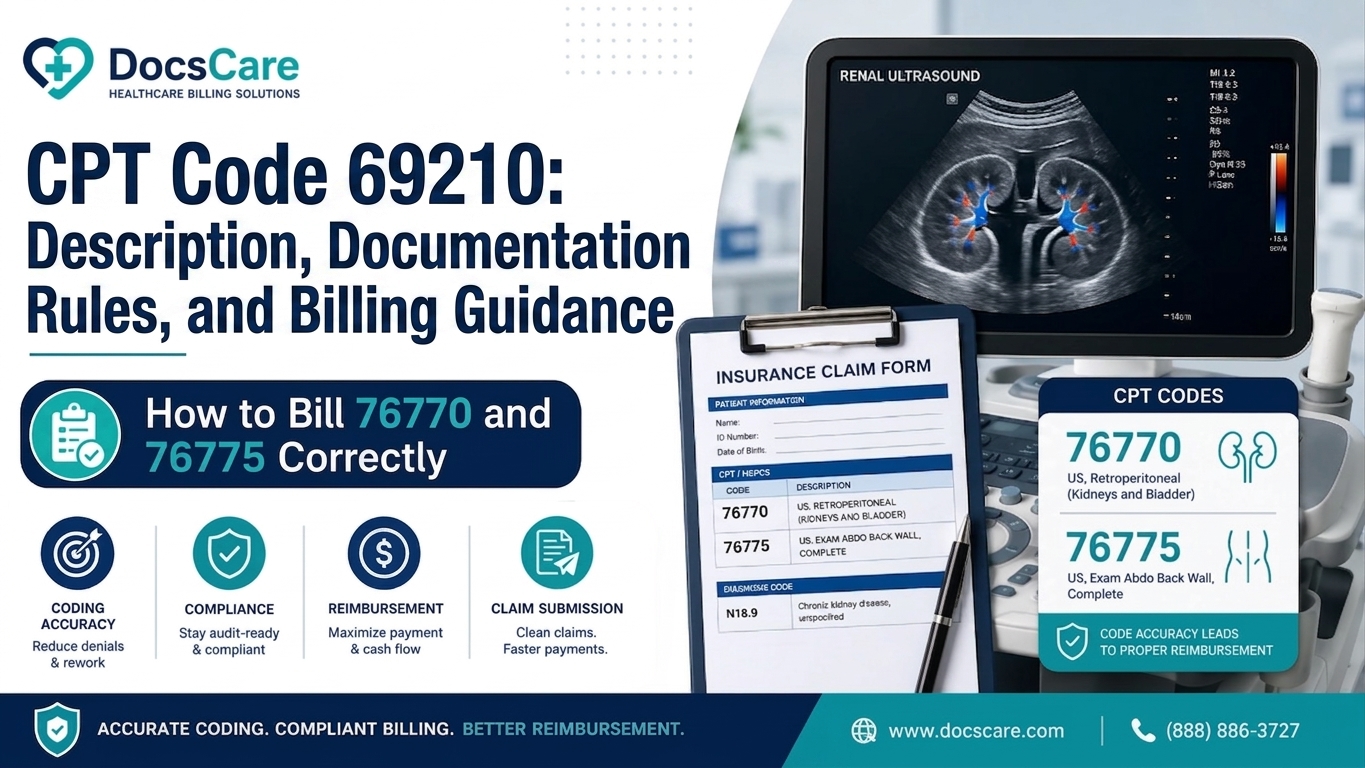
CPT code 69210 describes the removal of impacted cerumen, or earwax, from the external ear canal using instrumentation. The code applies when a physician or other qualified provider uses tools such as a curette, alligator forceps, or a suction device to extract cerumen that irrigation alone cannot clear. It’s a unilateral code, meaning it covers one ear per reported unit, and payers scrutinize it closely because “earwax removal” sounds routine even when the clinical picture isn’t. This guide covers the official descriptor, how 69210 differs from the irrigation code 69209, the ICD-10 codes it pairs with, and the modifier and documentation rules that keep claims from bouncing back.
Table of Contents
ToggleWhat Is CPT Code 69210?
The official CPT descriptor for 69210 reads: removal of impacted cerumen requiring instrumentation, unilateral. That single word, “instrumentation,” is what separates 69210 from every other cerumen-removal option. A provider performs the procedure using a curette, forceps, a suction device, or occasionally an operating microscope for better visualization, rather than flushing the canal with water or saline.
Because 69210 requires physician-level skill, most payers expect the provider — not auxiliary staff acting independently — to perform and document the extraction. The code is inherently unilateral, so a practice reports it once per affected ear, using laterality to distinguish a one-ear procedure from a two-ear one.
CPT 69210 vs. CPT 69209: What’s the Difference?
Coders confuse these two codes more than almost any other pair in the ear, nose, and throat section. The distinction comes down to method, not outcome.
| Aspect | CPT 69210 | CPT 69209 |
|---|---|---|
| Method | Instrumentation (curette, forceps, suction) | Irrigation or lavage with fluid |
| Who typically performs it | Physician or other qualified provider | May be performed by clinical staff under supervision |
| Documentation focus | Confirms tool-based extraction and impaction | Confirms fluid-based flushing and impaction |
| Same ear, same date | Not reportable together | Not reportable together |
| Different ears, same date | Reportable with RT/LT modifiers if methods differ by ear | Reportable with RT/LT modifiers if methods differ by ear |
If a provider attempts irrigation first and it fails, then completes the removal with instrumentation, the claim reports 69210 only. Coding guidance directs practices to bill the higher level of service rather than stacking both codes for one ear.
What Counts as “Impacted” Cerumen?
Not every patient with visible earwax qualifies for 69210. Impaction is a clinical judgment, and the documentation needs to support it. Impacted cerumen typically:
- Obstructs the ear canal or blocks a clear view of the tympanic membrane
- Causes symptoms such as hearing loss, ear pain, a feeling of fullness, itching, or tinnitus
- Resists removal by irrigation because it’s hardened, dry, or tightly adherent to the canal wall
- Requires magnification or specialized tools to remove safely
A note that simply says “cerumen removed” without any of these details reads like routine hygiene, not a billable procedure, and payers treat it accordingly.
How the Procedure Is Performed
The provider starts with an otoscopic exam to confirm impaction and rule out other causes of the patient’s symptoms. From there, they select the appropriate instrument based on how the cerumen is packed and how much of the canal it occupies. Curettes work well for softer plugs near the canal opening; forceps and suction handle harder or deeper impactions, sometimes with an operating microscope for visualization. The procedure doesn’t usually require anesthesia, though it can be uncomfortable, and providers document the ear treated, the tools used, and the outcome — whether the canal is now clear and the tympanic membrane visible.
Documentation Coders Should Confirm Before Billing
Before submitting a 69210 claim, check the note for:
- A stated diagnosis of impaction, not just “cerumen noted”
- A description of the instrument used, not irrigation
- Which ear (or both) was treated
- The symptoms or functional problem that made removal medically necessary
- A separately documented reason and exam finding if an E/M service is billed the same date
Missing any one of these is one of the fastest ways to turn a routine procedure into an appeal. Building this check into a broader medical coding services workflow keeps small oversights from becoming lost revenue.
Modifiers and Laterality Rules
Getting the modifier logic right on 69210 depends on the payer as much as the procedure itself.
Unilateral claims use RT or LT to specify the treated ear. For bilateral removal, Medicare Part B treats 69210 as inherently priced for both ears — practices report it once, as one unit, without a laterality or bilateral modifier. Commercial payers don’t always follow that logic, so confirm with each payer contract whether they want modifier 50 on a single line or separate RT and LT lines for a bilateral claim.
When a provider also performs a separately identifiable evaluation and management service — for an unrelated complaint documented with its own history, exam, and diagnosis — append modifier 25 to the E/M code, not to 69210. Without it, most payers bundle the visit into the procedure’s reimbursement and pay only the lower rate. Modifier 59, or the more specific X{EPSU} modifiers, may apply when a distinct procedural circumstance needs to be flagged, but check current National Correct Coding Initiative edits before applying it, since bundling rules change.
MEDICAL CODING SUPPORT
Get Your CPT 69210 Claims Right the First Time
Correct modifier and documentation rules for CPT 69210 change by payer and MAC jurisdiction, and a single mismatch can trigger a denial. Docscare’s AAPC-certified coding team reviews laterality, medical necessity, and same-day E/M rules before every claim goes out, reducing avoidable denials on ear procedures like 69210.
Explore Medical Coding Services →
Accurate modifiers • Payer-specific rules • Fewer denials
ICD-10 Codes That Pair With CPT 69210
CPT 69210 needs a diagnosis code from the H61.2- family to establish medical necessity:
| ICD-10 Code | Description |
|---|---|
| H61.20 | Impacted cerumen, unspecified ear |
| H61.21 | Impacted cerumen, right ear |
| H61.22 | Impacted cerumen, left ear |
| H61.23 | Impacted cerumen, bilateral |
Reserve H61.20 for cases where the record genuinely can’t establish laterality. Most payers expect the laterality-specific code that matches the treated ear, and coders should treat the unspecified version as an exception rather than a default. Understanding how ICD-10 and CPT codes work together across a claim — not just for cerumen removal, but for coding generally — helps prevent this kind of mismatch further down the revenue cycle.
Common Reasons CPT 69210 Claims Get Denied
Impacted cerumen removal is a small procedure that generates an outsized share of denials. The recurring culprits:
- The note describes cerumen removal without documenting true impaction or medical necessity
- Irrigation was performed, but the claim reports 69210 instead of 69209
- The laterality modifier is missing, wrong, or inconsistent with the diagnosis code
- An E/M service is billed the same day without modifier 25 and a separately documented diagnosis
- A bilateral procedure is billed with the wrong modifier logic for that specific payer
- The unspecified diagnosis code, H61.20, is used when the chart supports a laterality-specific code
A consistent denial management review — checking these points before submission rather than after a rejection — protects revenue on a code that looks simple but carries real payer scrutiny. Building that check into a broader revenue cycle management workflow keeps small procedure codes like this one from quietly eroding collections.
Who Reports CPT 69210?
Family medicine physicians, internists, pediatricians, and geriatric specialists all report 69210 regularly, since impacted cerumen is common across age groups and often turns up during an unrelated visit. Otolaryngologists (ENT specialists) report it most often, particularly for harder impactions that need magnification or suction. Audiologists don’t typically bill the removal code themselves, but they need to understand it, since same-day audiologic testing and cerumen removal have their own coordination rules. If some of these terms are unfamiliar, the medical billing glossary breaks down CPT, ICD-10, RCM, and dozens of other terms your team runs into daily.
Frequently Asked Questions
What does CPT code 69210 mean?
CPT 69210 means removal of impacted cerumen requiring instrumentation, unilateral. It applies when a provider uses a curette, forceps, or suction — not irrigation — to clear earwax from one ear.
Is CPT 69210 unilateral or bilateral?
The code is unilateral by definition. For bilateral removal, Medicare Part B bundles both ears into a single unit with no modifier, while commercial payers may require modifier 50 or separate RT/LT lines — check the payer contract.
What’s the difference between CPT 69210 and 69209?
69210 covers instrument-based removal; 69209 covers irrigation or lavage. The two codes aren’t reportable together for the same ear on the same date.
What ICD-10 code should be billed with CPT 69210?
Use H61.21 (right), H61.22 (left), or H61.23 (bilateral) based on the documented laterality. H61.20 (unspecified) applies only when the record genuinely can’t establish which ear.
Can a provider bill an E/M visit and CPT 69210 on the same day?
Yes, if the E/M addresses a separate, documented problem with its own history and exam findings. Append modifier 25 to the E/M code, not to 69210.
Does simple ear irrigation qualify for CPT 69210?
No. Irrigation or lavage alone is reported with CPT 69209. CPT 69210 requires instrumentation.
Who can perform and bill CPT 69210?
A physician or other qualified health care professional typically performs and bills the procedure, most often in family medicine, internal medicine, pediatrics, and otolaryngology.
Why do CPT 69210 claims get denied?
The most common reasons are missing documentation of true impaction, incorrect laterality modifiers, billing 69210 when irrigation alone was performed, and omitting modifier 25 on a same-day E/M service.
MEDICAL CODING SUPPORT
Reduce Denials on Small Procedure Codes Like 69210
Impacted cerumen removal is a small procedure with outsized denial risk when coding and documentation don’t line up. Docscare’s medical coding team keeps CPT and ICD-10 pairings current, applies modifiers correctly, and helps practices submit clean claims the first time. Start with a coding review to see where 69210 and similar procedure codes may be costing you revenue.
Explore Medical Coding Services →
Accurate modifiers • Payer-specific rules • Fewer denials
CPT 69210 rewards precision. The procedure itself takes minutes, but the coding around it — impaction criteria, laterality, modifier logic, and same-day E/M rules — determines whether the claim gets paid the first time or comes back for correction. Practices that build these checks into their standard coding workflow see fewer denials on a code that, on paper, looks about as simple as billing gets.