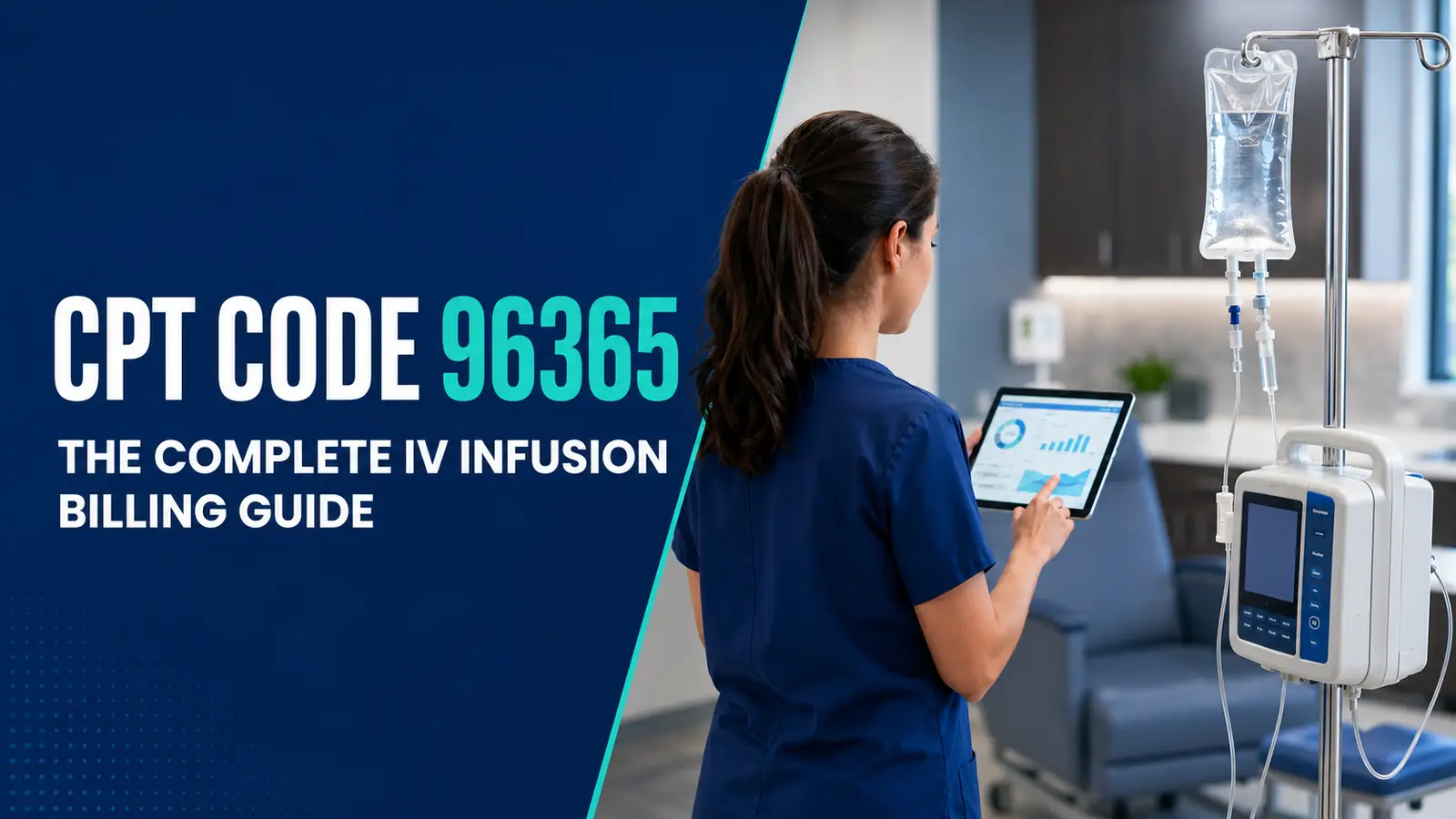
CPT code 96365 reports the first hour of an intravenous infusion given for a therapeutic, prophylactic, or diagnostic purpose. Coders use it when a provider infuses a single medication or substance, such as an antibiotic, antiemetic, or diagnostic contrast agent, for a documented clinical reason rather than simple fluid replacement. The infusion has to run at least 16 minutes and no more than one hour to qualify. Chemotherapy and complex biologic agents fall under a separate code family, and plain hydration fluids fall under a different one too. Mixing these up is one of the more common reasons infusion claims come back denied.
Table of Contents
ToggleWhat CPT Code 96365 Actually Covers
CPT 96365 sits in the injection and infusion section of the CPT code set and describes an initial, physician-ordered IV infusion that serves one of three purposes: treating a condition, preventing one, or supporting a diagnostic procedure. A vitamin or antibiotic infusion given to treat an active infection counts as therapeutic. A pre-procedure infusion meant to reduce infection risk counts as prophylactic. Contrast media infused ahead of an imaging study counts as diagnostic.
The code covers one substance at a time. If a second substance goes in after the first, or at the same time through a separate line, that gets its own code from the add-on family covered below. Two things routinely trip up coders: hydration-only fluids never qualify for 96365, since there’s no therapeutic intent behind plain saline given to prevent dehydration, and chemotherapy or other highly complex biologic agents get reported under the 964xx series instead, even when the delivery setup looks identical from the infusion chair.
CPT 96365 vs. Hydration and IV Push Codes
The infusion codes split mainly by purpose and duration, not by what’s in the bag alone. A saline bag can be billed as hydration or folded into a therapeutic infusion, depending on why it’s running. Here’s how the three most commonly confused codes break down:
| CPT Code | Reports | Time Threshold | Typical Use |
|---|---|---|---|
| 96360 | Initial IV hydration | 31 minutes or more | Plain fluids, no drug or therapeutic intent |
| 96365 | Initial therapeutic, prophylactic, or diagnostic infusion | 16 minutes to 1 hour | Antibiotics, antiemetics, contrast, vitamin therapy |
| 96374 | Initial IV push | Under 16 minutes | Rapid bolus administration of a single drug |
An infusion lasting under 16 minutes generally reports as a push (96374), not 96365, regardless of what’s in the bag. That 16-minute threshold shows up in payer policy manuals more often than in the CPT book itself, so it’s worth confirming against the specific payer’s published guidance before finalizing a claim.
The Add-On Code Family: 96366, 96367, and 96368
Once the initial hour is billed with 96365, three add-on codes cover what happens next:
- 96366 adds each additional full hour of the same substance running through the same line.
- 96367 covers the initial hour of a second substance that starts after the first one finishes — a sequential infusion.
- 96368 covers a second substance running at the same time as the first through a separate line — a concurrent infusion — and it’s reported only once per day, regardless of how many drugs overlap.
A few scenarios make the pattern easier to apply:
| Scenario | Codes to Report |
|---|---|
| Same drug infused for 2 hours total | 96365 + 96366 (×1) |
| Same drug infused for 3 hours total | 96365 + 96366 (×2) |
| Second drug starts after the first ends | 96365 + 96367 |
| Two drugs run simultaneously through separate lines | 96365 + 96368 |
Two drugs mixed into one bag and infused together count as a single infusion, not a concurrent one, so 96368 doesn’t apply there. That distinction alone accounts for a meaningful share of infusion coding errors. Providers should confirm infusion hierarchy, sequential services, concurrent administration, and separately reportable services against the current CMS NCCI Policy Manual.
Stop Infusion Coding Errors Before Submission
Sequencing 96365 against 96366, 96367, and 96368 requires more than a quick glossary check. DocsCare’s AAPC-certified coding team reviews every infusion encounter against current NCCI edits to prevent costly denials and support cleaner claims.
Explore Medical Coding Services →
AAPC-certified team • Current NCCI edits
Documentation That Has to Be in the Chart
Payers expect specific documentation to support 96365, and missing pieces are the single biggest driver of denials on this code. The chart needs:
- Start and stop times for the infusion, recorded to the minute
- The name, dose, and route of the substance infused
- A physician order or standing protocol establishing medical necessity
- A diagnosis code that connects logically to the reason for the infusion
- Notes on patient monitoring during the infusion, including any reaction
Without documented start and stop times, most payers can’t confirm the infusion met the 16-minute threshold, and the claim risks downcoding to a push service or an outright denial. Getting these details right is part of the broader discipline behind accurate medical billing services, and it’s often the difference between a clean claim and a resubmission.
Modifiers Commonly Used With CPT 96365
NCCI edits bundle some infusion and injection services together by default. When two services genuinely happened separately, a modifier unbundles them for payment. Modifier 59 is the general-purpose option, and CMS also recognizes four more specific modifiers under the same family:
- XE — the infusion happened during a separate encounter
- XP — a different provider performed the service
- XS — the infusion used a separate organ or structure, such as a distinct IV site
- XU — the service didn’t overlap with the usual components of the primary procedure
Before overriding an NCCI edit, review the current CMS guidance on modifiers 59, XE, XP, XS, and XU and confirm that the documentation supports a genuinely distinct service. Reach for these only when the documentation genuinely supports two distinct services. Appending a modifier just to get a bundled claim to pay is one of the patterns payers audit for specifically.
What CPT 96365 Typically Pays
Reimbursement for 96365 depends on the payer, the contracted rate, the place of service, and whether the claim bills facility or non-facility. Medicare’s rate changes with each year’s Physician Fee Schedule update, and commercial payers set their own rates on top of that baseline. Rather than rely on a flat number, check the current rate through CMS’s Physician Fee Schedule Look-Up Tool or the specific payer’s fee schedule before estimating revenue from this code. Most payers also apply a Medically Unlikely Edit that limits the initial code to one unit per patient per day, which is worth building into any internal charge audit or a broader revenue cycle management review.
Why CPT 96365 Claims Get Denied
A handful of patterns account for most 96365 denials. These align closely with the broader list of common reasons claims get denied across specialties, with a few infusion-specific twists:
- Missing or vague start and stop times. Without them, the payer can’t verify the infusion met the time threshold for the code billed.
- A second “initial” code on the same encounter. Only one initial infusion or push code applies per encounter unless the second service happened at a genuinely separate site with modifier 59 support.
- A substance name that doesn’t match the J-code billed alongside it.
- No documented order connecting the infusion to a clinical reason.
- A sequential infusion coded as concurrent, or the reverse, which misrepresents how the drugs were actually administered.
A Quick Coding Example
A patient comes in with a diagnosed infection and receives an IV antibiotic infusion running 90 minutes. Once that finishes, a separate antiemetic infuses through the same line for 20 minutes to manage nausea. That encounter reports as:
- 96365 — initial hour of the antibiotic infusion
- 96366 (×1) — the additional 30-plus minutes of the same antibiotic
- 96367 — initial hour of the antiemetic, since it started after the antibiotic infusion ended
Three codes, one encounter, and each one depends on documented start and stop times to hold up under review.
Frequently Asked Questions
What does CPT code 96365 report?
CPT 96365 reports the first hour of an IV infusion given for a therapeutic, prophylactic, or diagnostic reason. It covers a single substance infused for at least 16 minutes and up to one hour, and it excludes plain hydration and chemotherapy administration.
What’s the difference between CPT 96365 and 96360?
The difference comes down to purpose. 96360 reports plain IV hydration with no drug or therapeutic intent behind it, while 96365 reports an infusion of a substance given to treat, prevent, or diagnose a condition.
Can 96365 and 96374 be billed on the same visit?
Only one initial infusion or push code typically applies per encounter. If a second substance requires a separate initial-level service at a genuinely distinct site, modifier 59 or one of its X{EPSU} variants can support billing both, but documentation needs to justify the distinction clearly.
Does CPT 96365 cover chemotherapy administration?
No. Chemotherapy and other highly complex biologic agents report under the 964xx code series, such as 96413, even when the infusion setup looks the same as a standard therapeutic infusion.
How many times can 96365 be billed in one day?
Most payers apply a Medically Unlikely Edit that limits 96365 to one unit per patient per day as an initial service. Additional infusion time or substances get reported with the appropriate add-on codes instead of repeating 96365.
What modifiers pair with CPT 96365?
Modifier 59 and its more specific variants, XE, XP, XS, and XU, unbundle 96365 from another service when documentation supports two genuinely separate infusions or encounters.
How is CPT 96365 reimbursed?
Reimbursement varies by payer, contract terms, and place of service. Providers should check the current Medicare Physician Fee Schedule or the specific payer’s fee schedule rather than assume a fixed rate.
Small Documentation Gaps Create Expensive Denials
Denied infusion claims often develop from small documentation gaps repeated across dozens of encounters. DocsCare’s medical coding specialists catch those issues before submission, helping practices protect revenue and maintain cleaner claims.
Explore Medical Coding Services →
Fewer coding gaps • Stronger revenue performance