
Denial Management Services That Recover Revenue and Stop Denials at the Source
Claim denials hit 11.8 percent of initial submissions industry wide, up from 10.2 percent just a few years ago. Docscare’s denial management team appeals denied claims within 72 hours and fixes the upstream causes so the same denial doesn’t happen twice.
Industry avg denial rate (2024)
Cost to rework one claim
Our appeal response time
Overturn rate on our appeals

What Denial Management Services Actually Do
Denial management is the full process of identifying, resolving, and preventing insurance claim denials. It’s not the same as billing, and it’s not a one time cleanup project. It runs as a continuous cycle:
- Denial identification. Every ERA and EOB is scanned for denial codes the moment it arrives.
- Root cause analysis. Each denial is categorized by reason code (CARC/RARC) and mapped back to the source: registration, coding, documentation, or payer specific rule.
- Appeal or correction. Soft denials get corrected and resubmitted. Hard denials get formal appeals with clinical documentation.
- Prevention. Patterns feed back into coding, front desk, and clinical documentation workflows so the denial doesn’t recur.
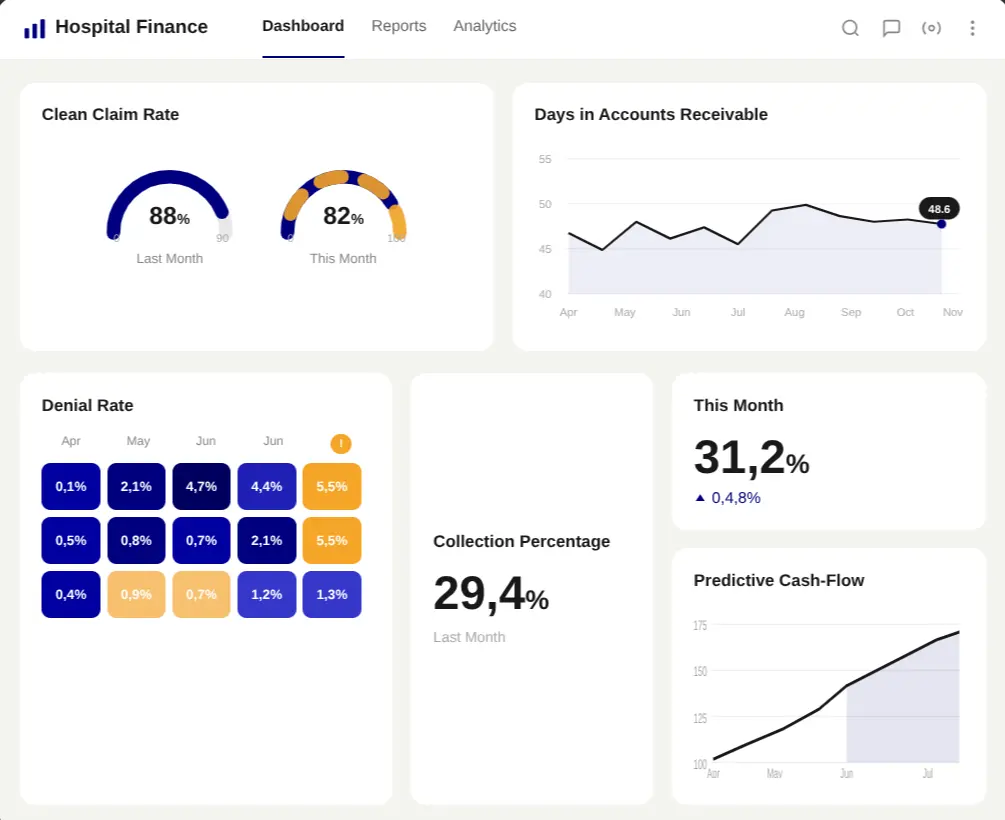
- Reporting. Monthly denial analytics show which payers, procedures, and providers are driving denials.
Without active denial management, denied claims sit in aging buckets until they hit timely filing limits and become permanent write offs. Industry data puts the cost of reworking a single denied claim between $25 and $181 in staff time alone, before any lost revenue is counted.
Why Claim Denials Are Rising in 2026
The denial rate trajectory isn’t random. Four forces are pushing denial rates up and making each denial harder to resolve:
Payer AI is faster than your staff.
Commercial insurers now use AI to review claims at scale. One payer reportedly denied over 300,000 claims in under two months. Speed and volume make manual appeals tougher to keep up with.
Medicare Advantage denials climbed 4.8 percent in one year.
The average Medicare Advantage denial now sits around $1,000. If your payer mix is MA heavy, your exposure is larger than the industry average.
Prior authorization requirements expanded.
Payers added auth requirements for more imaging, specialty drugs, and elective procedures. Missing or invalid authorization is now the #1 denial reason nationally.
Documentation standards tightened.
Medical necessity denials rose 70 percent in dollar value. Payers want more specific clinical notes, not just the CPT code.
What this means for your practice: The denial management work that used to take one biller 10 hours a week now takes 20 to 25 hours and requires deeper payer expertise than most small practices can hire for.
See your practice’s denial exposure.
The Top 10 Reasons Claims Get Denied.
Nine of the top 10 denial reasons are preventable. This matters because prevention is dramatically cheaper than appeal. Every denial you stop at the front end saves 30 to 90 days of cash flow delay plus $25 to $181 in rework labor.
| # | Denial Reason | CARC / RARC Code | Preventable? |
|---|---|---|---|
| 1 | Missing or invalid prior authorization | CO-197 | Yes, at intake |
| 2 | Eligibility or coverage terminated | CO-27 | Yes, at check-in |
| 3 | Duplicate claim submission | CO-18 | Yes, at submission |
| 4 | Non covered service under plan | CO-96 / CO-204 | Yes, at eligibility |
| 5 | Missing or invalid modifier | CO-4 / CO-182 | Yes, in coding |
| 6 | Medical necessity not met | CO-50 | Sometimes, via documentation |
| 7 | Timely filing limit exceeded | CO-29 | Yes, with tracking |
| 8 | Coordination of benefits error | CO-22 | Yes, at intake |
| 9 | Bundling or NCCI edit | CO-97 | Yes, in coding |
| 10 | Incorrect patient demographics | CO-16 / CO-140 | Yes, at registration |
Docscare’s denial management service targets the preventable causes directly. Our reporting tells you which of these 10 reasons is costing you the most money, ranked by dollar impact, so you know where to fix the workflow. For a full breakdown of what these codes mean, see the CMS reference on claim adjustment reason codes.
Soft Denials Vs Hard Denials: Why the Difference Matters
Short answer: Soft denials can be corrected and resubmitted. Hard denials require a formal appeal or become write offs. Speed matters for both, but the workflow is completely different.
| Denial Type | Soft Denial | Hard Denial |
|---|---|---|
| What it is | Temporarily unpaid claim that can be corrected and resubmitted | Permanent denial that requires a formal appeal or results in write off |
| Common causes | Missing information, wrong modifier, coding error, duplicate flag | Not medically necessary, non covered service, timely filing, no authorization |
| Resolution path | Correct and resubmit (corrected claim) | Formal appeal with supporting documentation |
| Typical turnaround | 7 to 21 days | 30 to 90 days (longer for external review) |
| Recovery rate | High (80%+ when handled quickly) | Moderate (40% to 65% depending on clinical documentation) |
Many practices treat every denial the same way, which wastes time on soft denials that just needed a modifier fix and under invests in hard denials where a well written appeal could have recovered $5,000. Our team triages denials within 24 hours and routes each one to the right workflow.
Our Denial Management Process
Six steps, same workflow on every engagement.
ERA ingestion and denial capture
Every 835 ERA and paper EOB is processed the day it arrives. Denials flagged by CARC and RARC code within hours.
Triage within 24 hours
Each denial is classified as soft or hard, routed to the appropriate specialist, and assigned a priority based on dollar value and timely filing deadlines.
Root cause analysis
Every denial is tagged against its root cause: registration, coding, documentation, medical necessity, authorization, or payer specific rule. Patterns surface immediately.
Correction or appeal within 72 hours
Soft denials: corrected claim submitted within 72 hours. Hard denials: appeal drafted with clinical documentation, payer specific language, and citation to applicable policy.
Prevention loop
Monthly, we report the top denial patterns back to your front desk, coders, and providers with specific workflow changes to prevent recurrence.
Reporting and KPIs
You get a monthly dashboard with denial rate trend, recovery rate, days to resolution, top denying payers, and top denying procedures. No guesswork.
What Our Denial Management Services Include
Every Docscare denial management engagement covers:
- Daily ERA and EOB processing. No denial sits for more than one business day before triage.
- Appeals drafting and submission. Level 1 appeals, second level appeals, and external review support.
- Corrected claim resubmission. For soft denials, including modifier corrections, documentation attachments, and coding fixes.
- Root cause analytics. CARC/RARC code mapping, payer specific denial patterns, and provider level reporting.
- Timely filing tracking. Every denial is tracked against each payer’s specific filing deadline so nothing becomes a write off from neglect.
- Prior authorization support. When missing auth caused the denial, we coordinate with your clinical team to obtain retroactive auth where possible.
- Medical necessity appeals. Our team drafts appeals with specific clinical language that payers respond to, not boilerplate templates.
- Monthly denial reporting. Executive dashboard plus detailed report identifying which fixes will have the biggest revenue impact.

The Real Cost of Not Managing Denials
Most practices underestimate denial cost because they see only the obvious number: dollars written off. The full cost has four components:
| Cost Category | Per Claim | Annual (2,400 claims) |
|---|---|---|
| Rework labor cost | $25 to $181 | $60,000 to $434,400 |
| Revenue written off (unappealed denials) | $150 to $5,390 | Depends on specialty mix |
| Delayed payment (cash flow impact) | 30 to 90 days | Working capital strain |
| Staff burnout and turnover | N/A | $40,000+ per replacement |
For a typical physician practice submitting 2,400 claims annually with an 11.8 percent denial rate, the combined cost of unmanaged denials runs between $85,000 and $250,000 per year. That’s money sitting on the table, plus the operational drag of staff who should be serving patients instead of chasing payers. Data on denial rate trends comes from Experian Health’s 2025 State of Claims report.
Want a custom denial cost analysis for your practice?
Why Docscare for Denial Management
Four differentiators separate us from general billing companies that treat denial management as an afterthought:
Appeals within 72 hours
Every denial gets an appeal or corrected claim submitted within 72 hours of receipt. Internal SLA, tracked on every account.
Specialty specific appeal writers
Our cardiology appeals are written by people who've appealed cardiology denials for years. Same for behavioral health, orthopedics, and every specialty we cover.
Prevention built in, not billed separately
Some companies charge extra for prevention reporting. For us, prevention is the whole point. Reporting is included.
Transparent recovery reporting
You see every appeal, the outcome, the dollar recovered, and the specific reason the denial happened. No black boxes.
“Docscare recovered $184,000 in denied claims from our first six months together, including $62,000 in Medicare Advantage denials we’d written off. Their monthly denial report changed how we do intake.”
— Maria Lopez, Practice Administrator, Cardiology Associates of Central Texas
[Placeholder: replace with real client testimonials before publishing]
Frequently Asked Questions
If your question is not answered here, contact our billing team directly. Most questions
get a same-day response.
What is denial management in medical billing?
Denial management is the process of identifying, resolving, and preventing insurance claim denials. It includes reviewing every denied claim, determining the root cause, filing corrected claims or formal appeals, and changing upstream workflows so the same denial doesn’t repeat. Effective denial management combines same day triage, specialty specific appeals, and monthly root cause reporting.
What is a good denial rate for a medical practice?
Industry benchmarks put an acceptable denial rate below 5 percent. The current national average sits around 11.8 percent, with 41 percent of providers reporting denial rates above 10 percent. Practices with mature denial management programs typically operate in the 3 to 5 percent range. If your denial rate is above 8 percent, you have a fixable revenue problem.
How long do I have to appeal a denied claim?
Appeal timelines vary by payer. Most commercial payers allow 30 to 180 days from the denial date for the initial appeal. Medicare allows 120 days for redetermination. Medicaid varies by state, typically 60 to 90 days. Missing the appeal window converts a denial into a permanent write off, which is why same week response matters. See the CMS Medicare appeals process for full Medicare appeal rules.
Can denied claims be resubmitted?
Yes, if the denial is a soft denial. A soft denial happens when a claim is missing information, has a coding error, or was flagged as a duplicate. These can be corrected and resubmitted as a corrected claim. Hard denials such as medical necessity, non covered service, or timely filing cannot be simply resubmitted and require a formal appeal with supporting documentation.
What's the difference between denial management and accounts receivable?
Denial management focuses on denied claims specifically: the appeal, correction, and prevention workflow. Accounts receivable management tracks all outstanding claims regardless of denial status, including unpaid but not yet denied claims. Denials are one source of aged A/R. Most practices need both services, and they work best when coordinated under one team.
How much do denial management services cost?
Denial management services typically price one of three ways: percentage of recovered revenue (commonly 15 to 25 percent of dollars recovered), per claim fee for each denial worked (typically $8 to $25 per denial), or as part of a bundled RCM service. Docscare offers percentage and bundled pricing depending on denial volume and whether coding and billing are included.
How long does it take to see results from denial management?
First recoveries typically arrive within 30 to 60 days of engagement as soft denials are corrected and initial appeals resolve. Prevention impact (lower denial rate) shows in month 2 or 3 as workflow changes from root cause analysis take effect. Sustained impact compounds: practices commonly see denial rates drop 3 to 5 percentage points within six months.
Can you work denials from my existing billing company?
Yes. Docscare can provide denial management as a standalone service while your existing billing company continues claims submission. We access denial data through your practice management system or clearinghouse, work the denials, and report back. Many practices start with denial management only and expand scope later.
Get Your Free Denial Audit
We’ll review your last 90 days of denied claims (up to 50 denials), identify the top five root causes, and show you the dollar value of what’s recoverable right now. No cost, no obligation.
Or call us at (214) 646-1606 to speak with a Denial Management specialist today.
