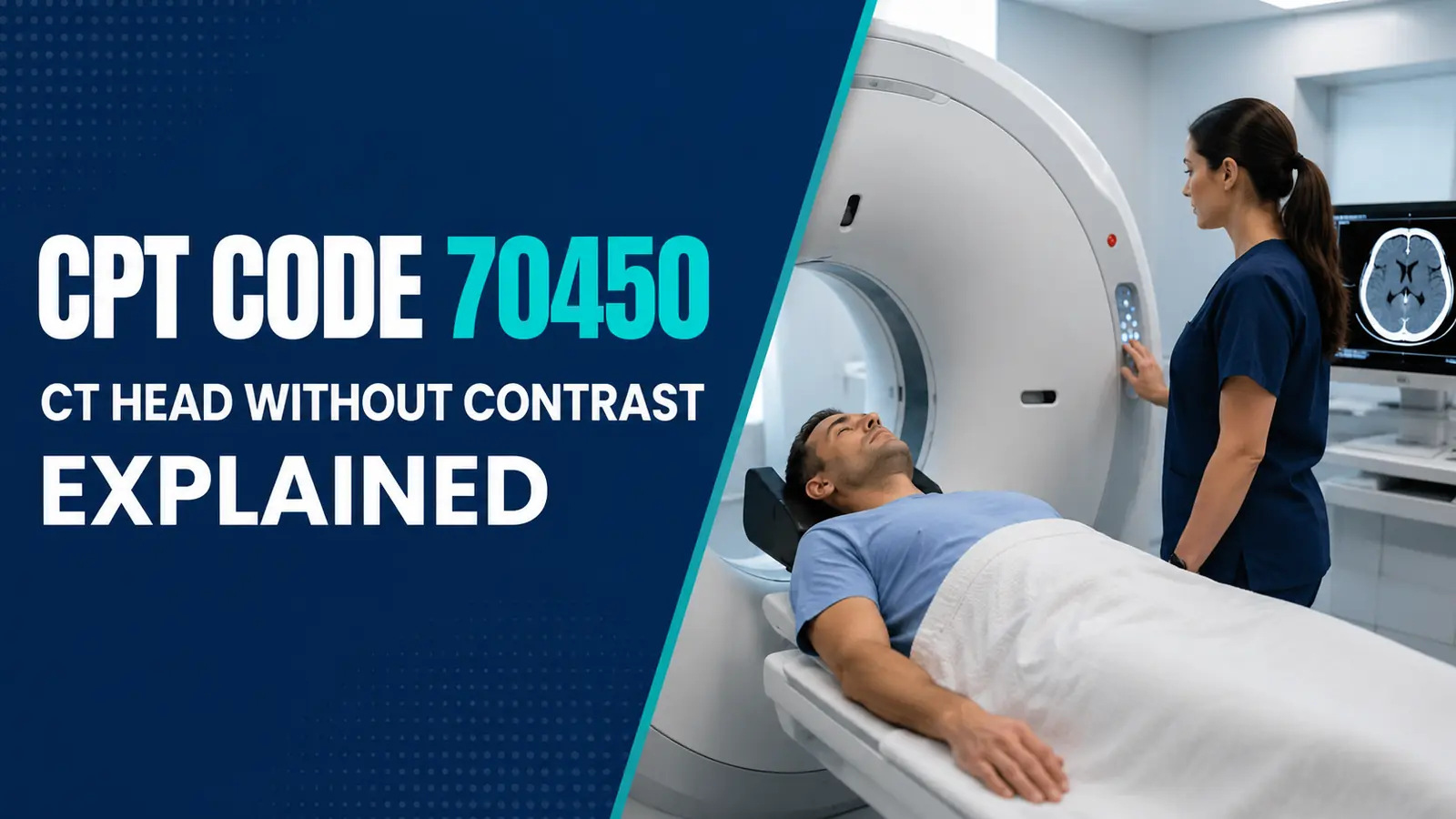
The CPT code for a CT scan of the head without contrast is 70450. The American Medical Association defines it as computed tomography, head or brain, without contrast material. Radiology departments, hospitals, and billing teams report 70450 whenever a physician orders a non-contrast CT to evaluate the brain for trauma, bleeding, stroke, or another acute neurological finding.
This guide breaks down what 70450 covers, how it differs from the two related contrast codes, which modifiers apply, and the documentation details that keep these high-volume radiology claims from bouncing back as denials.
Table of Contents
ToggleWhat CPT Code 70450 Covers
CPT 70450 sits in the Diagnostic Radiology section of the CPT manual, under the imaging procedures for the head and neck. The code reports a cross-sectional X-ray study of the skull and its contents, captured without any iodinated contrast material injected before or during the scan.
A CT scanner rotates around the patient’s head, taking a series of X-ray images that a computer assembles into a 3D view of the brain, ventricles, and surrounding structures. The scan itself typically takes five to fifteen minutes, though total time in the department runs longer once positioning and setup are factored in.
Physicians order this study because it works fast and doesn’t require the patient to tolerate contrast dye, which matters when someone is unstable, has kidney disease, or has a documented contrast allergy. Emergency departments rely on 70450 constantly. Outpatient neurology and primary care order it too, usually to work up headaches, dizziness, or other symptoms that need a quick look at brain anatomy before deciding on next steps.
Common clinical indications include:
- Head trauma or a fall with new confusion
- Suspected stroke or intracranial hemorrhage
- Sudden, severe headache
- Seizure, syncope, or unexplained loss of consciousness
- Neurological deficits such as weakness or slurred speech
CPT 70450 vs. 70460 vs. 70470: Know the Difference
Three codes cover CT imaging of the head, and the difference comes down to contrast, not the body part.
| CPT Code | Contrast | Typical Use |
|---|---|---|
| 70450 | Without contrast | First-line imaging for trauma, stroke rule-out, acute headache, or altered mental status |
| 70460 | With contrast | Used when contrast enhancement is needed, often to characterize a finding from an initial scan |
| 70470 | Without and with contrast | Reserved for cases that genuinely require both phases in one session, such as evaluating a mass or lesion |
Coders shouldn’t infer contrast status from the order alone. The signed radiology report has to state the technique used, and that statement is what determines which of the three codes actually applies. A report that documents contrast when the order specified none, or the reverse, is a discrepancy to resolve before the claim goes out, not a detail to smooth over at the coding desk.
70450 is also distinct from 70480 through 70482, which cover CT of the orbit, sella, or posterior fossa, and from 70496, the CT angiography code for the head. For a deeper look at how these code families relate to diagnosis coding, see our guide to ICD-10 vs. CPT code differences, which walks through how the two code sets work together on a single claim.
When Physicians Order a Head CT Without Contrast
Non-contrast imaging is the default first step for most acute neurological presentations, and the clinical logic holds up on the ordering side and the billing side alike.
For suspected stroke, a non-contrast CT is what rules out hemorrhage before a care team can consider clot-busting medication. Speed matters more than contrast enhancement in that window. For trauma, the same logic applies: a fast, contrast-free scan catches a skull fracture or bleed without adding a step that could complicate an unstable patient.
Headache, dizziness, syncope, and seizure show up constantly in the order history for 70450, and this is also where claims run into the most scrutiny. A headache alone doesn’t automatically justify imaging under most payer policies. Documentation needs a red flag, such as a sudden severe onset, a new neurological finding, or a change from the patient’s usual headache pattern, to support medical necessity.
Protect Every Radiology Claim From Coding Errors
A single mismatched digit in a CPT or ICD-10 code can turn a clean claim into a denial. Docscare’s AAPC-certified coding team reviews every radiology claim for code accuracy, modifier placement, and LCD alignment before submission, helping practices maintain a 99% clean claim ratio.
Documentation That Supports Medical Necessity
Medicare and commercial payers both expect a specific documentation trail before they’ll pay a 70450 claim, and auditors typically look for the same four elements:
| # | Required Element | Why It Matters |
|---|---|---|
| 1 | Signed, Dated Physician Order | Must name the study and state the clinical reason. “Rule out pathology” alone creates a denial risk. |
| 2 | Technique Statement in the Report | The report must explicitly confirm that the scan was performed without contrast so the code selection can be verified. |
| 3 | Findings and Impression | The interpreting radiologist’s findings and impression must be complete, signed, and dated. |
| 4 | ICD-10 Code Matching the LCD | The diagnosis code must align with the current Local Coverage Determination for the applicable MAC jurisdiction. |
Coverage policy varies by Medicare Administrative Contractor, so billing teams should confirm the current LCD for their jurisdiction through the CMS Medicare Coverage Database rather than assuming last year’s covered-diagnosis list still applies. Documentation in the clinical notes has to support the ICD-10 code on the claim, not just whatever the radiology report’s impression says. When the two don’t line up, that gap is exactly what payer audits are built to catch.
Modifiers Used With CPT 70450
Four modifiers show up regularly on 70450 claims:
- Modifier 26 (professional component) — use when the radiologist bills only for interpreting the images, typically because the facility owns the equipment.
- Modifier TC (technical component) — use when the facility bills for the equipment and technologist time, and interpretation is billed separately.
- Modifier 76 — applies when the same physician repeats the scan on the same day for documented medical necessity.
- Modifier 77 — applies when a different physician repeats the scan on the same day.
70450 can also be subject to National Correct Coding Initiative (NCCI) edits when billed alongside other head and neck imaging codes on the same date of service. Checking the current NCCI edit pairs before submission catches a bundling conflict before it becomes a denial instead of after.
Why Claims for CPT 70450 Get Denied
Radiology billing teams see a fairly consistent pattern behind 70450 denials, and most of it traces back to documentation rather than the imaging itself.
- Vague clinical indication. An order or note that reads “headache, rule out pathology” without more detail gives the payer nothing to match against a covered diagnosis. Require ordering providers to document the specific symptom, its onset, and any red flags at the time of the order.
- ICD-10 code not aligned with the LCD. Diagnosis codes like headache, dizziness, or syncope aren’t automatically excluded, but submitting them without supporting clinical context (trauma history, neurological findings, anticoagulant use) draws secondary review far more often than codes with that context attached.
- Missing technique statement. If the radiology report never states the scan was performed without contrast, the payer has no way to confirm 70450 is the right code, and the claim can pend or deny on that gap alone.
- Incorrect modifier split. Billing the global service when only the professional or technical component applies is a common and avoidable error, especially in settings where equipment ownership and interpreting-physician arrangements aren’t consistent across locations.
Building a pre-submission check for these four items catches most 70450 denials before the claim ever reaches the payer, which is a far cheaper fix than working an appeal after the fact. For practices juggling denial patterns across more than just radiology, a dedicated denial management workflow catches these patterns before they turn into a backlog.
Stop Preventable CT Head Claim Denials
CT head denials usually trace back to a documentation or coding gap—not the imaging itself. Docscare combines AAPC-certified expertise with radiology-specific claim review to catch missing technique statements, modifier errors, and LCD mismatches before submission, supporting fewer denials and steadier reimbursement.
What Accurate Coding Means for Practice Revenue
CT head claims move fast, mostly because 70450 is one of the highest-volume codes in outpatient and emergency radiology. That volume is exactly why small coding errors compound. A modest denial rate on a code billed dozens of times a month adds up to real, recoverable revenue sitting in an aging bucket.
Practices that outsource radiology coding to AAPC-certified coders tend to see two things improve at once: first-pass acceptance rates go up, and the time staff spend reworking denied claims goes down. Docscare’s clients average a 99% first-submission pass rate and a 30% increase in overall revenue after moving billing and coding work to our team, a result that comes from catching the documentation and modifier issues covered above before claims leave the building, not after a payer sends them back. It’s the same standard that shapes how Docscare supports practices end to end, and it starts with what makes a claim clean in the first place.
Frequently Asked Questions
What is CPT code 70450 used for?
CPT code 70450 reports a CT scan of the head or brain performed without contrast material. Physicians order it to evaluate trauma, suspected stroke or bleeding, severe headache, seizure, syncope, and other acute neurological symptoms.
What is the difference between CPT 70450, 70460, and 70470?
The three codes differ by contrast use. 70450 is without contrast, 70460 is with contrast, and 70470 covers a scan performed both without and with contrast in the same session. The signed radiology report’s technique statement determines which code applies.
What ICD-10 codes support medical necessity for CPT 70450?
Coverage depends on the LCD your Medicare Administrative Contractor publishes for CT scans of the head and neck. Common supporting diagnoses include head trauma, suspected intracranial hemorrhage, and neurological deficits, but the ICD-10 code always needs matching clinical documentation, not just a symptom listed in isolation.
Does CPT 70450 require a modifier?
Not always. Add modifier 26 when billing only the professional component, TC when billing only the technical component, and 76 or 77 when the scan is medically necessary to repeat on the same day. A global claim with no split billing typically needs no modifier.
Why do claims for CPT 70450 get denied?
The most common reasons are a vague clinical indication on the order, an ICD-10 code that doesn’t match the governing LCD, a radiology report missing the without-contrast technique statement, and an incorrect modifier split between professional and technical components.
How much does Medicare reimburse for CPT 70450?
Reimbursement varies by locality, place of service, and which component is billed. Because national rates change annually and geographic adjustments apply, check the current amount through the CMS Physician Fee Schedule lookup tool rather than relying on a fixed figure.
Can 70450 and 70460 be billed on the same day?
Only when the clinical circumstances genuinely require a separate non-contrast scan and a separate contrast-enhanced scan, and NCCI edits allow the combination. In most cases, a same-session study needing both phases should be billed as 70470 instead of billing 70450 and 70460 together.
Is CPT 70450 the same as a CT scan of the brain?
Yes. “CT of the head” and “CT of the brain” describe the same study for billing purposes, and both map to CPT 70450 when performed without contrast.
The Bottom Line
CPT 70450 is a high-volume code, which is exactly why small errors around documentation, modifiers, and diagnosis coding tend to surface as denials at scale rather than one-off mistakes. Getting the technique statement, the ICD-10 match, and the modifier split right on the front end keeps these claims moving instead of sitting in an appeals queue.
For practices billing a meaningful volume of head CT studies, that level of consistency usually comes from coders who specialize in radiology claims rather than from a general billing workflow stretched across every service line.