
Medical Billing Services in North Dakota
North Dakota’s physician practices face a healthcare landscape unlike almost any other state: a population spread across small towns and vast distances, a single insurer that touches nearly every claim, and a shortage of billing staff in the counties that need them most. Docscare provides outsourced medical billing services in North Dakota for solo physicians, small clinics, and multi-specialty groups, whether you practice in Fargo, Bismarck, Grand Forks, or a rural critical access hospital service area. Our team manages claim submission, coding, credentialing, and revenue cycle management remotely, so your staff can focus on patients instead of paperwork. Docscare maintains a 99% clean claim rate and has helped client practices increase revenue by an average of 30% after switching from in-house billing.
Why North Dakota Practices Need a Dedicated Medical Billing Partner
Running a billing department well in North Dakota takes more than software. The state’s population is thin and spread out, so most practices are small: a solo family physician in Devils Lake, a two-provider clinic in Dickinson, or a rural health clinic attached to a critical access hospital. These practices rarely have the volume to justify a full-time, specialized coder or a credentialing specialist on staff, yet they face the same payer rules and compliance requirements as a large multi-location group in Minneapolis or Denver.
Staffing is the harder problem. Rural counties across North Dakota compete for the same small pool of experienced billers, and when a practice’s one biller leaves for a job in Fargo or retires, claims back up fast. A four-week gap in billing can mean tens of thousands of dollars in delayed reimbursement for a small practice operating on thin margins.
North Dakota also has an unusually concentrated payer market. One insurer handles the overwhelming majority of commercial claims in the state, which means front-office staff and billers need deep, specific familiarity with that payer’s prior authorization rules, timely filing limits, and appeal process, rather than broad general knowledge spread across a dozen national carriers. A billing partner that already knows how the state’s dominant payer, Medicare, and North Dakota Medicaid process claims can resolve denials faster than a generalist team learning the payer for the first time.
North Dakota Practice Insights
Common Medical Billing Challenges for North Dakota Practices
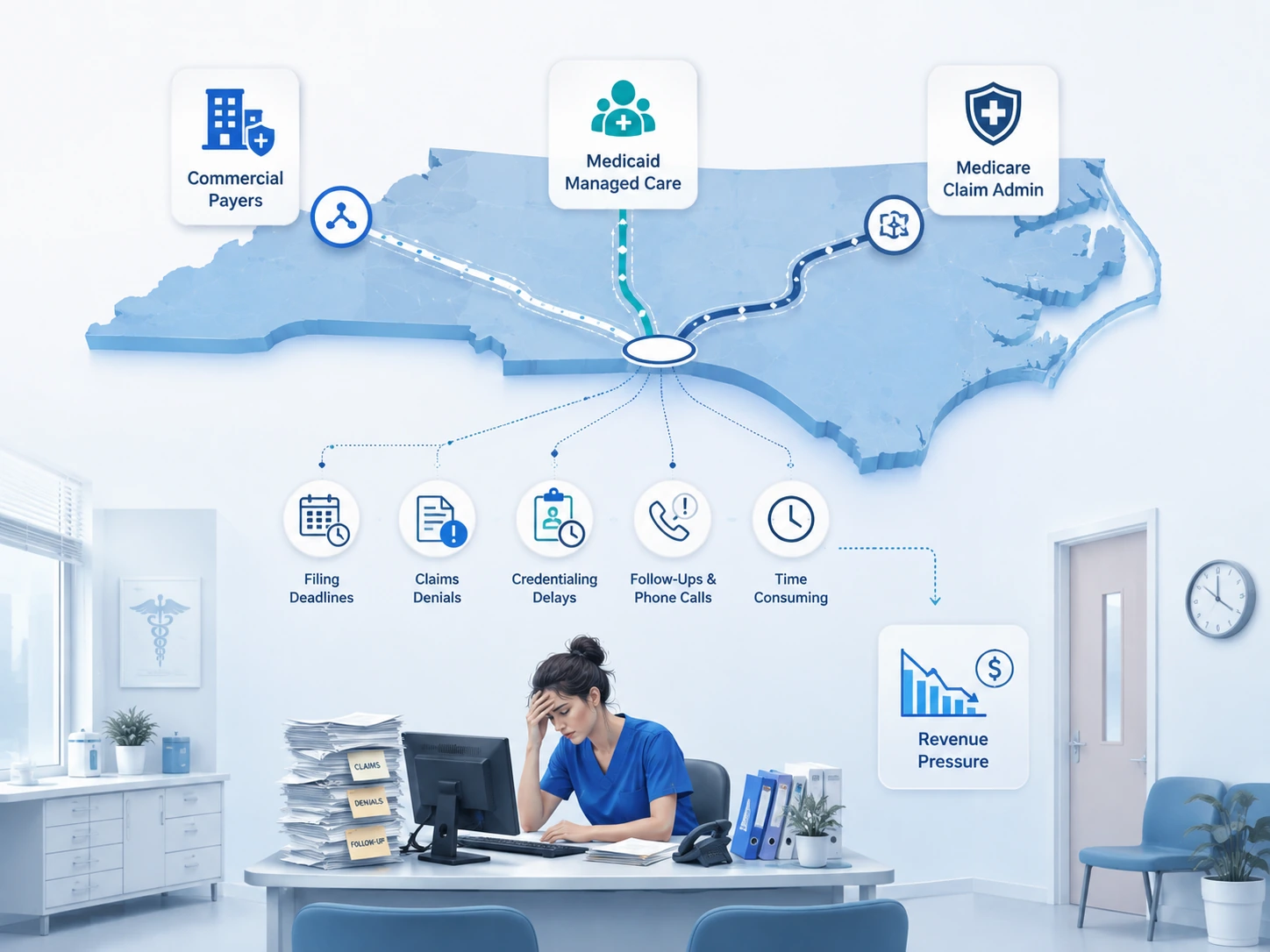
Practices across the state report a similar set of recurring problems, most of which trace back to distance, staffing, and payer concentration rather than the type of care being billed.
Recurring Claim Denials
Claim denials often cluster around missing prior authorization for imaging or specialty referrals. Because BCBSND processes such a large share of claims statewide, one misunderstood policy update can generate denials across dozens of patient accounts before anyone notices the pattern.
Payer policy riskCredentialing Delays
Enrolling a new physician with BCBSND, Medicare, and North Dakota Medicaid typically takes 60 to 120 days. CAQH profile maintenance, license verification, and payer-specific applications must move in parallel so an already-active provider does not lose weeks of billable revenue.
60–120 day timelineRural Staffing Gaps
Credentialing gaps and timely filing misses become more likely when a rural office has no backup biller during a staff absence. Limited billing coverage can allow small issues to accumulate until they begin affecting revenue across the practice.
Continuity challengeTelehealth Billing Complexity
Telehealth has grown quickly in North Dakota's western counties, where Bakken-region patients may live an hour or more from the nearest specialist. Claims carry distinct place-of-service codes, modifier rules, and payer-specific coverage limits; one incorrect detail can stall reimbursement.
Code and modifier accuracy
The North Dakota Healthcare and Insurance Landscape
Understanding the state’s healthcare landscape helps explain why billing here works differently than it does in more urban states.
Blue Cross Blue Shield of North Dakota (BCBSND) is the dominant health insurer in the state, covering roughly half the population and reaching nearly all North Dakota hospitals and physicians. Sanford Health and Essentia Health operate the largest integrated health systems in the state, with CHI St. Alexius Health, Altru Health System, and Trinity Health rounding out the major regional networks. Independent and small practices often affiliate loosely with these systems for referrals while remaining financially and administratively separate, which means their billing still runs on its own.
Rural access defines the rest of the picture. North Dakota has roughly three dozen Critical Access Hospitals and dozens more rural health clinics spread across the state, and close to 40% of residents live outside a metro area. Many of these facilities and their attached clinics bill under cost-based reimbursement rules that differ from standard fee-for-service billing, adding another layer of complexity that a generic billing service may not handle correctly.
North Dakota’s Medicaid Expansion program, which the state’s Department of Health and Human Services administers in partnership with BCBSND, covers a meaningful share of patients in lower-income and rural counties. Several counties in the state also carry federal Health Professional Shortage Area (HPSA) designations for primary care, which affects everything from provider recruitment to the incentive payments a practice may be eligible for. A billing partner that understands these designations can help a practice capture reimbursement it might otherwise miss.
Medical Billing Services for Small Practices in North Dakota
Most physician practices in North Dakota are small by national standards: one to five providers, a lean front office, and a biller who wears several other hats. That’s the norm here, not the exception, and it shapes what a billing partner needs to deliver.
A solo family medicine practice in a town of a few thousand people doesn’t need an enterprise RCM platform built for a 200-provider hospital system. It needs claims submitted correctly the first time, denials worked quickly, and a partner who answers the phone when a patient’s coverage doesn’t match what the front desk expected. Docscare’s medical billing services for small practices were built around exactly that scale: boutique attention without the enterprise price tag or the long onboarding process larger vendors require.
For a small North Dakota practice, outsourcing billing often frees up 10 to 20 hours a week of staff time that used to go toward claim follow-up and insurance calls. That time can go back into patient scheduling, front-desk coverage, or simply reducing overtime. Because Docscare handles all specialties rather than specializing in one niche, a small multi-specialty clinic or a solo provider who sees a mix of Medicare, Medicaid, and commercial patients gets one point of contact instead of juggling separate vendors for coding, credentialing, and collections.

Protect Earned Revenue
Claim denials and prompt-pay disputes eat into revenue that your practice is legally entitled to collect, and small practices rarely have the staff time to fight every one. Our Denial Management Services track North Dakota's 30-day claim decision requirement, flag underpayments, and follow through on appeals so denied claims do not quietly become written-off revenue.
Reduce Claim Denials →How Docscare Supports Medical Billing Services in North Dakota
Docscare provides a full set of outsourced revenue cycle services for North Dakota practices, coordinated by one team rather than split across multiple vendors.
Claims Submission & Scrubbing
We submit clean claims within 24 hours of visit coding, track every claim through adjudication, and follow up on denials before they age past a payer's appeal window.
Explore Claims Management →Medical Coding
Our AAPC-certified coding team reviews CPT, ICD-10, and HCPCS codes for accuracy before submission, which reduces the denial rate that comes from coding errors rather than coverage issues.
Explore Medical Coding →Denial Management
Our specialists work every denial within 72 hours, correct and resubmit standard rejections, and prepare the arbitration package when a Idaho out-of-network dispute qualifies under state law.
Explore Denial Management →Accounts Receivable Follow-Up
We work aging claims past 30, 60, and 90 days instead of writing them off, which is often where NJ FamilyCare reimbursement gets stuck.
Explore A/R Follow-Up →Credentialing & Provider Enrollment
Getting a new physician enrolled with BCBSND, Medicare, and North Dakota Medicaid takes coordinated paperwork across several payers at once. Our credentialing services for North Dakota physicians manage CAQH profiles, payer applications, and re-credentialing deadlines so a new provider can start billing as soon as possible after joining your practice.
Explore Credentialing →Revenue Cycle Management
End-to-end oversight beyond individual claims, we track days in accounts receivable, denial trends by payer, and reimbursement rates over time, and share that reporting with your practice so you always know where revenue stands.
Explore RCM Services →Auto No-Fault & Workers' Compensation Billing
Claims are filed and tracked against Michigan's separate fee schedules for auto and work-injury cases, helping prevent missed requirements and delayed reimbursement.
Need support across the complete billing lifecycle?
View All DocsCare Services →North Dakota Billing Decision Guide
Outsourcing vs. In-House Medical Billing in North Dakota
Practices deciding whether to keep billing in-house or outsource face a different calculation in North Dakota than in a state with a deep local labor pool. Here is how the two approaches typically compare for a small or mid-size practice.
Factors
Neither approach is automatically right for every practice. A larger clinic with an experienced, well-staffed billing department may have good reasons to keep the function in-house. For most solo and small North Dakota practices, though, the staffing risk alone can make outsourcing the more resilient option. For a broader framework, read our guide on how to choose a medical billing company.
Frequently Asked Questions
If your question is not answered here, contact our billing team directly. Most questions get a same-day response.
Does Docscare provide medical billing services for practices in North Dakota?
Yes. Docscare provides outsourced medical billing, coding, credentialing, and revenue cycle management for North Dakota practices remotely, from solo clinics to multi-specialty groups. We aren’t physically located in the state, but our team works directly with North Dakota’s major payers, including BCBSND, Medicare, and North Dakota Medicaid, on your practice’s behalf.
How much does outsourced medical billing cost for a North Dakota practice?
Pricing depends on claim volume, specialty mix, and the specific services a practice needs, so Docscare provides a customized quote rather than a flat rate. During a free consultation, we review your current claim volume and payer mix to give you a clear, transparent cost estimate before you commit to anything.
Can Docscare help small or solo physician practices in rural North Dakota?
Yes. Solo and small practices are a core part of who we serve, including practices attached to critical access hospitals and rural health clinics. Our boutique service model is built for practices that don’t have the volume to justify a full in-house billing department.
How does Docscare handle claims with Blue Cross Blue Shield of North Dakota (BCBSND)?
Because BCBSND processes the majority of commercial claims statewide, our team stays current on its prior authorization rules, timely filing limits, and appeal process. We track BCBSND-specific denial patterns across our North Dakota clients so we can catch and correct policy changes quickly.
Does Docscare support credentialing with North Dakota Medicaid Expansion?
Yes. We manage CAQH profile setup, payer applications, and re-credentialing deadlines for North Dakota Medicaid, Medicare, and commercial payers, including the state’s Medicaid Expansion program administered through BCBSND.
How long does it take to switch medical billing companies?
Most North Dakota practices can transition within 30 to 45 days, depending on how quickly your current biller can transfer data and how many payers require updated enrollment information. We work around your existing claims cycle so billing doesn’t stop during the switch.
