
Medical Billing Services in West Virginia That Get Your Practice Paid Faster
Docscare provides outsourced medical billing services in West Virginia for independent physicians, group practices, and behavioral health clinics. We verify eligibility, review codes, submit clean claims, post payments, work every denial, and chase aging A/R, so your staff stops fighting payers and your revenue arrives sooner.
We’re headquartered in Austin, Texas, and every biller, coder, and account manager on our team works in the United States. This page explains what West Virginia practices face with Medicaid managed care, Medicare, and state prompt-pay rules, and how our team handles each one.
What do medical billing services in West Virginia include?
Medical billing covers everything between the patient visit and the paid claim. For a West Virginia practice, Docscare’s work breaks into eight parts:
- Eligibility and benefits verification before the visit, including which Medicaid managed care plan the patient belongs to
- Charge entry and code review by AAPC-certified coders using CPT, ICD-10, and HCPCS
- Clean claim submission to Medicare, Medicaid, and commercial payers
- Payment posting and reconciliation against each remittance
- Denial management, including corrections, resubmissions, and appeals
- Accounts receivable follow-up on unpaid and underpaid claims
- Patient statements and balance follow-up
- Monthly reporting on collections, denial trends, and days in A/R
These services sit inside the same medical billing services Docscare provides in all 50 states. What changes in West Virginia is the local layer: which payers you bill, which rules apply, and which mistakes cost practices the most.
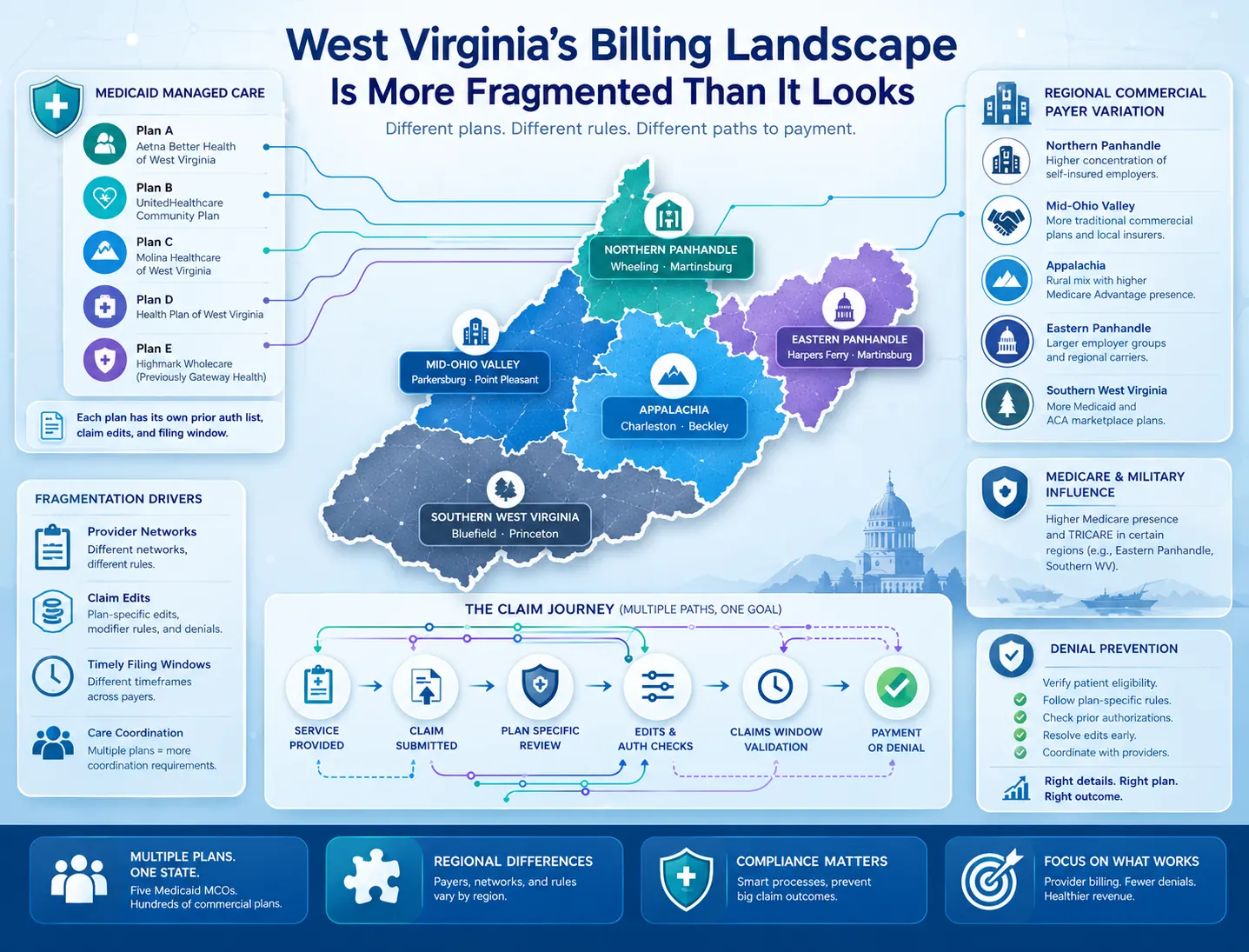
How does West Virginia’s payer mix change your billing?
West Virginia billing compliance sits at the intersection of state insurance regulations, managed care structures, and federal healthcare laws. Here’s what governs the claims a West Virginia practice submits.
West Virginia Prompt-Pay Statute
W. Va. Code § 33-45-2Requires an insurer to pay or deny a clean claim within 30 days of electronic submission and within 40 days of a manual one. Interest of 10% per year applies to late payments after 40 days.
Read additional exception details
Insurers generally have to notify you within 30 days of receipt regarding what additional information is needed. A claim with an unaddressed defect is not considered clean.
Medicaid & Mountain Health Trust
MedicaidManaged care delivers coverage to about 87% of members via four MCOs: Aetna Better Health, Highmark Health Options, The Health Plan, and Wellpoint. Each maintains distinct rules and portals.
Medicare Part B Jurisdiction M
MedicarePalmetto GBA processes Medicare claims for West Virginia. Providers must verify eligibility and claim status through their IVR system or the eServices portal.
Commercial Plans & PEIA
State & CommercialPEIA covers active state and local government employees who choose between self-insured preferred provider plans and alternative managed care networks with unique filing limits.
Outsourced Revenue Cycle Optimization
Docscare ServicesMitigate payer mix complexities with specialized billing partners who handle multi-payer credentialing, electronic scrubbers, and aggressive denial tracking.
HIPAA Privacy & Security
Federal lawAny outsourced billing vendor handling West Virginia patient records must adhere to strict federal security protocols and have an executed Business Associate Agreement.
Where do West Virginia practices lose revenue ?
Most lost revenue traces back to four problems. None of them is exotic, and all of them are fixable.
- Wrong-plan claims. Medicaid members can change plans, and a claim sent to the wrong managed care organization comes back denied for eligibility. Front desks miss this when nobody verifies coverage at every visit.
- Coding and documentation gaps. Behavioral health and substance use disorder visits draw close payer attention. Session limits, authorization rules, and documentation requirements trigger denials that a general biller often misses.
- Enrollment gaps. A provider who isn’t enrolled with a specific plan gets denials on every claim until enrollment finishes, and credentialing can take 90 to 120 days.
- Slow follow-up. One employee who also answers phones and checks in patients can’t work aging claims. Unworked denials drift past filing limits, and the revenue disappears.
Small practices feel this first because they have no cushion. Every week a claim sits in A/R, the practice funds care out of pocket.
We close each gap at the source. We verify eligibility and plan assignment before the visit, our coders review each claim before submission, we confirm payer enrollment during onboarding, and we work every denial. When a denied claim arrives, we investigate, correct, and resubmit it within 24 to 48 hours.
Stop letting wrong-plan assignments hold your revenue.
Denials that start with a wrong-plan assignment or a missing authorization can hold payments for weeks. Docscare’s medical billing team verifies eligibility, reviews every claim, and works each denial so your practice can reduce claim denials. Tell us about your West Virginia payer mix and where revenue is slipping.
How Does Docscare’s Billing Process Work for a West Virginia Practice?
Every engagement follows the same five steps, adjusted to your payer mix and specialty.
Start with a 90-day audit
Free revenue review
We review claims, denials, and A/R aging from the last 90 days so we know where your revenue slips. The audit is free.
Map your payers and enrollment
Comprehensive network setup
We list every Medicare, Medicaid MCO, and commercial plan you bill and confirm each provider’s enrollment status. If a provider still needs payer enrollment, our physician credentialing and payer enrollment team handles CAQH updates and applications.
Connect to your systems
3 to 5 business day setup
We work inside your existing EHR or practice management system, so your staff learns nothing new. Most practices finish onboarding in 3 to 5 business days.
Run the daily claim cycle
End-to-end management
We verify eligibility, review codes, scrub claims, submit them, post payments, and work denials and aging A/R.
Review results every month
Dedicated specialist support
You get a monthly report on collections, denials, and A/R aging, and your dedicated specialist answers your questions.
Let our team handle your billing workflow while you focus on patient care.
Can small West Virginia practices afford to outsource medical billing?
For many, outsourcing costs less than an in-house hire. A full-time biller brings salary, benefits, software, and training costs, and claims stop when that person is out sick or leaves. Docscare charges a percentage of collected revenue, typically 4% to 8% depending on specialty, claim volume, and service scope. We don’t charge setup fees or monthly minimums, and we don’t require long-term contracts, so we earn more only when you collect more. Other companies bill per claim or charge a flat monthly rate. Neither is wrong, but ask what each fee includes. Our medical billing cost guide breaks down every pricing model, and it’s worth reading before you sign with anyone.
| Factor | In-house biller | Docscare |
|---|---|---|
| Coverage when staff are out | Claims stop until someone covers. | A team works claims every day. |
| Coding review | Depends on one person’s training. | AAPC-certified coders matched to your specialty. |
| Payer rule tracking | Handled alongside other duties. | Tracked across Medicaid plans, Medicare, and commercial payers. |
| Denial follow-up | Worked when time allows. | Investigated, corrected, and resubmitted within 24 to 48 hours. |
| Cost structure | Salary, benefits, software, training. | Percentage of collections, typically 4% to 8%. |
| Contract terms | Employment commitment. | No setup fees, monthly minimums, or long-term contracts. |
In-house billing still works when your volume supports a dedicated team with real coding and denial expertise. Read when in-house billing still makes sense to test that against your own numbers. If you run a solo or two-to-five-provider practice, our page on medical billing for small practices covers that situation in detail.
Medical Specialties We Bill for in West Virginia
We bill for all specialties, including family medicine, internal medicine, cardiology, orthopedics, dermatology, pediatrics, OB/GYN, psychiatry and mental health, physical therapy, and urgent care. Our specialty-trained billers and coders match each practice with staff who know its code sets, documentation standards, and denial triggers.
Explore all specialtiesChoose your practice type
What to Ask a West Virginia Medical Billing Company Before You Sign
Put these questions to any billing company, including us, to ensure your practice gets the transparency and reliability it deserves.
Mountain Health Trust Plans
Which Mountain Health Trust plans do you bill, and how do you confirm plan assignment before each visit?
Medicare Eligibility via Palmetto GBA
How do you verify Medicare eligibility and claim status through Palmetto GBA?
Fee Structure Transparency
What does the fee cover, and what costs extra?
Data & Payer Continuity
What happens to my data and my payer relationships if I leave?
Support Model
Will I work with one named person or a support queue? (At Docscare, you get a dedicated specialist.)
Business Associate Agreement
Do you sign a business associate agreement before touching patient data? (Docscare signs on day one.)
Frequently Asked Questions
If your question is not answered here, contact our billing team directly. Most questions get a same-day response.
How much does outsourced medical billing cost in West Virginia?
Expect roughly 4% to 8% of what your practice collects, depending on specialty, claim volume, and the services you include. Docscare has no setup fee, no monthly minimum, and no lock-in contract. Whatever model a company uses, percentage, per claim, or flat monthly, compare exactly what the fee covers.
Does Docscare bill Mountain Health Trust and other West Virginia Medicaid plans?
Yes. We bill West Virginia Medicaid and follow the rules of each of the four Mountain Health Trust plans, from authorizations to claim edits. Before every visit we confirm which plan the patient is enrolled in, because a claim sent to the wrong plan comes back denied.
Can Docscare bill Medicare claims for West Virginia providers?
Yes. Palmetto GBA handles Medicare Part B claims for West Virginia providers under Jurisdiction M. We submit the claims, check eligibility and claim status in Palmetto’s tools, and work any rejections or denials that come back.
What is a clean claim, and why does it matter in West Virginia?
A clean claim has no material defect and carries everything the payer needs to decide it. West Virginia’s prompt-pay law starts a payment clock of 30 days for electronic claims and 40 days for manual ones, with exceptions. An error at submission can cost you that protection and delay payment.
Will Docscare work with my EHR or practice management system?
Yes. Tell us which system you use during the initial audit, and we confirm how charges, claims, and reports will flow before onboarding begins. Your staff keeps working in the software they already know.
Is outsourced medical billing HIPAA compliant?
It can be, and it should be in writing. HIPAA requires a business associate agreement before a billing company handles protected health information. Docscare signs a Business Associate Agreement with every client on day one and builds HIPAA compliance into its daily workflow.
How long does it take to switch to an outsourced billing company?
Start with facts.
A 90-day look at denials, A/R aging, and payer mix shows whether your losses come from eligibility, coding, enrollment, or follow-up. That review is useful whether or not you outsource, and it tells you what to fix first.
Clean claim ratio
