
Medical Billing Services in Utah for Independent and Small Practices
If you run a practice in Salt Lake City, Provo, Ogden, or St. George, your claims move through a payer mix you won’t find anywhere else: Noridian for Medicare, PRISM and four Medicaid accountable care organizations, and commercial plans such as SelectHealth, Regence BlueCross BlueShield of Utah, and PEHP. Docscare provides outsourced medical billing services in Utah that cover every one of those payers, from charge entry to final payment.
We’re a US-based billing and revenue cycle management (RCM) company headquartered in Austin, Texas, and we work remotely with Utah practices statewide. Our team maintains a 99% clean claim ratio and a 99% first-submission pass rate, and clients see a 30% average revenue increase within their first year.
What Do Our Medical Billing Services in Utah Include?
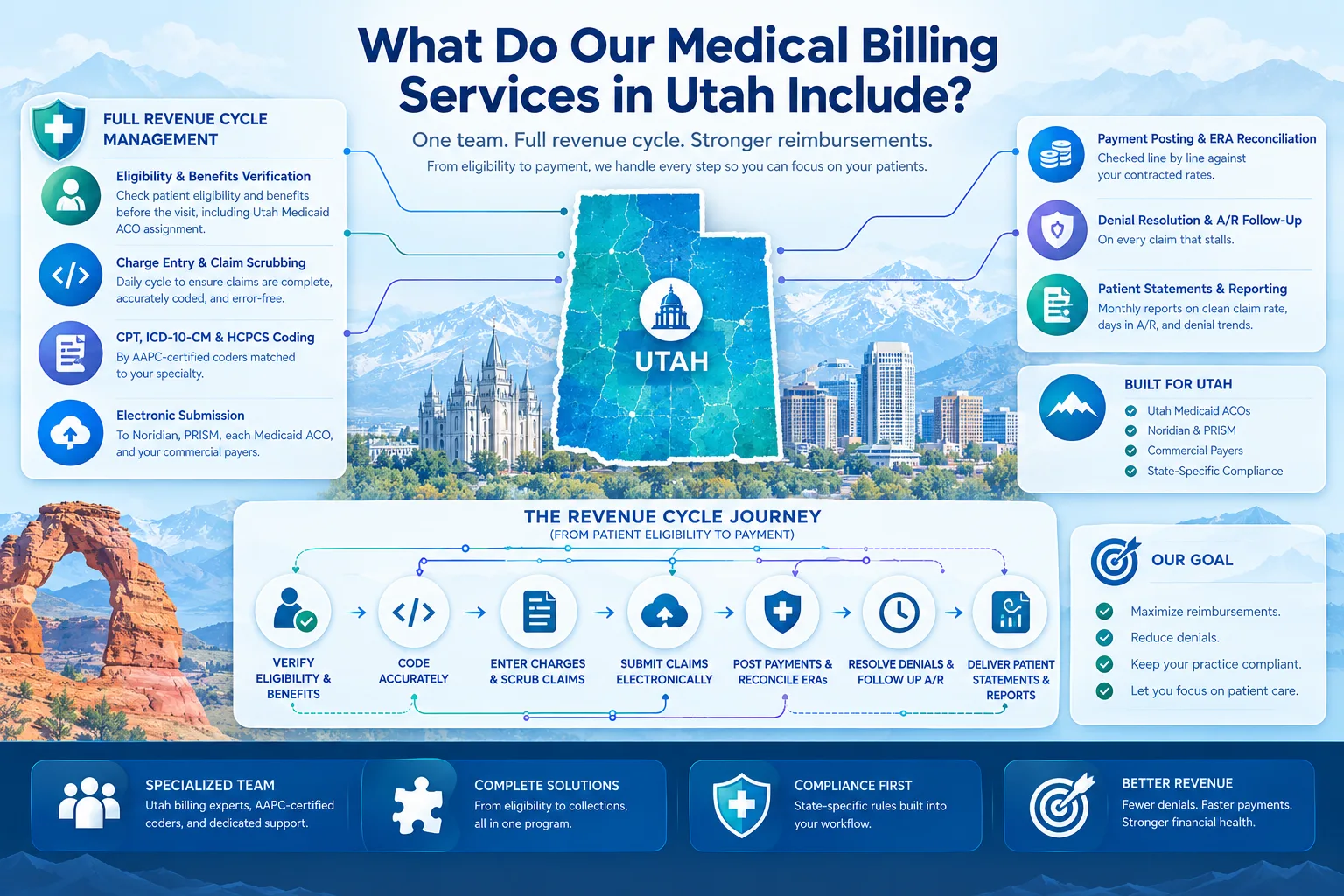
Outsourcing only works when one team owns the whole cycle. When one vendor codes the claim, another submits it, and nobody follows up, revenue leaks at every handoff. Our medical billing services give Utah providers a single team for each stage:
- Eligibility and benefits verification before the visit, including a check of the patient’s current Utah Medicaid ACO assignment.
- Charge entry and claim scrubbing on a daily cycle, so claims leave your office complete and correctly coded.
- CPT, ICD-10-CM, and HCPCS coding by AAPC-certified coders matched to your specialty.
- Electronic submission to Noridian, PRISM, each Medicaid ACO, and your commercial payers.
- Payment posting and ERA reconciliation, checked line by line against your contracted rates.
- Denial resolution and accounts receivable (A/R) follow-up on every claim that stalls.
- Patient statements and monthly reporting on clean claim rate, days in A/R, and denial trends.
What Makes Medical Billing in Utah Different?
Generic billing workflows break down in Utah because the state's largest payers operate differently from their counterparts elsewhere. Four rules shape nearly every Utah claim.
Utah Prompt-Pay Statute
Utah Code § 31A-26-301.6Under Utah law, a state-regulated insurer generally must pay or respond to a written claim within 30 days of receiving it. Insurers can extend this window by 15 days only with written notice before day 30.
Read additional exception details
When a delay is due to missing information, the insurer's notice must describe exactly what information they need. Any regulated claim past day 30 without proper notice is escalated instead of aging in A/R.
Medicare Part F Jurisdiction F
MedicareNoridian processes Medicare Part A and Part B claims for Utah. CMS re-awarded the contract to Noridian in August 2025, meaning local coverage determinations (LCDs) differ from other MACs and require strict adherence.
Medicaid, PRISM & Four ACOs
MedicaidFee-for-service claims go through PRISM (paperless since February 2023). Most members belong to one of four ACOs: Healthy U, SelectHealth Community Care, Molina Healthcare, and Health Choice Utah, with mandatory enrollment in 13 counties.
Timely Filing Windows
Filing LimitsWindows vary significantly by payer: 12 months for Medicare fee-for-service (42 CFR 424.44), 365 days for Healthy U and University of Utah Health Plans, and contract-specific limits for other commercial plans and ACOs.
Outsourced Revenue Cycle Optimization
Docscare ServicesMitigate complex Utah payer rules with structured pre-visit insurance verification, clean claim scrubbers, and aggressive denial tracking to prevent permanent write-offs.
HIPAA Privacy & Security
Federal LawAny outsourced billing vendor handling Utah patient records must adhere to strict federal security protocols and operate under an executed Business Associate Agreement.
Medical Billing Services for Small Practices in Utah
A two-physician family practice in Cedar City or Logan usually has one person handling billing, front-desk questions, and prior authorizations at the same time. When that person takes a vacation or leaves, claims stop going out the same week. Along the Wasatch Front the problem shifts: experienced billers are in demand, and large health systems can outbid a small clinic on salary.
Outsourcing removes that single point of failure. You get a dedicated billing specialist who knows your payer mix, backed by a full team, without adding a salary, benefits, or billing software licenses to your overhead. If you want the operational detail first, our guide to billing for smaller practices walks through it.
What do outsourced medical billing services cost in Utah?
Docscare charges a percentage of collected revenue, typically 4% to 8% depending on your specialty, claim volume, and service scope. There are no setup fees, no monthly minimums, and no long-term contracts. Because our fee comes from what we collect, our incentive matches yours: get every valid claim paid in full.

In-House Billing vs. an Outsourced Medical Billing Services Provider in Utah
If you’re deciding between hiring a biller and working with an outsourced medical billing services provider in Utah, compare the full picture rather than the monthly invoice alone.
| Factor | In-house biller | Docscare |
|---|---|---|
| Cost structure | Salary, benefits, payroll taxes, software, and training. | Percentage of collections (typically 4% to 8%), no setup fees. |
| Coverage during absences | Claims pause when the biller is out. | A team covers your account every business day. |
| Utah payer knowledge | Depends on one person's experience. | Team works Noridian, PRISM, ACO, and commercial rules daily. |
| Coding credentials | Varies by hire. | AAPC-certified coders matched by specialty. |
| Denial follow-up | Often slips during busy weeks. | Every denial investigated, corrected, and tracked by cause. |
| Reporting | Built manually, if at all. | Monthly KPI reporting. |
| HIPAA | Your internal policies. | Signed Business Associate Agreement from day one. |
In-house billing can still make sense for a large group with a full billing department and low denial rates. For many smaller practices, the math favors outsourcing once benefits, software, turnover, and uncollected claims are counted. Our breakdown of what outsourced billing typically costs runs those numbers line by line.
Which Claim Denials Hit Utah Practices Most Often?
Most preventable denials in Utah trace back to a short list of causes, which our denial team tracks by reason code and payer to fix upstream.
Wrong Payer
ACO & Medicaid routing errors
The member switched ACOs or lives in a mandatory-enrollment county, and the claim incorrectly went to fee-for-service Medicaid.
Enrollment Gaps
PRISM & network matching
The rendering provider isn't linked properly to the billing group in PRISM or within the respective ACO's active network.
Medical Necessity
Noridian LCD compliance
Documentation fails to satisfy the specific Noridian Local Coverage Determination (LCD) that governs the billed service.
Missing Authorization
Imaging, drugs & procedures
Missing prior authorization for specialized imaging, major medical procedures, or high-cost pharmaceutical drugs.
Timely Filing
Payer window management
The original claim or its subsequent correction arrived after the target payer's strict submission window closed.
Our denial team tracks each issue by reason code and payer to correct claims and fix upstream workflows.
How Do We Onboard a Utah Practice?
- Free revenue cycle audit. We review your denial patterns, A/R aging, coding trends, and payer mix to find where revenue is slipping away.
- Payer and contract mapping. We document every payer you bill, from Noridian and PRISM to each ACO and commercial plan, along with fee schedules and filing limits.
- System connection. We work inside your existing EHR or practice management system. Most practices are fully onboarded within 3 to 5 business days, with no new software to install.
- Daily claim submission. We code, scrub, and submit your charges every business day.
- Follow-up and reporting. We work denials and aging A/R continuously and send a monthly report on the numbers that drive your revenue.
Credentialing, Payer Enrollment, and Specialty Billing for Utah Practices
Ensuring complete network alignment, precise Medicaid setup, and AAPC-certified coding across 45 medical specialties.
Credentialing & Payer Enrollment
PRISM, PECOS, and CAQH Management
A perfectly coded claim still denies if the rendering provider isn't enrolled. In Utah, Medicaid enrollment comes first via PRISM, followed by ACO participation and commercial contracts. Our dedicated physician credentialing and payer enrollment team manages CAQH profiles, PECOS Medicare updates, and re-credentialing dates.
Specialty Billing & Behavioral Health
45 Specialties with AAPC-Certified Coders
We support 45 medical specialties—including family medicine, internal medicine, pediatrics, OB/GYN, cardiology, orthopedics, dermatology, physical therapy, psychiatry, and mental health—matched with AAPC-certified coders. Behavioral health features a specialized workflow navigating prepaid mental health plans and integrated UMIC options. Learn more about our comprehensive medical billing services.
Let our experts safeguard your network participation and prevent costly enrollment gaps.
Frequently Asked Questions
If your question is not answered here, contact our billing team directly. Most questions get a same-day response.
Where can I find medical billing services in Utah?
You can hire a local Utah billing company or an outsourced provider that serves Utah remotely. Medicare, Medicaid, and commercial claims are all submitted electronically, so Utah payer experience matters more than office location. Docscare works remotely with practices statewide and bills Noridian, PRISM, all four Medicaid ACOs, and major commercial plans.
How long does an insurance company have to pay a claim in Utah?
Under Utah Code § 31A-26-301.6, a state-regulated insurer generally has 30 days from receiving a written claim to pay it or respond. It can extend that by 15 days with written notice to the provider and the insured before the 30 days end. Self-funded ERISA plans usually fall outside this rule.
Who processes Medicare claims in Utah?
Noridian Healthcare Solutions processes Medicare Part A and Part B claims for Utah as the MAC for Jurisdiction F. The jurisdiction also covers Alaska, Arizona, Idaho, Montana, North Dakota, Oregon, South Dakota, Washington, and Wyoming.
Which Medicaid ACOs operate in Utah?
The Utah Legislature’s 2025 managed care review covered four ACOs: Healthy U, SelectHealth Community Care, Molina Healthcare of Utah, and Health Choice Utah. Enrollment is mandatory in 13 of Utah’s 29 counties, including Salt Lake and Utah counties.
How much do medical billing services in Utah cost?
Most outsourced billing companies charge a percentage of collections. Docscare typically charges 4% to 8% of collected revenue depending on specialty, claim volume, and scope, with no setup fees, monthly minimums, or long-term contracts.
Is outsourcing medical billing worth it for a small practice in Utah?
For many solo and small-group practices, yes. Outsourcing replaces a fixed salary, benefits, and software cost with a fee tied to collections, and it removes the risk of claims stopping when one biller is out.
Does Docscare have an office in Utah?
How long does it take to switch to Docscare?
Master Noridian policies, ACO assignments, and commercial deadlines.
Utah's payer mix rewards practices that keep up with Noridian policy updates, ACO assignments, and commercial filing windows. Docscare's billing team handles coding, claims, credentialing, and denials for Utah practices under one agreement, priced as a percentage of what we collect, so you can improve reimbursement without adding staff. Get medical billing support from a team that already knows your payers.
Clean claim ratio
