Hepatology ICD-10 codes live mainly in two places: K70 to K77 (Diseases of liver) and B15 to B19 (Viral hepatitis). A liver practice also reports supporting codes from C22 for liver cancer, I85 for esophageal varices, R18 for ascites, E83 and E88 for metabolic liver disease, and Z94.4 or T86.4- for transplant care. For dates of service from October 1, 2026 through September 30, 2027, you code from the FY 2027 ICD-10-CM set, which adds K74.0A for moderate (stage F2) fibrosis and K76.83 for intestinal failure-associated liver disease.
This guide lists the hepatology ICD-10 codes liver clinics rely on, explains the sequencing and excludes rules that trip up claims, and shows how each diagnosis supports the procedure, test, or risk score attached to it. It’s written for hepatologists, GI groups with a liver clinic, and the coders and billers who keep those claims clean.
Table of Contents
ToggleWhat Are Hepatology ICD-10 Codes?
Hepatology ICD-10 codes are the ICD-10-CM diagnosis codes that describe liver disease, its cause, and its complications. They tell the payer why a liver service was medically necessary. Payers read them against the CPT code on the same claim line, so the diagnosis often decides whether an elastography, a hepatic function panel, or a specialty drug gets paid.
Most of these codes come from Chapter 11 (Diseases of the digestive system), but several sit in other chapters. Here’s where to look.
| Code range | What it covers | Typical hepatology use |
|---|---|---|
| K70 | Alcoholic liver disease | Alcohol-associated steatosis, hepatitis, fibrosis, cirrhosis, and failure |
| K71 | Toxic liver disease | Drug-induced liver injury (DILI) |
| K72 | Hepatic failure, not elsewhere classified | Acute, chronic, and unspecified liver failure, with or without coma |
| K73 | Chronic hepatitis, not elsewhere classified | Chronic hepatitis with no viral, alcoholic, or drug cause |
| K74 | Fibrosis and cirrhosis of liver | Fibrosis staging, biliary cirrhosis, other cirrhosis |
| K75 | Other inflammatory liver diseases | MASH, autoimmune hepatitis, liver abscess |
| K76 | Other diseases of liver | MASLD, portal hypertension, hepatorenal syndrome, hepatic encephalopathy |
| K77 | Liver disorders in diseases classified elsewhere | Manifestation code that never goes first |
| B15 to B19 | Viral hepatitis | Acute and chronic hepatitis A, B, C, D, and E |
| C22, C78.7 | Primary and secondary liver cancer | HCC, intrahepatic cholangiocarcinoma, liver metastases |
| I85, I81, I82.0 | Varices, portal vein thrombosis, Budd-Chiari syndrome | Vascular complications of liver disease |
| E83, E88.01 | Mineral metabolism disorders, alpha-1 antitrypsin deficiency | Wilson disease, hemochromatosis, AATD |
| Z94.4, T86.4- | Liver transplant status and complications | Post-transplant follow-up, rejection, graft failure |
What Changed in Hepatology ICD-10 Codes for FY 2027?
Two liver codes joined the code set on October 1, 2026. Neither one retitles an existing code, so your current favorites still validate. You’ll lose specificity, though, if your EHR and claim scrubber don’t carry the new codes.
| Code | Description | Effective | What it changes |
|---|---|---|---|
| K74.0A | Hepatic fibrosis, moderate fibrosis | Oct. 1, 2026 (FY 2027) | Stage F2 now has its own code, between K74.01 (stage F1) and K74.02 (advanced). |
| K76.83 | Intestinal failure-associated liver disease | Oct. 1, 2026 (FY 2027) | Replaces nonspecific “other liver disease” coding for this condition. |
| K76.0 | MASLD added as an inclusion term | Oct. 1, 2025 (FY 2026) | Confirms that MASLD reports with K76.0. |
| K76.82 | Hepatic encephalopathy | Oct. 1, 2022 (FY 2023) | Older superbills may still send HE to less specific codes. |
The date of service decides which code set applies, not the date you submit the claim. An F2 fibrosis visit on September 28, 2026 can’t carry K74.0A even if you bill it in October. CMS posts the annual files on its ICD-10 code files page, and the NCHS ICD-10-CM browser tool lets you search any fiscal year and open the official coding guidelines. Keep an eye on April 1 as well, since CMS and NCHS can release a mid-year update.
How Do You Code MASLD, MASH, and Liver Fibrosis?
Code MASLD (formerly NAFLD) with K76.0 and MASH (formerly NASH) with K75.81. When the provider documents a fibrosis stage, add a code from K74.0- after the liver disease code. Once the provider documents cirrhosis, report a cirrhosis code rather than a fibrosis stage.
| Code | Description | Coding note |
|---|---|---|
| K76.0 | Fatty change of liver, not elsewhere classified | Inclusion terms list MASLD and NAFLD. Excludes1: NASH (K75.81). |
| K75.81 | Nonalcoholic steatohepatitis (NASH) | Inclusion term: MASH. Add the K74.0- fibrosis stage when documented. |
| K74.00 | Hepatic fibrosis, unspecified | Use only when the note gives no stage. |
| K74.01 | Hepatic fibrosis, early fibrosis | Stage F1, mild fibrosis. |
| K74.0A | Hepatic fibrosis, moderate fibrosis | Stage F2, moderate fibrosis. New for FY 2027. |
| K74.02 | Hepatic fibrosis, advanced fibrosis | Advanced fibrosis as the provider documents it. |
| K74.60 / K74.69 | Unspecified / other cirrhosis of liver | Choose K74.69 when the provider names a cirrhosis type that has no code of its own. |
Three rules carry most of the weight in this family:
- K76.0 and K75.81 never share a claim. The Excludes1 note under K76.0 treats simple steatosis and steatohepatitis as mutually exclusive. Pick the one the provider diagnosed.
- Fibrosis is a second code, not a replacement. K74.0 carries a “code first underlying liver disease” note, so K75.81 (or whichever etiology applies) leads and the stage follows.
- The stage needs a documented source. A coder can assign K74.0A only when the provider writes “F2” or “moderate fibrosis.” A raw kPa value from a FibroScan report, without the provider’s interpretation, isn’t enough. Query the provider or ask for an addendum.
MetALD (MASLD with increased alcohol intake) has no dedicated code yet. An international expert panel, writing in Hepatology Communications, recommended coding whichever driver the clinician judges dominant, K76.0 or the K70 family, until the classification catches up.
Which ICD-10 Codes Cover Alcohol-Associated Liver Disease?
Category K70 holds the alcohol-associated liver codes, and several are combination codes that already include ascites or coma. Every K70 code also carries a “use additional code” note for alcohol abuse and dependence (F10.-), so a K70 claim usually lists at least two diagnoses.
| Code | Description |
|---|---|
| K70.0 | Alcoholic fatty liver |
| K70.10 / K70.11 | Alcoholic hepatitis without / with ascites |
| K70.2 | Alcoholic fibrosis and sclerosis of liver |
| K70.30 / K70.31 | Alcoholic cirrhosis of liver without / with ascites |
| K70.40 / K70.41 | Alcoholic hepatic failure without / with coma |
| K70.9 | Alcoholic liver disease, unspecified |
Watch for two traps. First, K74 lists alcoholic cirrhosis and alcoholic fibrosis as Excludes1, so K70.3- and K74.6- never appear together. Second, K70.31 already says “with ascites,” so adding R18.8 repeats information the combination code carries. Pick the F10 code that matches the provider’s own words (use, abuse, dependence, or remission), because each one describes a different clinical picture.
What Are the ICD-10 Codes for Viral Hepatitis?
Viral hepatitis sits in B15 to B19, outside the liver chapter. The fourth and fifth characters separate acute from chronic infection, flag the delta agent, and record hepatic coma.
| Code | Description |
|---|---|
| B15.9 | Hepatitis A without hepatic coma |
| B16.9 | Acute hepatitis B without delta-agent and without hepatic coma |
| B17.10 / B17.11 | Acute hepatitis C without / with hepatic coma |
| B18.0 | Chronic viral hepatitis B with delta-agent |
| B18.1 | Chronic viral hepatitis B without delta-agent |
| B18.2 | Chronic viral hepatitis C |
| B18.8 / B18.9 | Other / unspecified chronic viral hepatitis |
| B19.10 / B19.20 | Unspecified viral hepatitis B / C without hepatic coma |
| Z86.19 | Personal history of other infectious and parasitic diseases |
Pair these with K74 when fibrosis or cirrhosis is present. Category K74 carries a “code also” note for viral hepatitis, and the order follows the reason for the visit. A patient seen to manage cirrhosis caused by hepatitis C could carry K74.60 and B18.2, sequenced by the focus of that encounter.
Cured hepatitis C needs its own decision. Once the provider documents a sustained virologic response and calls the infection resolved, B18.2 no longer describes the patient. Most coders move to Z86.19 and keep any lasting liver damage, such as cirrhosis, coded on its own.
Coding accuracy
Unspecified liver codes and missing fibrosis stages turn routine FibroScan and lab claims into medical-necessity denials. Our medical coding services match every liver procedure to the most specific diagnosis the chart supports, including the new FY 2027 codes. Talk with our AAPC-certified coders about improving coding accuracy in your liver clinic.
How Do You Code Cirrhosis Complications and Liver Failure?
Decompensated cirrhosis rarely fits one code. Each complication the provider documents and manages earns its own line, and several of these codes carry notes that control the order.
| Complication | Code | Coding note |
|---|---|---|
| Portal hypertension | K76.6 | Use an additional code for complications such as portal hypertensive gastropathy (K31.89). |
| Ascites (non-alcoholic cirrhosis) | R18.8 | Add with K74.6- when ascites is documented. Not needed with K70.11 or K70.31. |
| Esophageal varices | I85.00 / I85.01 | Without / with bleeding. Secondary varices (I85.10 / I85.11) need the underlying cause coded first. |
| Hepatic encephalopathy | K76.82 | Code also the underlying liver disease. Excludes1: the “with coma” failure codes (K70.41, K72.01, K72.11, K72.91). |
| Hepatorenal syndrome | K76.7 | Report alongside the cirrhosis or failure code that explains it. |
| Hepatopulmonary syndrome | K76.81 | Report alongside the underlying liver disease. |
| Chronic hepatic failure | K72.10 / K72.11 | Without / with coma. |
| Acute or subacute hepatic failure | K72.00 / K72.01 | Without / with coma. |
| Portal vein thrombosis | I81 | Excludes2 at K76, so it can appear with liver disease codes. |
| Budd-Chiari syndrome | I82.0 | Hepatic vein thrombosis. |
Coma changes the code, not just the narrative. K76.82 covers hepatic encephalopathy without coma. When the provider documents hepatic coma, the coder moves to the matching “with coma” code, such as K72.11 for chronic hepatic failure with coma, and drops K76.82.
Which Codes Cover Autoimmune, Cholestatic, Metabolic, and Drug-Induced Liver Disease?
| Condition | Code | Coding note |
|---|---|---|
| Autoimmune hepatitis | K75.4 | Inflammatory liver disease category. |
| Primary biliary cholangitis | K74.3 | The tabular title still reads “primary biliary cirrhosis.” |
| Secondary biliary cirrhosis | K74.4 | — |
| Primary sclerosing cholangitis | K83.01 | Sits in the biliary tract block (K80 to K87), not K70 to K77. |
| Wilson disease | E83.01 | Excludes2 at the K70 to K77 level, so it can be reported with liver codes. |
| Hereditary hemochromatosis | E83.110 | Also Excludes2 at K70 to K77. |
| Alpha-1 antitrypsin deficiency | E88.01 | Endocrine and metabolic chapter. |
| Drug-induced liver injury | K71.- | Pair with a T36 to T50 code; see sequencing below. |
| Chronic hepatitis, not elsewhere classified | K73.- | Use when no viral, alcoholic, or drug cause is documented. |
For drug-induced liver injury, the order depends on how the patient took the drug. A correctly prescribed drug that injured the liver counts as an adverse effect: K71.- goes first, followed by the T-code with 5 in the fifth or sixth character. An overdose or the wrong drug counts as poisoning: the poisoning code comes first, then the K71 manifestation.
What Are the ICD-10 Codes for Liver Cancer and Liver Transplant?
| Code | Description |
|---|---|
| C22.0 | Liver cell carcinoma (hepatocellular carcinoma) |
| C22.1 | Intrahepatic bile duct carcinoma |
| C22.8 | Malignant neoplasm of liver, primary, unspecified as to type |
| C22.9 | Malignant neoplasm of liver, not specified as primary or secondary |
| C78.7 | Secondary malignant neoplasm of liver and intrahepatic bile duct |
| Z94.4 | Liver transplant status |
| T86.40 to T86.49 | Complications of liver transplant (unspecified, rejection, failure, infection, other) |
| Z76.82 | Awaiting organ transplant status |
C22.9 draws attention in audits. If the provider’s assessment calls the lesion metastatic, report C78.7 with the primary site. If the provider confirms HCC, report C22.0. For transplant recipients, Z94.4 fits routine follow-up, while documented rejection, failure, or infection moves the claim to the matching T86.4- code.
When Should You Use Symptom Codes Like R74.01 or K76.9?
Use a sign or symptom code only until the provider reaches a diagnosis. The ICD-10-CM Official Guidelines allow symptom codes when no definitive diagnosis has been established, and they tell coders not to add symptoms that are routinely part of a confirmed condition.
- R74.01 Elevation of liver transaminase levels: fits a referral workup for abnormal ALT or AST.
- R16.0 Hepatomegaly, not elsewhere classified.
- R17 Unspecified jaundice.
- R18.8 Other ascites, while the cause is still under evaluation.
- K76.9 Liver disease, unspecified: a last resort that gives payers little to work with on elastography and lab claims.
Once the note says MASLD, cirrhosis, or chronic hepatitis C, retire the symptom code. Leaving R74.01 on a patient with documented MASH makes the claim look less certain than the chart.
How Should You Sequence Liver Diagnoses on a Claim?
Sequencing follows the reason for the encounter and the instructional notes in the tabular list. Five checks settle most hepatology claims:
- List first the condition chiefly responsible for the visit or procedure.
- Follow every “code first,” “use additional code,” and “code also” note at the category and subcategory level, not just on the code you picked.
- Respect Excludes1 pairs: K76.0 with K75.81, K74.- with K70.3-, and K76.82 with the “with coma” failure codes.
- Use a combination code when one exists, and don’t add a separate code for an element it already names.
- Point each CPT line to the diagnosis that justifies it, not automatically to the first code on the claim.
| Scenario | Codes, in order | Why |
|---|---|---|
| MASH with F2 fibrosis documented after FibroScan, visit on Oct. 20, 2026 | K75.81, K74.0A | K74.0 says code first the underlying disease, and F2 maps to K74.0A for FY 2027 dates of service. |
| Alcohol-associated cirrhosis with ascites, alcohol dependence in remission | K70.31, F10.21 | K70.31 includes ascites, and K70 requires an F10 code. |
| Compensated cirrhosis from chronic hepatitis C, seen for cirrhosis follow-up | K74.60, B18.2 | K74 instructs code also viral hepatitis; order follows the encounter focus. |
| Decompensated cirrhosis with hepatic encephalopathy (no coma) and portal hypertension | K74.60, K76.82, K76.6 | HE needs its underlying disease coded; K76.6 captures the portal hypertension. Add K72.10 if the provider documents chronic hepatic failure. |
| Elevated ALT on referral, no diagnosis yet | R74.01 | A symptom code fits until the provider confirms a diagnosis. |
How Do Hepatology ICD-10 Codes Affect Payment and Risk Adjustment?
Diagnosis codes do two jobs on a liver claim. They prove medical necessity for the service on the same line, and for Medicare Advantage patients they feed the CMS-HCC risk model that shapes the plan’s payment.
Medical necessity for liver procedures and tests
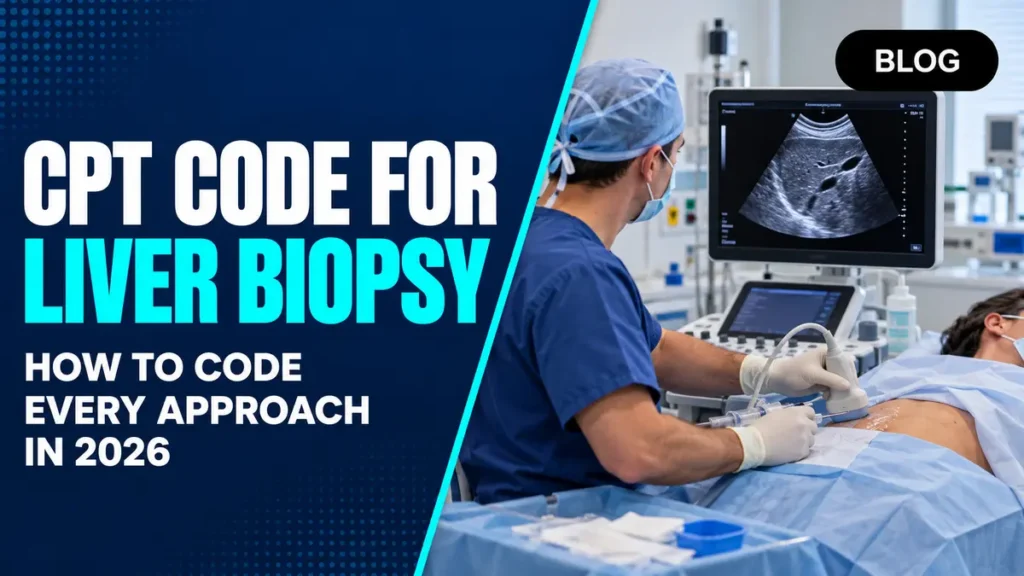
Elastography (91200 or 76981), hepatic function panels (80076), percutaneous liver biopsy (47000), and paracentesis (49082 or 49083) all depend on a linked diagnosis that meets the payer’s coverage policy. A FibroScan linked only to K76.9 tells the payer almost nothing, while the same exam linked to K75.81 and K74.0A shows exactly why it was ordered. The procedure side has its own traps: our guide on how to code each liver biopsy approach covers 47000 and the alternatives. For the elastography side, the hepatology billing services page explains how we settle the 91200 versus 76981 question. When a payer still rejects the link, our billing team rechecks each claim line against the diagnosis before resubmission.
CMS-HCC risk adjustment
Under the CMS-HCC V28 model, several liver diagnoses map to payment categories: liver transplant status and complications (HCC 62), chronic liver failure and end-stage liver disorders (HCC 63, which includes portal hypertension and chronic hepatic failure), cirrhosis of liver (HCC 64), and chronic hepatitis (HCC 65, which includes chronic hepatitis C). The model keeps only the most severe category in that hierarchy, so a documented cirrhosis code outranks chronic hepatitis. Mappings change by payment year, so check the current files on the CMS risk adjustment page before relying on any single code-to-HCC link. Auditors also expect the note to show the condition was monitored, evaluated, assessed, or treated at that visit.
Which Hepatology Coding Errors Cause the Most Denials?
| Error | What happens | Fix |
|---|---|---|
| K76.0 and K75.81 on the same claim | Edit rejection under the Excludes1 rule | Code only the diagnosis the provider documented. |
| Fibrosis code with no underlying disease | Sequencing edit or medical-necessity denial | Code the etiology first, then K74.0-. |
| K74.60 used for alcoholic cirrhosis | Wrong code and an Excludes1 conflict | Use K70.30 or K70.31 with an F10 code. |
| K74.0A on a date of service before Oct. 1, 2026 | Invalid code rejection | Use the FY 2026 code set for those dates. |
| B18.2 kept after documented cure | Overstated diagnosis and risk-adjustment audit exposure | Move to Z86.19 when the provider documents resolution. |
| C22.9 after the provider confirmed HCC or metastasis | Lost specificity and an audit flag | Use C22.0 or C78.7 as documented. |
| K76.82 with a “with coma” failure code | Excludes1 conflict | Report the coma-specific failure code alone. |
| R74.01 after a definitive diagnosis | Weak medical necessity | Replace it with the confirmed liver diagnosis. |
When these errors repeat, the fix belongs upstream in templates and charge capture rather than in one-off corrections. Our team will trace each denial back to its source so the same error stops coming back. Liver claims that have already aged past 90 days need a different push, and our accounts receivable recovery work focuses on those balances. For the wider picture of liver billing, including prior authorization and care management, see our hepatology medical billing guide for 2026.
What Should Providers Document for Accurate Liver Coding?
Coders can’t assign a specific code that the note doesn’t support. If you build a hepatology template, give it fields for these details:
- Etiology: MASLD, MASH, alcohol-associated, viral (type, acute or chronic), autoimmune, drug-induced, or other.
- Fibrosis stage and the method behind it (elastography interpretation, biopsy, or serum score).
- Cirrhosis status, compensated or decompensated, with each complication named.
- Ascites, varices (bleeding or not), encephalopathy (with or without coma), and portal hypertension.
- Alcohol use in the provider’s words: use, abuse, dependence, or remission.
- Treatment status for viral hepatitis, including a documented cure.
- Cancer status: primary liver cancer, metastasis, or a lesion still under evaluation.
- Transplant status, plus any documented rejection, failure, or infection.
A template with these fields lets coders land on the specific code the first time. Practices that would rather hand off coding, claims, and follow-up together can use our full revenue cycle support.
Frequently Asked Questions
What is the ICD-10 code for fatty liver?
K76.0 covers fatty liver not elsewhere classified, and its inclusion terms list MASLD and NAFLD. Alcohol-associated fatty liver uses K70.0 instead.
What is the ICD-10 code for MASH?
MASH reports with K75.81. The code title still reads “Nonalcoholic steatohepatitis (NASH),” and MASH appears as an inclusion term. Add a K74.0- code when the provider documents a fibrosis stage.
What is the ICD-10 code for stage F2 liver fibrosis?
K74.0A (Hepatic fibrosis, moderate fibrosis) covers stage F2 for dates of service on or after October 1, 2026. Code the underlying liver disease first.
What is the ICD-10 code for liver cirrhosis?
K74.60 reports unspecified cirrhosis and K74.69 reports other specified cirrhosis. Alcoholic cirrhosis uses K70.30 or K70.31, primary biliary cholangitis uses K74.3, and secondary biliary cirrhosis uses K74.4.
Can you code hepatic encephalopathy with hepatic failure?
Yes, when there’s no coma. K76.82 carries a “code also” note for the underlying liver disease, which includes the hepatic failure codes without coma such as K72.10 and K72.90. When coma is documented, report the “with coma” failure code and leave K76.82 off.
What ICD-10 code do you use after hepatitis C is cured?
Once the provider documents that the infection has resolved, most coders report Z86.19 (Personal history of other infectious and parasitic diseases) and continue coding any remaining liver disease, such as cirrhosis.
Which ICD-10 codes should a hepatology superbill include?
A practical superbill covers K76.0, K75.81, K74.00 through K74.02 plus K74.0A, K74.60, K74.69, K70.30, K70.31, B18.1, B18.2, K76.6, K76.82, R18.8, I85.00, I85.01, C22.0, Z94.4, and R74.01. Review it every October so it matches the new code set.
Keep Liver Diagnoses as Current as the Patient
Liver disease moves in stages, and the codes have to move with it. A patient who was K76.0 last year may be K75.81 with K74.0A today and K74.60 with K76.6 next year. Update the problem list at each visit, load each October’s code changes before the first claim of the fiscal year, and audit a sample of liver claims every quarter for stage, sequencing, and excludes conflicts.
Free hepatology claim review
Liver diagnoses change as patients progress, and claims fall behind when the codes don’t keep pace. Docscare’s AAPC-certified coders keep hepatology claims matched to the chart, with a 99% clean claim rate and a 97.45% first-pass acceptance rate. Explore our billing support built for liver practices and ask for a free review of your hepatology claims.