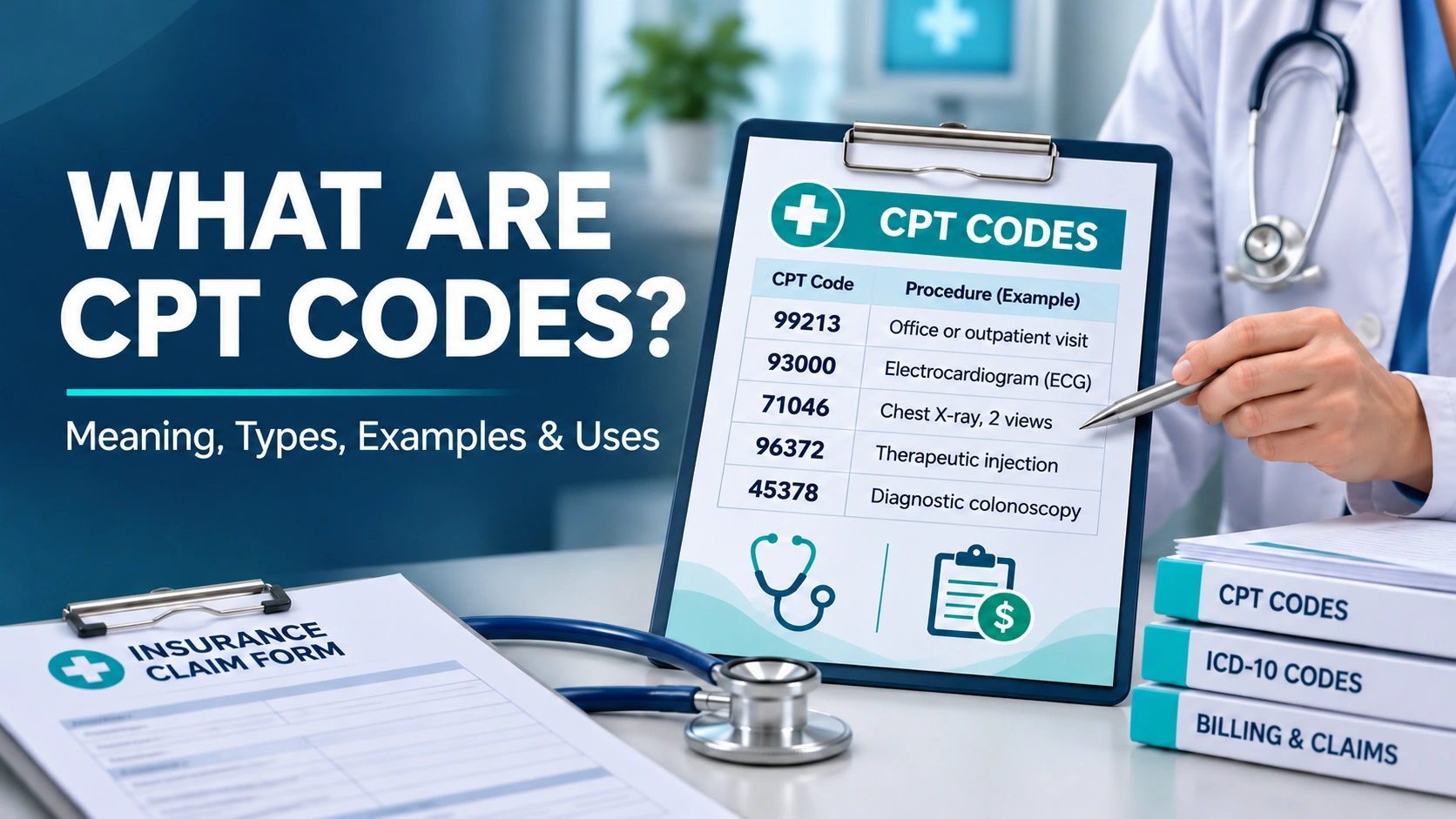
hCPT codes are five-character codes that describe the medical, surgical and diagnostic services a physician or other qualified health care professional provides. CPT stands for Current Procedural Terminology. The American Medical Association (AMA) owns and maintains the code set, and HIPAA names it as the national standard for reporting professional services.
Each code on a claim has one job. The CPT code tells the payer what you did. The diagnosis code tells it why. Your contract and the payer’s fee schedule decide what gets paid.
That split matters more than it sounds. A correct CPT code is required for a clean claim, but it doesn’t guarantee payment.
This guide covers the types of CPT codes, common examples, how CPT differs from ICD-10-CM and HCPCS, what changes on January 1, 2027, and why CPT-coded claims get denied.
Quick answer: what are CPT codes?
- What they are: five-character codes for the services a clinician provides, owned and maintained by the AMA and named under HIPAA as the national standard for professional services.
- Types: Category I (five digits, your main billing codes), Category II (four digits plus F, quality tracking), Category III (four digits plus T, emerging services) and PLA (four digits plus U, proprietary lab tests).
- How they differ: CPT says what was done, ICD-10-CM says why, and HCPCS Level II covers supplies, drugs and equipment.
- When they change: a new edition takes effect every January 1. CPT 2027 applies to dates of service from January 1, 2027.
- What they don’t do: a correct code is required for a clean claim, but it doesn’t guarantee payment.
Table of Contents
ToggleWho maintains CPT codes?
The AMA’s CPT Editorial Panel maintains the code set. The panel meets three times a year to review applications for new codes and revisions to existing ones.
Two things follow from that for your practice:
- CPT isn’t free to use. The AMA holds the copyright, so practices use the code set through an AMA license, an authorized codebook, or billing software that carries a license.
- The short descriptor isn’t the whole code. Each code comes with guidelines, section notes and parenthetical instructions that change how you report it. If your team only reads the one-line descriptor in the EHR dropdown, it’s missing part of the rule.
What are the types of CPT codes?
CPT has three categories plus a separate set of laboratory codes. Most practices bill Category I codes almost exclusively.
| Type | Format | What it covers | What it means for your claim |
|---|---|---|---|
| Category I | Five digits (00100 to 99499) | Established services, grouped into sections: evaluation and management, anesthesia, surgery, radiology, pathology and laboratory, and medicine | Your primary billing codes. Payment depends on the fee schedule and your contract. |
| Category II | Four digits plus F | Supplemental tracking codes for performance measurement | Reported alongside a Category I code, never in place of one. |
| Category III | Four digits plus T | Temporary codes for emerging technologies, services and procedures | Coverage varies by payer. Confirm before the service. |
| PLA | Four digits plus U | Proprietary laboratory analyses, meaning tests tied to a specific lab or manufacturer | Used for lab billing. Rarely relevant outside labs. |
Category I codes cover what the AMA calls established medical and laboratory procedures, and a service has to meet a high bar of clinical evidence to get one.
Category II codes help you report that a quality measure was met, such as documenting a specific screening. Some payer quality programs require them and others ignore them.
Category III codes are temporary. According to the AMA, one is good for five years, after which it can be renewed or put forward for Category I. A Category III code tells you a service is being tracked. It doesn’t tell you a payer covers it, so check the policy before the procedure and not after the denial.
PLA codes are the part most explainers skip, yet they made up 27% of the new codes in CPT 2026, the largest share of any group.
What are some examples of common CPT codes?
These are codes a primary care or multi-specialty practice sees every week. The summaries are plain-language paraphrases, not the official AMA descriptors.
| CPT code | Plain-language summary | Section |
|---|---|---|
| 99213 | Office visit, established patient, low-complexity decision making or at least 20 minutes of total time | Evaluation and management |
| 99214 | Office visit, established patient, moderate-complexity decision making or at least 30 minutes | Evaluation and management |
| 99203 | Office visit, new patient, low-complexity decision making or at least 30 minutes | Evaluation and management |
| 93000 | 12-lead electrocardiogram with interpretation and report | Medicine |
| 90471 | Administration of one vaccine | Medicine |
| 36415 | Routine blood draw by venipuncture | Pathology and laboratory |
| 85025 | Complete blood count with automated differential | Pathology and laboratory |
| 71046 | Chest X-ray, two views | Radiology |
| 73221 | MRI of an upper-extremity joint without contrast | Radiology |
Notice how much one digit carries. 99213 and 99214 describe the same kind of visit, and the difference between them is the complexity of the decision making or the time spent. Our guide to CPT code 99213 walks through how to choose between the two.
How are CPT codes different from ICD-10 and HCPCS codes?
A claim uses three code sets, and each answers a different question.
| Code set | Question it answers | Format | Maintained by | Example |
|---|---|---|---|---|
| CPT (HCPCS Level I) | What was done? | Five characters | American Medical Association | 99213, an office visit |
| ICD-10-CM | Why was it done? | Three to seven letters and numbers | CDC’s National Center for Health Statistics | E11.9, type 2 diabetes without complications |
| HCPCS Level II | What supplies, drugs or equipment were used? | One letter plus four digits | Centers for Medicare & Medicaid Services (CMS) | J3301, a triamcinolone injection |
CPT is technically Level I of HCPCS, which is why you’ll see “HCPCS/CPT” on claim forms and fee schedules. Level II picks up what CPT doesn’t describe.
The two levels overlap in one place. CMS sometimes creates a Level II code, often a G code, for a service that CPT also describes. When that happens, Medicare expects the G code and a commercial payer may expect the CPT code. Don’t swap one for the other without checking the payer’s policy.
The diagnosis code does more than sit next to the procedure. It supports medical necessity for each CPT line, and a procedure with no supporting diagnosis is one of the most common reasons a claim is denied.
How often do CPT codes change?
A new edition takes effect every January 1, and some codes change between editions. Bill with the edition in force on the date of service, not the date you submit the claim.
| Edition | Applies to | Total changes | New | Revised | Deleted |
|---|---|---|---|---|---|
| CPT 2026 | Dates of service in 2026 | 418 | 288 | 46 | 84 |
| CPT 2027 | Dates of service from January 1, 2027 | 453 | 299 | 74 | 80 |
The AMA released CPT 2027 on September 9, 2026. Three changes are worth flagging now:
- Maternity care. A new code framework replaces the global maternity care bundle. If you bill obstetrics, this is the biggest change in the edition, and the AMA has published FAQs on the maternity code changes, including care that spans the transition date.
- AI-related services. Ten new codes bring the total to 43.
- Specialty updates. New or revised codes cover unattended sleep studies, diaphragmatic hernia repair, ventricular assist devices, prostate biopsy and biofeedback.
Between editions, the AMA releases Category III codes three times a year. The other code sets run on their own calendars too: ICD-10-CM’s main update takes effect each October 1, and CMS updates HCPCS Level II quarterly.
A deleted code that slips through in January comes back as a rejection in February, and someone on your staff has to rework it. DocsCare’s medical coding services take code selection and review off your team’s plate, with the aim of improving coding accuracy through each code set change. Talk with our team about how your claims are coded today.
How does a CPT code move through a claim?
Coding is one step in the wider medical billing process, and it only works if the steps before and after it hold up.
- Document the service. The clinician’s note has to support every service billed. The code describes what the note says happened.
- Assign the CPT code. Use the code set in force on the date of service.
- Add modifiers and units. Apply them where the codebook or the payer requires them.
- Link the diagnosis. Point each line to the ICD-10-CM codes that support it.
- Submit the claim. Professional claims go out on the CMS-1500 form or its electronic equivalent, the 837P.
- Post the payment and read the remittance. It shows what was allowed, paid, adjusted or denied for each line.
Worked example: one MRI order, six possible codes
A physician orders an MRI of the shoulder. Which code applies depends on two details in the order.
| Body part | Without contrast | With contrast | Without, then with contrast |
|---|---|---|---|
| Upper extremity, other than a joint | 73218 | 73219 | 73220 |
| Upper-extremity joint | 73221 | 73222 | 73223 |
A shoulder is a joint, so a study without contrast is 73221. If the radiologist adds contrast, the code changes, and billing 73221 for that study is an error even though the body part is the same.
Two more details affect the claim. Many payers want a laterality modifier, RT or LT, which are HCPCS Level II modifiers and separate from CPT’s own two-digit modifiers such as 25 and 59. Advanced imaging also often needs prior authorization, and the rules differ by plan.
Medicare’s payment for the code comes from the Physician Fee Schedule and varies by locality. Commercial rates come from your contract. Our guide to CPT code 73221 covers the billing rules for joint MRI in more depth.
Why do CPT-coded claims get denied?
Most CPT-related denials trace back to a handful of causes. The remittance names the cause with a claim adjustment reason code (CARC), so start there.
| What went wrong | CARC you’ll often see | How to fix it |
|---|---|---|
| Code deleted or revised for the date of service | 181 | Rebill with the code from the edition in force on that date |
| Modifier missing or doesn’t fit the code | 4 | Check the codebook and payer manual, then send a corrected claim |
| Diagnosis doesn’t support the procedure | 11 or 50 | Review the payer’s medical-necessity policy and link the diagnosis the note supports |
| Claim is missing information | 16 | Read the remark code for the missing item and resubmit |
| Service bundled into another code billed that day | 97 | Check the bundling edits before deciding whether a modifier applies |
| No prior authorization | 197 | Confirm the plan’s authorization rules before the service next time, and appeal if you had approval |
| Filed after the deadline | 29 | Usually not recoverable, so track filing limits by payer |
One denial on that list has nothing to do with the claim form. If the note doesn’t describe the service billed, change the code only when the documentation supports the change.
What should you do after a denial?
Fix a coding or claim-form error with a corrected claim, following the payer’s corrected-claim process. A claim that was processed and denied on its merits goes to appeal.
Deadlines differ by payer. For Original Medicare:
- Filing: claims are due within one calendar year of the date of service.
- Appeal: you have 120 days from receiving the initial determination to request a redetermination, and Medicare presumes you received the notice five days after its date.
Medicaid and commercial limits come from the state, the plan and your contract, and they’re often much shorter. If denials are piling up faster than your team can work them, denial management services can take over the follow-up and appeals.
Frequently asked questions about CPT codes
Can I look up CPT codes for free?
Partly. The AMA holds the copyright, so the full code set with official descriptors and guidelines requires a license or an authorized codebook. For a single code, CMS’s Physician Fee Schedule Look-Up Tool shows the Medicare payment amount by locality at no cost.
What is a CPT modifier?
A modifier is a two-character suffix that tells the payer something about the service changed without changing the code itself. Modifier 25, for example, flags a separate evaluation and management service on the same day as a procedure. Some modifiers you’ll use with CPT codes, such as RT and LT, belong to HCPCS Level II.
Can one visit have more than one CPT code?
Yes. Each service gets its own line on the claim. Whether the payer pays each line separately depends on bundling rules, which is why a visit plus a same-day procedure often needs a modifier to be paid in full.
Who assigns CPT codes in a practice?
It varies. In some practices the clinician picks the code in the EHR, and in others a coder assigns it from the note. Either way, the code has to match the documentation, and the billing provider is responsible for what goes on the claim.
Does having a CPT code mean insurance covers the service?
No. A code describes a service. Each payer decides coverage for that service, for that patient and in that setting, under its own policies and your contract.
What should your practice do before January 1?
The weeks before a new edition takes effect are when coding problems are cheapest to prevent.
- Load the 2027 code set into your billing system, and keep 2026 available for 2026 dates of service.
- Pull your 20 most-billed codes and check each one for a 2027 revision or deletion.
- If you bill maternity care, work out how you’ll handle patients whose care spans the transition date.
- Reread the guidelines and parenthetical notes for your top codes, not only the descriptors.
- Confirm each major payer’s filing limit and set an internal deadline ahead of it.
- Record the date you receive every denial, because appeal deadlines count from it.
- Name one person to watch AMA, CMS and ICD-10-CM updates through the year.
Code set changes, modifier rules and payer policies are a lot for a small billing team to track alongside everything else. DocsCare’s medical coding services give independent practices a dedicated team for code selection and review, which reduces the administrative workload on your staff. Contact our team to talk through your specialty and your current denial patterns.
This article is general information, not legal, coding or compliance advice. Rules depend on your payer contracts, plan types and state law, so confirm with the official source before acting. CPT is a registered trademark of the American Medical Association.