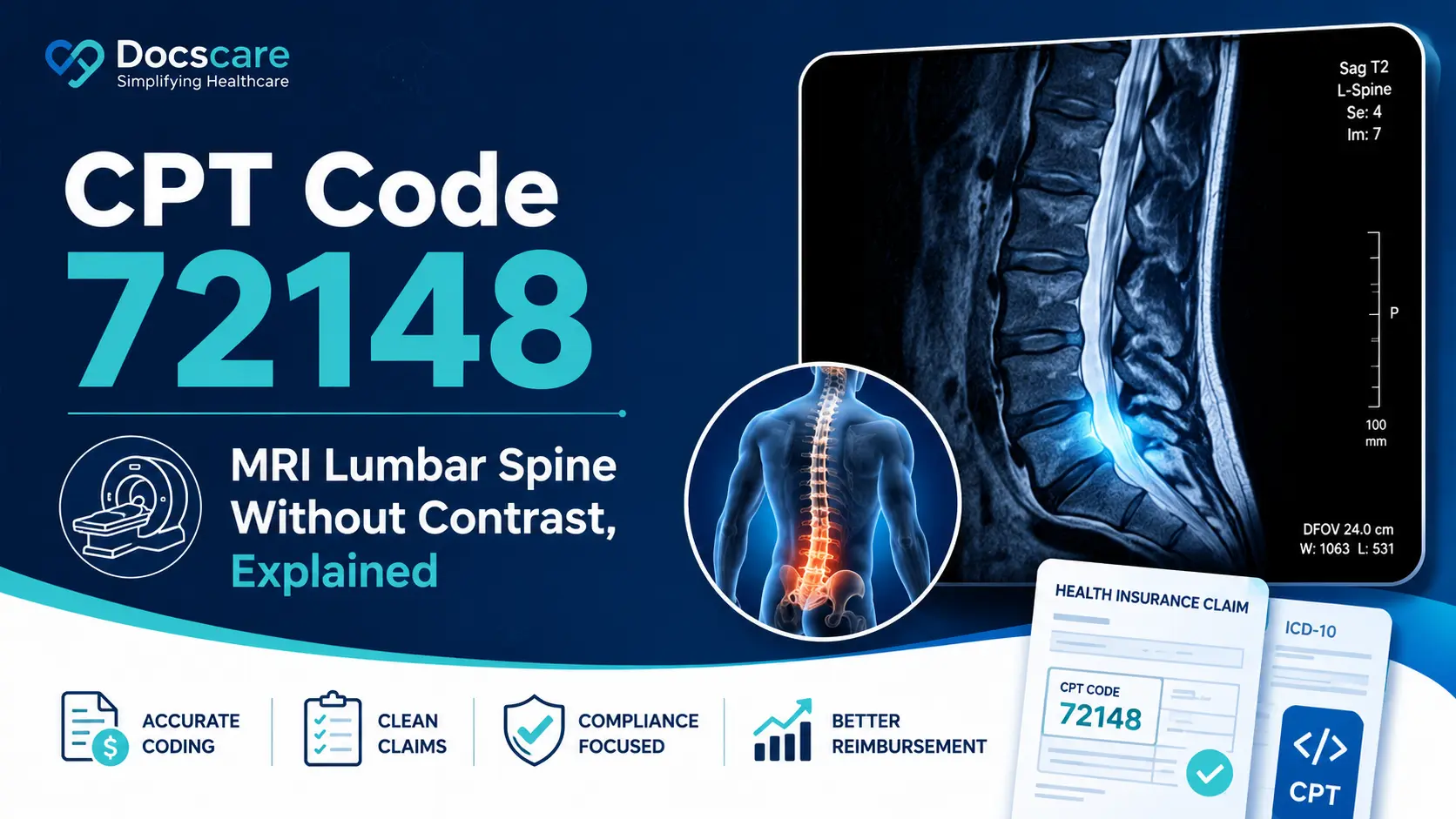
CPT code 72148 is the code you use when a radiologist performs an MRI of the lumbar spine without contrast material. It is one of the highest volume imaging codes billed in the United States, which also makes it one of the most common places for a clean claim to turn into a denial. Here is what the code covers, which modifiers apply, and where claims actually fall apart.
Table of Contents
ToggleWhat Does CPT Code 72148 Cover?
CPT Code 72148 describes a magnetic resonance imaging study of the lumbar spinal canal and its contents, performed without contrast material. Radiologists and ordering physicians use it to evaluate the lower back for conditions like herniated discs, spinal stenosis, sciatica, nerve compression, and degenerative disc disease.
The scan captures the vertebrae, discs, facet joints, and surrounding soft tissue using standard MRI sequences. No gadolinium contrast gets injected. That single detail, contrast versus no contrast, is what separates this code from its two closest relatives.
72148 vs 72149 vs 72158: Picking the Right Code
Billers mix these up constantly, and the mix up is a denial reason on its own. Here is the distinction.
| Code | Contrast Used | Typical Clinical Indication |
|---|---|---|
| 72148 | None | Standard, first-line lumbar MRI for back pain, disc, or nerve evaluation |
| 72149 | Contrast only | Suspected infection, tumor, or postoperative scar tissue |
| 72158 | Without, then with, same session | Non-contrast sequences run first, with contrast added during the same visit |
Code selection depends entirely on what the radiologist actually performed and documented, never on payer preference or reimbursement.
The NCCI Edit You Cannot Bill Around
CMS bundles 72148 and 72149 under the National Correct Coding Initiative. You cannot bill both codes for the same date of service. If your practice ran a series without contrast and then added contrast in the same session, the correct code is 72158, not two separate line items.
We see this exact error surface in claims we audit for new clients almost every quarter. It is a five second fix once you know the rule, and it is an automatic denial if you do not.
Every denied claim from a coding error is revenue your practice already earned and now has to fight for twice. Our Medical Coding Services team applies AAPC certified review to every claim before it goes out the door, catching NCCI conflicts like the 72148 and 72149 bundle before they become a denial.
Modifiers That Apply to CPT 72148
Four modifiers show up most often on this code:
- Modifier 26, Professional Component: the interpreting radiologist bills separately from the facility.
- Modifier TC, Technical Component: the facility bills for the equipment and staff time, separate from the interpretation.
- Modifier 59, Distinct Procedural Service: used when CPT Code 72148 is billed alongside another spine imaging code, such as a same day cervical spine MRI, to show the two studies covered different anatomy.
- Modifier 52, Reduced Services: applies when only a partial or limited protocol was completed.
Documentation has to support whichever modifier you attach. A modifier without a note explaining the distinct service or reduced scope invites a payer request for records, and that slows your reimbursement even when the claim eventually pays.
Why CPT 72148 Claims Get Denied
Four reasons account for most of what we see:
Medical necessity not established. The ICD 10 code on the claim does not satisfy the payer’s local coverage determination, or the ordering physician’s note does not document a clear clinical reason for the scan.
Missing prior authorization. Most commercial payers, and a growing number of Medicare Advantage plans, require prior authorization for lumbar MRI even though traditional Medicare often does not.
Billing 72148 and 72149 together. Covered above, and still one of the most preventable denials in spine imaging.
Conservative treatment not documented. Several payers expect four weeks of conservative treatment on file before a non emergent lumbar MRI, unless a red flag symptom is present.
Catch these before submission and your first pass acceptance rate on spine imaging climbs fast. Catch them after submission and you are looking at a rework cycle of a month or more for a claim that should have paid the first time.
What Documentation Needs to Support CPT 72148
- A signed order from the referring provider stating the clinical reason for the scan
- Confirmation in the radiology report that no contrast was administered
- A clear anatomical scope limited to the lumbar spine, since a broader total spine study needs a different code
- Symptom or diagnosis documentation that ties directly to the ICD 10 code on the claim
Reimbursement: What to Expect
Reimbursement for 72148 varies by setting, payer, and geography, so treat any figure as a planning estimate rather than a guarantee. Medicare’s Physician Fee Schedule sets a national baseline that differs between facility and non facility settings, and commercial payer contracts vary widely from there. Always verify current rates against the active fee schedule rather than a fixed number, since CMS updates the conversion factor every year.
Chasing down the right modifier, catching an NCCI bundling conflict, and confirming medical necessity before submission is exactly the work our coding team does on every claim. If spine imaging denials are eating into your revenue cycle, request a free audit of your last 90 days of imaging claims.
The Bottom Line
CPT Code 72148 is a high volume code with low tolerance for coding error. Know the difference between 72148, 72149, and 72158. Apply modifiers only when documentation backs them up. Confirm medical necessity and prior authorization before the claim goes out. Get those four things right and this becomes one of the more straightforward codes in your spine imaging workflow.
Frequently Asked Questions
What is CPT code 72148 used for?
CPT 72148 bills an MRI of the lumbar spine performed without contrast material, most commonly to evaluate lower back pain, herniated discs, spinal stenosis, or nerve compression.
What is the difference between CPT Code 72148 and 72149?
72148 is for a lumbar MRI without contrast. 72149 is for a lumbar MRI with contrast only. They cannot be billed together for the same encounter.
When should I use CPT Code 72158 instead of 72148?
Use 72158 when the radiologist performs a lumbar MRI without contrast and then adds contrast during the same session. Billing 72148 and 72149 separately for that scenario triggers an automatic NCCI denial.
Does CPT Code 72148 require prior authorization?
Often yes, particularly for commercial payers and Medicare Advantage plans. Traditional Medicare requirements vary by contractor, so verify directly with the specific payer and plan before scheduling.
What modifiers commonly apply to CPT Code 72148?
Modifier 26 for the professional component, modifier TC for the technical component, modifier 59 for a distinct procedural service performed alongside another spine imaging code, and modifier 52 for a reduced or limited protocol.
Why do CPT Code 72148 claims get denied?
The most common reasons are failed medical necessity under the payer’s coverage policy, missing prior authorization, incorrectly billing 72148 alongside 72149, and missing documentation of conservative treatment for non emergent cases.