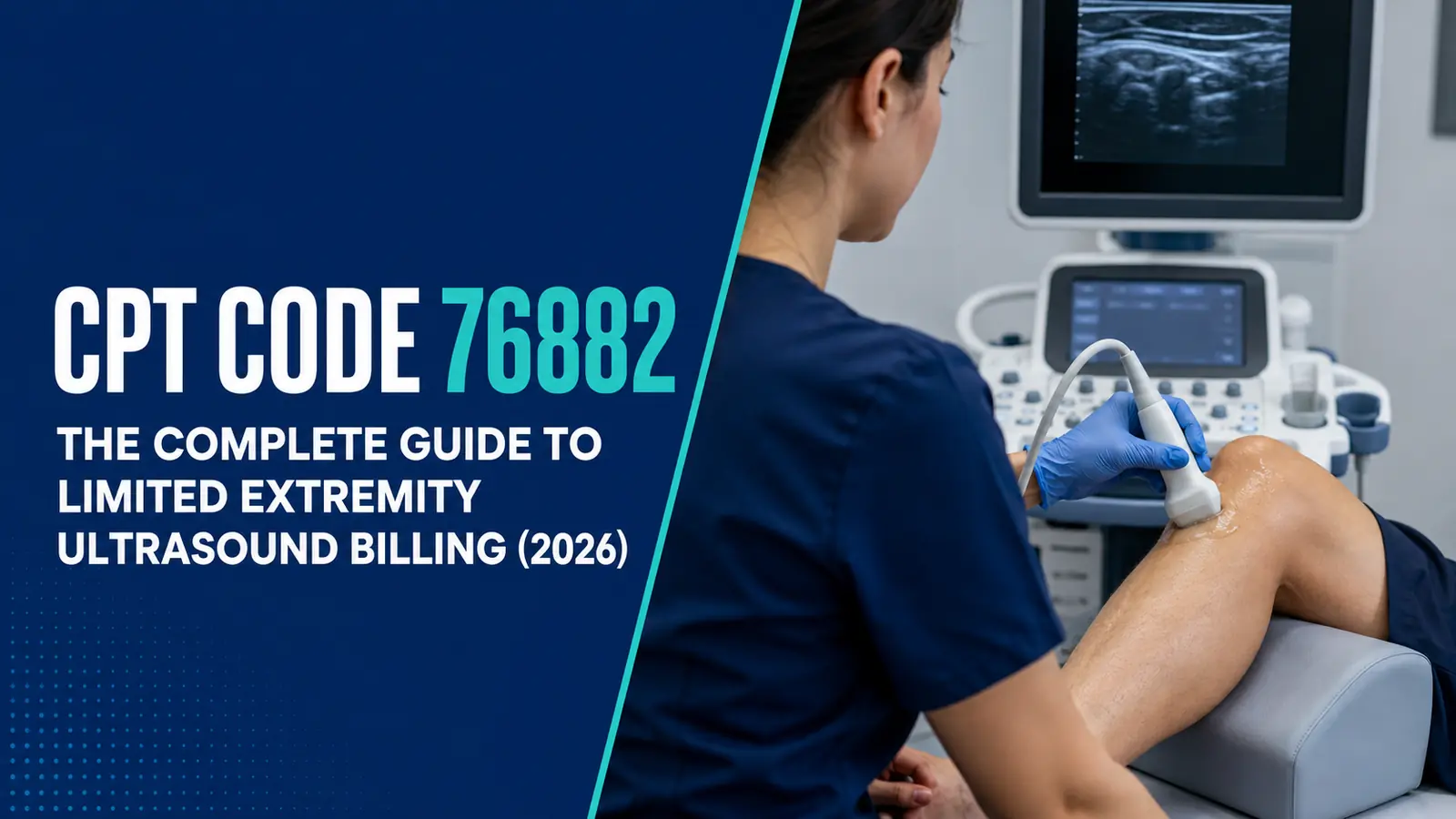
CPT code 76882 reports a limited, non-vascular ultrasound of an extremity a focused look at one structure such as a tendon, muscle, nerve, joint space, or soft-tissue mass, rather than a full joint survey. If your practice performs musculoskeletal ultrasound and you have ever watched this code get bundled, denied, or paid at half the units you expected, the problem is almost never the scan itself. It is the documentation and the code pairing around it.
This guide walks through what 76882 actually covers, how it differs from its two neighbors (76881 and 76883), which modifiers keep it paid, and the specific mistakes that trigger denials in rheumatology, podiatry, orthopedics, and sports medicine offices.
Table of Contents
ToggleWhat is CPT code 76882?
In plain terms, the provider uses ultrasound to study one or more specific non-vascular structures in an arm or leg. The image displays in real time on a monitor, and the practice permanently stores a copy in the medical record. The code applies when the exam is anatomically focused a single tendon, a suspected soft-tissue mass, a fluid collection, or a nerve instead of a full joint evaluation.
Two everyday examples make the boundary clear. An ultrasound of the axilla performed on its own is reported with 76882. So is an ultrasound that checks a soft-tissue mass in the thigh to determine whether it is cystic or solid. Neither of those is a complete joint study, so neither qualifies for 76881.
Which body areas fall under 76882?
The code is built for extremity work: shoulders, elbows, wrists, hands and fingers, hips, knees, ankles, feet and toes, plus the soft tissue of the groin, axilla, and calf. If the target sits in an arm or a leg and it is not a blood vessel, 76882 is usually the correct family, the only question left is whether the exam was complete or limited.
What is the difference between 76881, 76882, and 76883?
These three codes trip up more billers than any other part of musculoskeletal ultrasound. Here is the clean split.
| Code | Exam Type | What It Requires |
|---|---|---|
| 76881 | Complete joint | Real-time evaluation of all joint elements: joint space, peri-articular soft-tissue structures (muscles, tendons, and other soft tissue), and any identifiable abnormality. Only a joint contains every element needed for a “complete” study. |
| 76882 | Limited / anatomic specific | A focused look at a specific structure—one tendon, one muscle, a nerve, a fluid collection, or a soft-tissue mass—that does not assess every element required by 76881. |
| 76883 | Complete nerve(s) | A comprehensive evaluation of a nerve or nerves along their course. Reserved for detailed nerve studies, not a focal look at a single point. |
The decision rule is short: if you cannot document every element of a complete joint exam, you bill the limited code, 76882. Evaluating a non-joint region the groin, the axilla, the calf is never a complete exam by definition, so those studies land on 76882 as well.
Two guardrails worth memorizing. You should not report 76882 together with 76883 for the same nerve work, and you should not report a limited exam (76882) in the same session as a complete exam (76881) of the same anatomic region. Pick the code that matches what was actually performed and documented.
How many units of 76882 can you bill?
The Medically Unlikely Edit (MUE) for 76882 is 2 units per date of service. That ceiling causes real confusion, so it is worth stating precisely: the limit is two units total for the day, not two units per extremity.
A common scenario shows how this plays out. If you scan the left arm and then scan the right arm as a contralateral comparison, you bill two units and stop there. Coders also flag an important point on comparison studies you bill for the diagnostic study, not for a comparison scan performed purely to check the “normal” side.
When medical necessity supports imaging more than one structure or joint in the same extremity, and the orders specifically request it, some payers allow you to report the code per structure using separate lines with modifier 59. Before you bill multiple units, review current NCCI (CCI) edits, because both the MUE value and the payer’s interpretation of it can shift between annual updates.
Which modifiers does 76882 need?
76882 is a global code, meaning it bundles both the professional and technical components. Whether you split it depends on who owns the equipment and who reads the study.
- Modifier 26 (Professional Component): append it when your provider only interprets the images and writes the report but does not own the equipment. A radiologist reading an ultrasound performed at a facility uses 26.
- Modifier TC (Technical Component): append it when your practice supplies the equipment, room, and technologist but a separate physician handles the interpretation.
- Modifier 59 (Distinct Procedural Service): append it when the ultrasound is a separate, distinct service performed alongside another procedure, such as a joint injection.
- Modifiers RT, LT, and digit modifiers: your documentation must support laterality. If you scan the right ankle, the note and the claim must both say right.
One hard rule protects you from an easy denial: the same practitioner cannot bill modifier 26 and modifier TC on the same code, for the same patient, on the same date. If your office both owns the machine and interprets the study, you bill 76882 globally with no component modifier at all.
Because CMS revalues services every year and the conversion factor changes, always confirm the current professional/technical split in the Medicare Physician Fee Schedule (MPFS) before you submit component-billed claims. A code that supported a certain split last year can be restructured the next.
How much does CPT 76882 reimburse?
There is no single national number for 76882. Reimbursement depends on the payer, your geographic locality, the place of service, and whether you bill globally or split the professional and technical components. Medicare pays through the MPFS, and each Medicare Administrative Contractor (MAC) can layer on its own local coverage rules.
The practical takeaway for your billing team: pull the current-year rate straight from the CMS Physician Fee Schedule Look-Up Tool for your locality, then compare it against your commercial contracts. Do not rely on a figure from a prior year or a generic online estimate. The RVU distribution between the professional and technical components can move between updates, which changes what a modifier-26 claim collects even when your coding stays identical.
Why do 76882 claims get denied?
Most 76882 denials trace back to a handful of repeatable errors. Fix these and your first-pass rate climbs.
Bundling with injection codes
The most frequent battle happens when 76882 is billed alongside ultrasound-guided joint injection codes 20604, 20606, and 20611. Many practices report that Medicare pays the diagnostic ultrasound separately, while some commercial payers — the carrier’s own policy language varies — treat 76882 as inclusive of the injection and deny it even with a modifier 59 and supporting documentation. The lesson is to verify each payer’s bundling policy before the visit rather than after the denial, and to make sure a genuinely separate diagnostic ultrasound is documented as its own service with its own findings.
Missing or weak documentation
76882 requires two things every single time: permanently recorded images and a written interpretation that describes each element evaluated. A claim without stored images and a signed report cannot survive an audit. Build a template that forces the interpreting provider to name the structure examined, describe the findings, and note laterality.
Wrong code for the anatomy
Choosing 76881 when the exam was actually limited — or reaching for an abdominal ultrasound code when the target is an extremity soft-tissue mass — produces both denials and compliance exposure. Match the code to what the documentation supports, not to the higher reimbursement.
Mismatched diagnosis codes
The number-one denial reason across all of medical coding is a CPT-to-ICD-10 mismatch. 76882 needs an ICD-10 diagnosis that establishes medical necessity — the “why” behind the scan, such as extremity pain, a soft-tissue mass, tendinopathy, or a suspected effusion. Check your MAC’s Local Coverage Determination for the list of supportive diagnoses before you submit.
Stop CPT 76882 Denials at the Source
Denials involving 76882 usually come from documentation gaps, bundling edits, or unsupported diagnoses. DocsCare identifies the exact cause, corrects the claim, and helps prevent the same issue from affecting future reimbursement.
Root-cause analysis • Claim rework • Denial prevention
How should a practice document 76882 correctly?
A clean 76882 record answers four questions without the coder having to guess:
- What was examined? Name the specific structure — “right Achilles tendon,” “soft-tissue mass, left thigh” — not just “extremity ultrasound.”
- Which side? State laterality clearly so RT, LT, or a digit modifier is defensible.
- What did you find? Describe the findings for each element evaluated, including any measurements such as tendon thinning or tear separation.
- Where are the images? Confirm permanently recorded images are stored in the chart.
When you compare to the contralateral side, note why the comparison was medically necessary. And if you also performed spectral Doppler or color-flow imaging, remember that Doppler is reported with its own vascular codes — your report needs to explain why the Doppler was done and what it showed.
Frequently asked questions about CPT 76882
Is 76882 a bilateral code?
No. 76882 is reported per extremity as a limited, anatomic-specific study. If you scan both sides, you use two units (subject to the MUE of 2), not a bilateral modifier. Comparison scans of the unaffected side are generally not separately billable.
Can 76882 and 76881 be billed together?
Not for the same anatomic region on the same date of service. A limited exam and a complete exam of the same region in the same session are mutually exclusive — report the one that matches what was performed.
Does 76882 require permanently recorded images?
Yes. Both the stored images and a written interpretive report describing each element evaluated are mandatory. Claims submitted without them will not withstand review.
What is the MUE for 76882?
The Medically Unlikely Edit is 2 units per date of service — a per-day total, not a per-extremity allowance.
Can a physician assistant perform and interpret 76882?
Coverage for who may perform and interpret extremity ultrasound depends on your MAC’s Local Coverage Determination and state scope-of-practice rules. Confirm the LCD language for your region before billing, and make sure the interpreting provider signs the report.
What diagnosis codes support 76882?
ICD-10 codes that document the clinical reason for the scan — extremity pain, a soft-tissue mass, tendon pathology, joint effusion, or nerve symptoms. The exact supportive list lives in your MAC’s LCD, so match the diagnosis to the medical necessity your note establishes.
Get Extremity Ultrasound Claims Paid the First Time
Every denied 76882 claim represents revenue your practice has already earned. DocsCare handles coding, documentation review, and payer-specific claim edits so your team can spend less time on appeals and more time with patients.
Cleaner claims • Fewer appeals • Faster reimbursement
The bottom line on CPT 76882
76882 is the workhorse code for focused, non-vascular extremity ultrasound. Get three things right and it pays reliably: choose it only when the exam is truly limited rather than a complete joint study, document the structure, laterality, findings, and stored images every time, and check each payer’s bundling and diagnosis rules before you submit alongside injection codes. When those pieces line up, a code that frustrates many practices becomes a dependable, correctly reimbursed part of your musculoskeletal workflow.