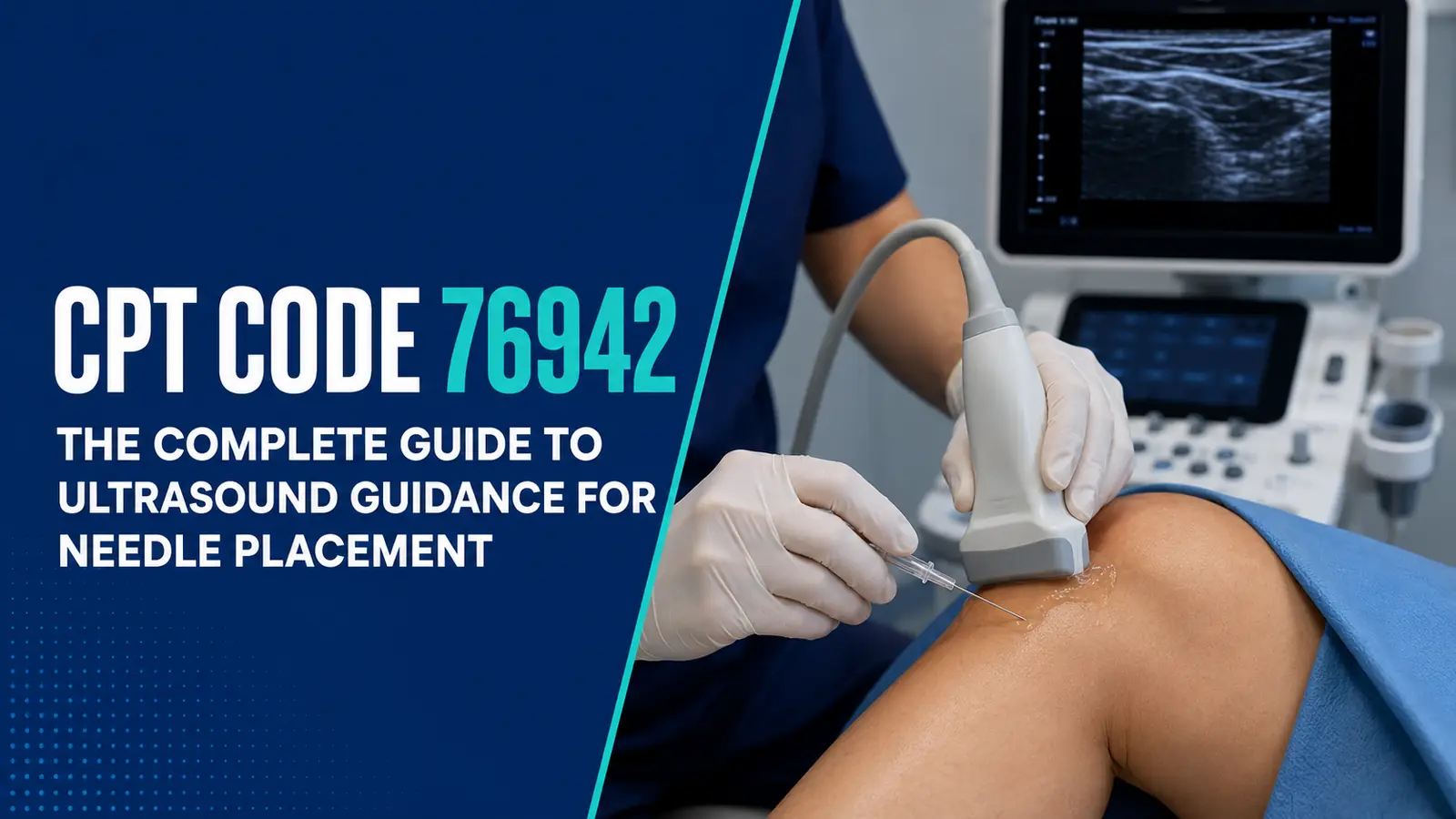
CPT code 76942 reports ultrasonic guidance for needle placement — the real-time ultrasound that steers a needle during a biopsy, aspiration, injection, or localization-device placement, plus the imaging supervision and interpretation that goes with it. It is an add-on service. It never stands alone on a claim, it pays once per patient encounter no matter how many needle passes you perform, and it gets denied fast when the guidance is bundled into the primary procedure or the images were never saved.
If your practice performs ultrasound-guided procedures, 76942 is one of the most misbilled codes on the fee schedule. Coders confuse it with the vascular-access code, drop it onto claims where the guidance is already baked into the procedure descriptor, or bill it per lesion instead of per session. Each of those mistakes is a preventable denial. This guide walks through exactly what the code covers, when you can bill it, the modifiers that keep it clean, and the 2026 numbers behind it.
Table of Contents
Toggle| Code | Type | Units per Encounter | Stands Alone? |
|---|---|---|---|
| 76942 | Add-on (imaging S&I) | 1 — regardless of passes | No — needs a primary code |
What is CPT code 76942?
The American Medical Association defines 76942 as “Ultrasonic guidance for needle placement (e.g., biopsy, aspiration, injection, localization device), imaging supervision and interpretation.” In plain terms: the physician uses live ultrasound to see the target, plan a safe path, watch the needle advance, and confirm the tip landed where it should.
Two things separate 76942 from a standard diagnostic ultrasound. First, it is a guidance service tied to a needle-based procedure, not a stand-alone exam of an organ. Second, it captures the professional interpretation — the short note describing what the physician saw and how the imaging steered the needle. Miss that interpretation, and you have documented the procedure but not the billable guidance.
You will see 76942 across radiology, musculoskeletal medicine, oncology, endocrinology, and surgery. A radiologist guiding a thyroid biopsy, a sports-medicine physician placing a shoulder injection, an interventional team draining an abscess — all of them may reach for 76942 when ultrasound genuinely directs the needle and the guidance is not already included in the base procedure.
When can you actually bill 76942?
Three conditions have to be true at the same time. Treat them as a checklist before the code ever reaches a claim.
- Real-time guidance actually happened. The physician used live ultrasound to advance and position the needle — not to mark a spot beforehand and then insert blind.
- A permanent image was stored. At least one saved image showing the needle in relation to the target. No image, no billable guidance.
- An interpretation was documented. A brief written note confirming the target was visualized, the needle tip was seen, and images were retained.
A fourth rule sits behind all of them: 76942 is an add-on. A qualifying primary procedure code must appear on the same claim, or the guidance has nothing to attach to and the payer rejects it outright.
Stop Ultrasound Guidance Denials Before Submission
DocsCare pairs AAPC-certified coders with pre-submission NCCI edit checks, helping ensure CPT 76942 is attached to the correct primary procedure, modifier, and supporting documentation.
76942 modifiers: which one, and when
Modifiers on 76942 usually come down to one question: who owns the equipment and who reads the images? Split billing settings need the professional/technical split; a global service needs neither.
| Modifier | Use It When | What It Means |
|---|---|---|
| 26 | You provide only the interpretation and report | Professional component only (equipment owned by the facility) |
| TC | You provide the equipment and image capture | Technical component only |
| None (global) | You own the equipment and read the images | Full global service — do not add 26 or TC |
| 59 / XU | Guidance is a distinct service at a separate site | Unbundles it from a procedure it would normally bundle with — documentation required |
| 50 | Guidance on paired bilateral sites (e.g., both knees) | Bilateral procedure — each side medically necessary |
A caution on modifier 59. It tells the payer “this really was separate.” Use it only when the documentation proves a distinct site or session. Reflexively appending 59 to force a bundled code through is exactly the pattern audit teams look for.
The bundling trap: where 76942 denials come from
Most 76942 denials are not random. They trace back to National Correct Coding Initiative (NCCI) edits that bundle the guidance into another code. If the ultrasound guidance is already written into the primary procedure’s descriptor, billing 76942 on top is double-dipping — and the payer catches it.
Codes that already include ultrasound guidance — do not add 76942:
- 20604, 20606, 20611 — joint/bursa injections and aspirations that include ultrasound guidance in the descriptor.
- 10005, 10006 — fine needle aspiration performed with ultrasound guidance.
- 76872, 76873 — transrectal ultrasound (TRUS); guidance is intrinsic.
- 32555, 49083 — thoracentesis and paracentesis with imaging guidance built in.
- 77002 — fluoroscopic guidance; bundles with 76942 when both guide the same needle in the same session and region.
The single most common trigger, per payer guidance, is pairing 76942 with fluoroscopic guidance (77002) on the same anatomic region in the same session. Nobody gets paid twice for guiding one needle two ways. Contractors deny the bundled line unless the documentation proves two genuinely separate sites.
76942 vs 76937 vs 76998: choosing the right guidance code
The guidance “family” looks interchangeable and is not. The defining split is what you are guiding the needle toward and where. Pick the wrong sibling and NCCI reads it as a coding error, not a rounding mistake.
| Code | Guides | Setting / Target |
|---|---|---|
| 76942 | Non-vascular needle placement | Biopsy, aspiration, injection, or localization-device placement (percutaneous) |
| 76937 | Vascular access | Central lines and vascular punctures — requires vessel patency and real-time entry documentation |
| 76998 | Intraoperative ultrasound | Guidance during an open surgical procedure |
| 77002 | Fluoroscopic (not ultrasound) | X-ray-based needle guidance — bundles with 76942 |
The quick decision rule: vascular target → 76937. Non-vascular percutaneous target → 76942. Open OR procedure → 76998. Fluoroscopy instead of ultrasound → 77002. And note the payer instruction that 76942 and 76937 should not be reported together — they describe mutually exclusive scenarios.
Medical necessity: the quiet denial reason
Even a perfectly coded 76942 can be denied if the guidance was not reasonable and necessary. The classic example: using ultrasound to inject an easily palpable joint. Payers reason that if the physician can feel the landmark, live imaging did not add clinical value — so the guidance is not separately payable.
Necessity should show in the note. Deep or non-palpable targets, prior failed blind attempts, distorted anatomy, or proximity to vessels and nerves all justify guidance. State the reason briefly and specifically. “Ultrasound used to avoid the adjacent neurovascular bundle” defends a claim far better than a generic “under ultrasound guidance.”
How much does 76942 reimburse in 2026?
Payment depends on which component you bill and where the service happens. Under the Medicare Physician Fee Schedule, CMS set the work RVU for 76942 at 0.80 for 2026, with the office (non-facility) global rate landing near the mid-$80s once equipment and sonography overhead are folded in. Facility rates run lower because the technical component is paid separately to the facility.
Representative figures below illustrate the professional/technical split; your allowable varies by locality, MAC, and the annual conversion factor.
| Billing | Component | Illustrative Allowable |
|---|---|---|
| 76942 (global) | Supervision + interpretation + technical | ~$54 |
| 76942-26 | Professional component only | ~$29 |
| 76942-TC | Technical component only | ~$26 |
Two practical notes. First, commercial payers often reimburse roughly 110–150% of the Medicare rate, though contracts vary widely. Second, the annual conversion factor moves year to year, so an unchanged code can still produce a different allowable. Always verify current figures against your MAC and the CMS Physician Fee Schedule before quoting a number to a client.
Documentation that survives an audit
Clean 76942 documentation is short but non-negotiable. Build these five elements into the procedure note template so nothing gets dropped in a busy clinic.
- Modality and purpose. State that ultrasound guidance was used, the anatomic site, and the reason (e.g., “ultrasound-guided aspiration, right shoulder”).
- Real-time confirmation. Note the guidance was performed live during the procedure, not before or after.
- Medical necessity. A specific reason imaging was required — depth, non-palpable target, vessel avoidance.
- Permanent image. At least one saved image of the needle relative to the target, retained per your archive policy.
- Interpretation. A brief read confirming the target was visualized and the needle tip positioned correctly.
One Misrouted Code Is Small. A Pattern Is Expensive.
DocsCare reviews ultrasound guidance claims before submission, identifies recurring bundling conflicts, and helps recover revenue that documentation or coding errors would otherwise leave behind.
The bottom line on 76942
CPT 76942 is not glamorous, but for practices doing ultrasound-guided biopsies, aspirations, injections, and localizations, it is real, defensible revenue. Keep four things true and it stays clean: the guidance was necessary, the image was saved, the units are honest (one per encounter), and the modifiers tell the truth. Get those right, and a code most billers dread becomes one of the steadiest lines on your remittance.
Frequently asked questions
Is CPT 76942 an add-on code?
Functionally, yes. It reports imaging supervision and interpretation and cannot stand alone — a qualifying primary procedure code must appear on the same claim for the guidance to be billable.
Can I bill 76942 more than once per session?
No. CMS treats it as one unit per patient encounter, regardless of the number of lesions, needle passes, or injections. The only common exception is bilateral paired sites, reported with modifier 50.
What is the difference between 76942 and 76937?
The target type is the whole ballgame. 76942 guides non-vascular needle placements (biopsies, aspirations, injections). 76937 guides vascular access. They describe mutually exclusive scenarios and should not be reported together.
Why does 76942 get denied so often?
The top reasons are bundling (the guidance is already included in the primary code, such as 20604–20611 or fluoroscopy 77002), missing documentation (no saved image or interpretation), and lack of medical necessity (guiding an easily palpable target).
Do I need modifier 26 on 76942?
Only if you provide the interpretation but not the equipment. Add 26 for the professional component in a facility setting. Use TC for the technical component, and no split modifier when you bill the global service in your own office.
Does 76942 require a saved ultrasound image?
Yes. A permanent stored image showing the needle in relation to the target is a hard requirement. Without it, the guidance is not billable even if it was performed.