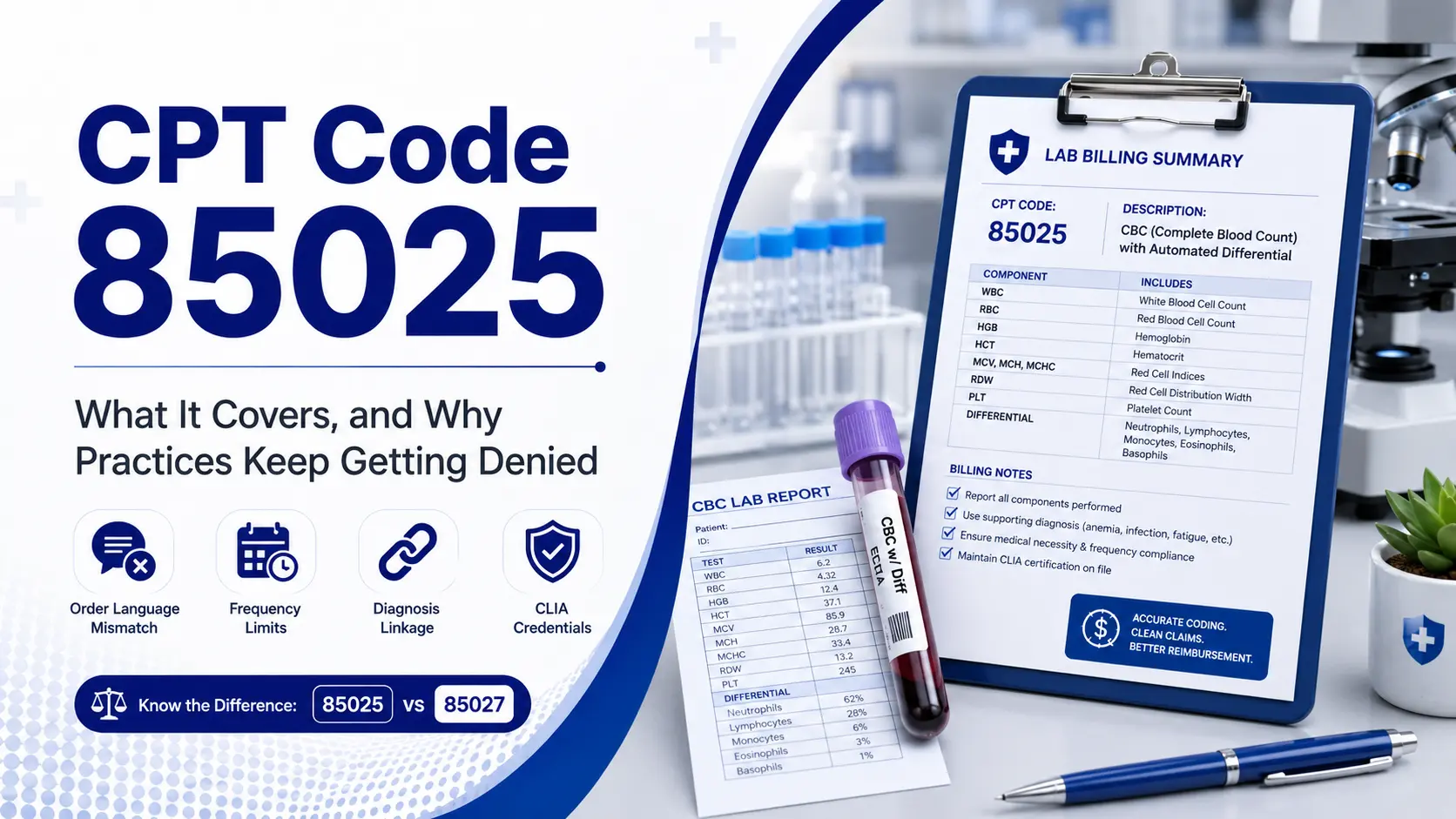
CPT 85025 covers a complete blood count with an automated differential white blood cell count. The official descriptor reads “Blood count; complete (CBC), automated (Hgb, Hct, RBC, WBC and platelet count) and automated differential WBC count.” That single word, differential, causes most of the denials we see on this code.
Here is the problem in one sentence. Your analyzer runs a differential automatically on every sample, so your lab reports one, so your biller codes 85025. But if the physician order said only “CBC,” you just billed a service nobody ordered.
Table of Contents
ToggleWhat is the difference between CPT Code 85025 and 85027?
85025 covers a CBC performed with an automated differential. 85027 covers the same test without the differential. That is the whole distinction, and it decides which code you can defend in an audit.
| CPT 85025 Compared With CPT 85027 | ||
|---|---|---|
| Comparison Element | CPT 85025 | CPT 85027 |
| Differential Included | Yes, automated WBC differential | No |
| Order Must Specify | CBC with differential | CBC alone is sufficient |
| Adding a Manual Differential | Not applicable; the differential is already included | Pair with 85004, 85007, or 85009 when supported |
| Audit Exposure | High when physician order language is vague | Lower when the order clearly supports CBC without differential |
The rule is simple. Order says CBC with differential, bill 85025. Order says CBC, bill 85027. Your analyzer default behavior does not change what the physician requested.
See how we audit lab order language
How does Medicare pay for 85025?
Medicare pays 85025 under the Clinical Laboratory Fee Schedule, not the Physician Fee Schedule. A standard Physician Fee Schedule lookup shows zero dollars and no RVUs for this code, which catches people checking the wrong tool. The payment lives in a different schedule entirely.
We watch practices conclude the test is not reimbursable because they queried the PFS. It is reimbursable. They looked in the wrong place.
CLFS rates come from the weighted median of private payer rates and refresh on a roughly three year cycle. Under the current window, the data collection period ran January 1 to June 30, 2025, and the reporting period runs May 1 to July 31, 2026. If your lab bills 85025 or 85027 at meaningful volume, you carry a reporting obligation inside that window. Missing it brings civil monetary penalties.
Which bundling and NCCI rules apply to 85025?
You cannot bill 85025 alongside its own components. Individual component codes, hematocrit alone, hemoglobin alone, automated RBC, WBC, or platelet counts alone, are not separately reimbursed when billed with the comprehensive code. NCCI edits catch this automatically.
The panel rule trips up more practices. CPT 80050, the general health panel, requires all three of a Comprehensive Metabolic Panel, a CBC, and a Thyroid Stimulating Hormone test. The CBC component can come through 85025 alone, or 85027 paired with 85004, 85007, or 85009. When all three components are ordered and performed, the panel code applies instead of the separate codes. Bill 80050 with only two of the three and the claim denies.
United Healthcare laboratory services policy lists the same configurations for panels 80050, 80055, and 80081, accepting 85025 or the 85027 combinations as the CBC component. Commercial payers mirror the CMS logic more often than not, so build your edit checks once and apply them broadly.
Which modifiers apply to 85025?
Two modifiers matter in practice: QW for waived testing sites, and 91 for a legitimate same day repeat.
- Modifier QW. Applies when the testing site holds a CLIA Certificate of Waiver. Point of care analyzers in physician offices usually need it.
- Modifier 91. Applies to a legitimate repeat test on the same day, when a clinician needs a second result to manage the patient. It does not apply when the lab reruns a specimen it botched.
NCCI rules exist specifically to prevent unbundling of the differential, and modifier use on 85025 draws scrutiny because the code runs at high volume across preoperative, emergency, oncology, and inpatient protocols. Document the clinical reason for every 91 you append.
Why do 85025 claims get denied?
Four causes account for nearly every 85025 denial: order language mismatch, frequency limits, weak diagnosis linkage, and missing CLIA credentials.
- Order language mismatch The order says CBC, the claim says 85025. Standing order protocols cause this constantly. A protocol reading “CBC every infusion day” may not specify differential. When the analyzer runs one by default and billing codes 85025 without verifying the original order, the practice creates compliance exposure.
- Frequency limits Medicare applies NCD 190.15 to blood counts, and repeat testing logic has to align with coverage rules. Weekly CBCs on a stable patient without a supporting diagnosis get cut.
- Weak diagnosis linkage Screening a patient with no signs or symptoms rarely supports payment. Anemia, infection, marrow suppression, and chemotherapy monitoring do.
- Missing CLIA credentials The ordering provider NPI has to transmit correctly and the lab needs valid CLIA certification, a hard requirement for point of care labs.
Free resource
Each one is cheap to fix and expensive to ignore. 85025 pays a few dollars. It is a low unit cost code running at enormous volume, so systematic gaps compound into meaningful annual revenue leakage.
How should oncology practices handle 85025?
Oncology bills 85025 more than almost any other specialty, which makes order language discipline the single highest return fix available to a hematology or oncology billing team.
A patient receiving chemotherapy typically needs a CBC with automated differential before each cycle to monitor bone marrow function and check for myelo suppression, which tells the oncologist whether the next dose is safe.
That volume is exactly why order language discipline matters here. Rewrite your standing protocols to read “CBC with automated differential” explicitly. One template change, thousands of defensible claims.
What we would check first
Pull your last 90 days of 85025 claims. Match each one against the originating order text. If more than a handful of orders say only “CBC,” you have a systematic problem, not a coding mistake, and it needs a template fix rather than biller retraining.
Frequently asked questions
What is CPT code 85025?
CPT 85025 is a complete blood count with automated differential white blood cell count. It reports hemoglobin, hematocrit, red blood cells, white blood cells, platelets, and an automated breakdown of white cell types.
Is CPT 85025 the same as a CBC with differential?
Yes. 85025 is the CPT code billed for a CBC with automated differential. A CBC without the differential uses 85027.
Can you bill CPT 85025 and 85027 together?
No. They describe the same underlying test, and NCCI edits deny the pair. Choose one based on whether the physician ordered a differential.
Does CPT 85025 need modifier QW?
It needs QW when the performing site operates under a CLIA Certificate of Waiver, which covers most physician office point of care analyzers.
How often will Medicare pay for CPT 85025?
Frequency depends on the diagnosis and the local coverage determination applying NCD 190.15. Routine screening without symptoms usually gets denied. Monitoring an active condition supports repeat testing.
Why does the Medicare fee lookup show zero for CPT 85025?
Because 85025 is priced on the Clinical Laboratory Fee Schedule, not the Physician Fee Schedule. Query the CLFS file instead.
What diagnosis codes support CPT 85025?
Anemia, infection, chemotherapy monitoring, and abnormal bleeding all support medical necessity. Screening codes generally do not.
order templates and NCCI edit configuration against your last 90 days of 85025 claims.