CPT Code 90791 is the psychiatric diagnostic evaluation without medical services, the code you bill for a new patient intake when the provider assesses but does not prescribe. It covers the full initial workup: a psychiatric history, a mental status exam, a diagnostic formulation, and a treatment plan. Every episode of mental health care starts here, which makes it one of the highest paying single codes a therapist bills, and one of the easiest to get wrong. The first claim sets the tone for the whole treatment relationship, so an error on the intake ripples into every session that follows.
If you bill behavioral health, you know the intake claim carries weight. Here’s what CPT Code 90791 actually is, how it differs from 90792, what it pays in 2026, and the handful of denials that catch even experienced billers.
Table of Contents
ToggleFREE CHECK
Losing intake claims to CPT Code 90791 errors?
What Is CPT Code 90791?
CPT Code 90791 is a psychiatric diagnostic evaluation performed without medical services. It is the intake code, billed once at the start of care when a clinician gathers a comprehensive history, performs a mental status exam, forms a diagnosis, and builds a treatment plan. There is no mandatory minimum time, though the evaluation typically runs 45 to 90 minutes, and the documentation has to stand on its own as a diagnostic record.
Clinicians who do not prescribe bill it: psychologists, licensed clinical social workers, licensed professional counselors, and licensed marriage and family therapists. Psychiatrists bill it too, but only when they do not provide medical services during the visit. As of January 2024, LMFTs and LMHCs became eligible Medicare providers and bill CPT Code 90791 at 75 percent of the fee schedule. For the full scope of behavioral health coding, see our mental health billing services.
CPT Code 90791 vs 90792: The One Word That Changes Everything
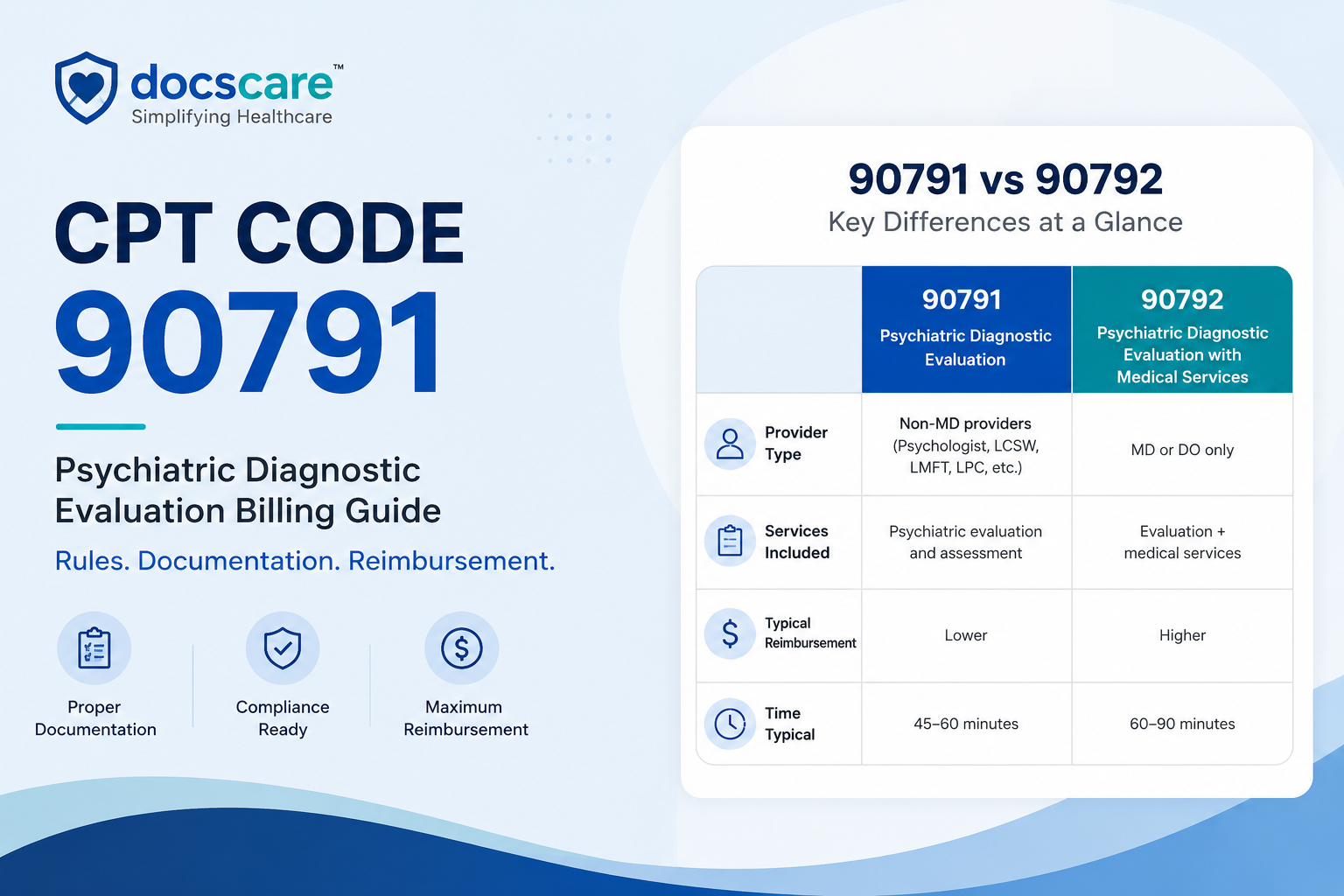
The difference between 90791 and 90792 comes down to a single word: medical. CPT Code 90791 has no medical services. 90792 includes them, prescribing, medication review, lab orders, or a physical assessment, and it pays about 24 to 27 dollars more. Here’s the full comparison.
| Factor | 90791 | 90792 |
|---|---|---|
| Medical services | None. No prescribing, no medication review, no physical exam | Included. Medication review, prescribing, lab orders, physical assessment |
| Who bills it | LCSW, LPC, LMFT, LMHC, psychologists, and psychiatrists not prescribing | Psychiatrists (MD/DO) and PMHNPs with prescriptive authority only |
| 2026 Medicare rate | About 174 to 178 dollars (non facility) | About 24 to 27 dollars more than 90791 |
| The compliance trap | Billing it when you prescribed is downcoding, lost revenue | Billing it without prescriptive authority is a violation, not an upgrade |
The trap runs both directions. A psychologist or social worker who bills 90792 commits a compliance violation, because that code requires prescriptive authority. A psychiatrist who prescribes during the intake but bills CPT Code 90791 downcodes the visit and gives away 24 to 27 dollars every time. Match the code to what the provider is licensed to do and actually did.
FREE CHECK
Not sure your intake codes match your providers?
What Does CPT Code 90791 Pay in 2026?
The 2026 Medicare national average for CPT Code 90791 runs roughly 174 to 178 dollars in non facility settings. Commercial payers often pay more, and rates vary by state and contract. LMFTs and LMHCs billing under their own credentials receive 75 percent of the physician rate, roughly 130 to 133 dollars. Because CPT Code 90791 is one of the higher value codes in behavioral health, payers scrutinize it closely, so confirm your own numbers on the CMS physician fee schedule and in each payer contract.
How Often Can You Bill CPT Code 90791?
Most payers allow CPT Code 90791 once per episode of care, or once every 6 to 12 months. That is the rule that trips up busy practices. You can bill it again sooner, but only with a documented clinical reason: a major change in the patient’s condition, a transfer to a higher level of care, or a treatment gap longer than six months. Absent that documentation, a second CPT Code 90791 too soon draws a frequency denial and can flag the account for review. Track the date of the last evaluation per patient, per provider, so a repeat intake is a decision, not an accident.
The CPT Code 90791 Denials We Prevent
Most CPT Code 90791 denials trace back to a short list of repeating errors. Documentation and coding problems are the leading denial category across healthcare, with industry denial rates between 10 and 15 percent, per 2026 denial benchmarks. Here are the ones that hit intake claims.
| Common Mistake | What It Causes | How We Prevent It |
|---|---|---|
| Wrong code for the provider (90792 by a provider without prescriptive authority) | Compliance violation and recoupment | We match the code to the rendering provider’s license and prescriptive authority |
| Billing 90791 more often than the payer allows | Frequency denial and audit review | We track the once per episode rule and document medical necessity for any repeat |
| A therapy or crisis code on the same day as 90791 | Mutually exclusive denial | We never bill 90791 with 90832, 90834, 90837, 90839, or family and group codes on the same date |
| Missing modifier 95 or wrong POS on a telehealth eval | Telehealth denial or overpayment flag | We append modifier 95 and set POS 10 or 02, and confirm the payer allows video for an intake |
| Documentation missing a required element | Denial on audit; the note must stand alone | We confirm history, mental status exam, diagnostic formulation, and treatment plan are all present |
| ICD-10 that does not support medical necessity | Necessity denial under the payer policy | We link a specific diagnosis (F32.x, F41.1, F90.x) that meets the payer LCD |
The same day rule deserves a closer look, because it is the one billers forget most. Payers treat CPT Code 90791 as mutually exclusive with therapy codes like 90837 and 90834, along with family, group, and crisis codes, on the same date of service. The one pairing many payers do allow is 90791 with psychological testing codes (96130 to 96133) when a full battery is performed. When claims do slip through with an error, our denial management services work them back to payment.
Billing CPT Code 90791 for Telehealth
CPT Code 90791 is billable for a synchronous video evaluation. Append modifier 95 and set the place of service to POS 10 when the patient is at home or POS 02 for another telehealth site. One rule catches people: several commercial payers require video specifically for the initial evaluation and will not accept an audio only intake for 90791, even when they allow audio only for follow up therapy. Confirm the payer’s intake policy before you schedule a phone only assessment, and document the modality, the patient location, and consent in the note. Medicare telehealth coverage details live in the CMS telehealth guidance.
What Belongs in a CPT Code 90791 Note
A CPT Code 90791 note is not a progress note. Payers expect it to work as a standalone diagnostic document, and a missing element is the second most common reason these claims fail on audit. Four pieces have to be there.
- A comprehensive psychiatric history, including the presenting problem in the patient’s own words, plus psychiatric, medical, family, and social history.
- A mental status exam covering appearance, speech, mood, affect, thought process and content, cognition, insight, and judgment, with a suicide and violence risk screening.
- A diagnostic formulation with a specific ICD-10 diagnosis (for example F32.1 for moderate major depressive disorder or F41.1 for generalized anxiety) that supports medical necessity.
- A treatment plan stating the recommended modality, frequency, and goals for care going forward.
How Docscare Keeps Your Intake Claims Clean
We bill behavioral health the way it actually pays, around the provider’s license, the once per episode rule, and the same day exclusions, not just a code number. Our AAPC-certified coders match 90791 or 90792 to the rendering provider, track evaluation frequency per patient, keep therapy and crisis codes off the intake date, set the right telehealth modifier and place of service, and confirm all four documentation elements before the claim goes out. When something denies, we work it back to payment.
We’re a US based medical billing company in Austin, Texas, fully HIPAA compliant, running a 99 percent clean claim rate with a 97.45 percent first pass acceptance rate. For a behavioral health practice, that accuracy protects the single most valuable claim you file, the one that opens every new episode of care. See how it fits into our full medical billing services.
FREE BEHAVIORAL HEALTH BILLING REVIEW
Let us review a sample of your 90791 and 90792 intake claims for provider-match, frequency, same-day, and telehealth errors, then show you exactly where the revenue is leaking. No cost, no obligation.
Frequently Asked Questions
What is CPT code 90791?
CPT 90791 is the psychiatric diagnostic evaluation without medical services. It covers the initial intake assessment, a comprehensive psychiatric history, a mental status exam, a diagnostic formulation, and a treatment plan, performed by a provider who does not prescribe. Psychologists, licensed clinical social workers, licensed professional counselors, and licensed marriage and family therapists bill it, and so do psychiatrists when they do not provide medical services during the evaluation.
What is the difference between CPT Code 90791 and 90792?
One word: medical. 90791 is the diagnostic evaluation without medical services, no prescribing, no medication review, no physical exam. 90792 includes those medical services and reimburses about 24 to 27 dollars more. Only providers with prescriptive authority (psychiatrists and psychiatric nurse practitioners) can bill 90792. A provider who cannot prescribe and bills 90792 commits a compliance violation, and a prescriber who bills 90791 after managing medication leaves money on the table.
How often can you bill CPT Code 90791?
Most payers allow 90791 once per episode of care, or once every 6 to 12 months. You can bill it again sooner when there is a clear clinical reason, a major change in the patient’s condition, a transfer to a higher level of care, or a treatment gap longer than six months, but the note has to document that medical necessity. Billing it more often than the payer allows triggers a frequency denial and can flag the account for review.
Can you bill CPT Code 90791 with therapy on the same day?
No. Payers treat 90791 as mutually exclusive with individual therapy codes (90832, 90834, 90837), family therapy (90846, 90847), group therapy (90853), and crisis codes (90839) on the same date of service. The one combination many payers allow is 90791 with psychological testing codes (96130 to 96133) when a full testing battery is also performed. Billing a therapy code alongside the intake on the same day is a common and preventable denial.
Can CPT Code 90791 be billed for telehealth?
Yes. 90791 is billable for a synchronous video evaluation with modifier 95 and the correct place of service, POS 10 when the patient is at home or POS 02 for another telehealth site. One catch: several commercial payers require video specifically for the initial evaluation and will not accept audio only for 90791, even when they allow audio only for follow up therapy. Confirm the payer’s intake policy before scheduling a phone only assessment.