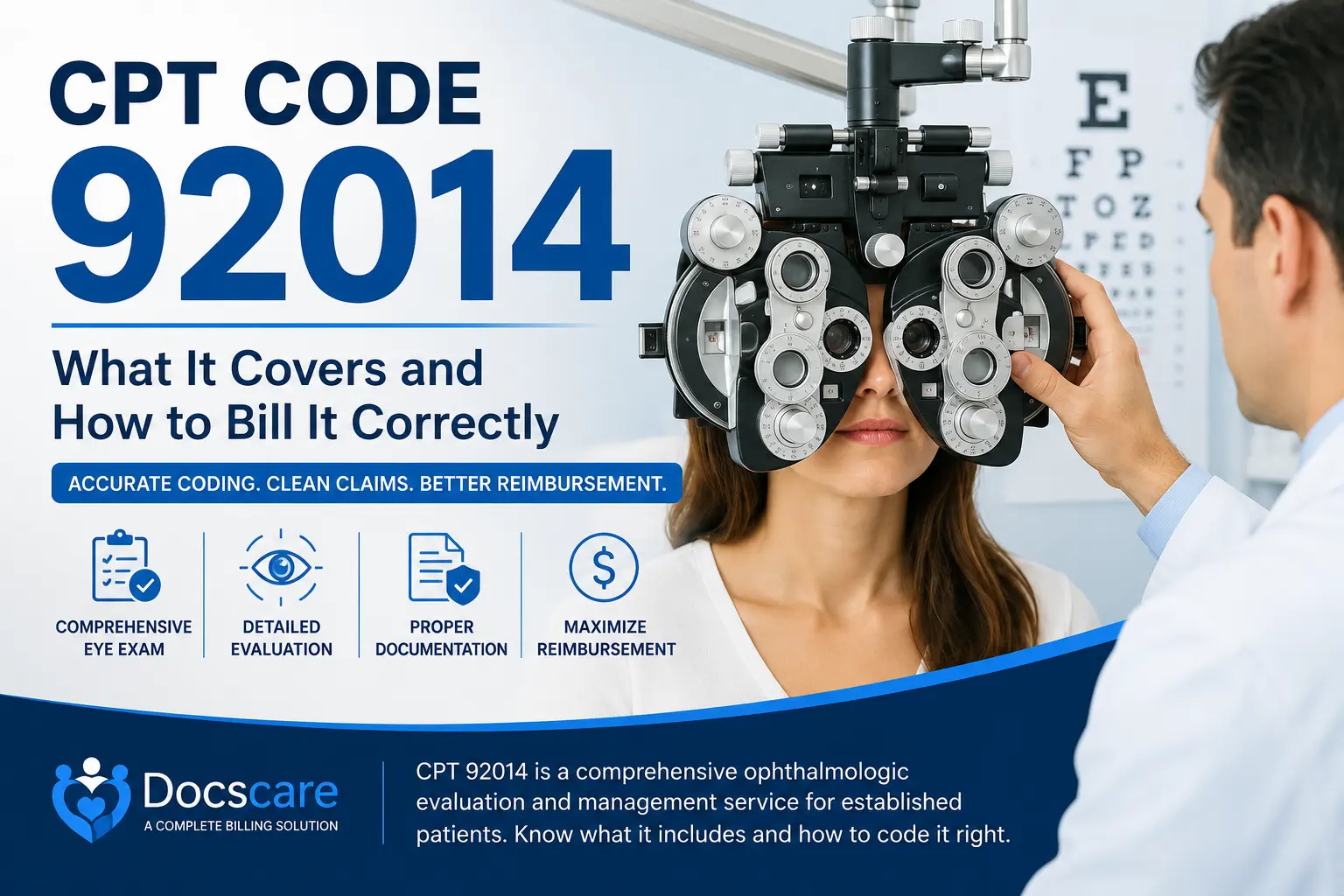
CPT code 92014 reports a comprehensive eye exam for an established patient, and it ranks among the most billed codes in eye care, with more than 7 million Medicare claims a year per CMS utilization data. It also generates a steady stream of preventable denials. Payers reject it over frequency limits, diagnosis mismatches, and documentation gaps that take thirty seconds to fix at the point of care.
This guide explains what 92014 covers, how it compares to the other eye codes and to E/M visits, what Medicare pays in 2026, and the habits that keep it off your denial queue. We wrote it for the person who actually works these claims: the practice manager or biller at an ophthalmology or optometry office.
Table of Contents
ToggleWhat does CPT code 92014 mean?
CPT 92014 describes a comprehensive ophthalmological service for an established patient, with initiation or continuation of a diagnostic and treatment program. In plain terms, the provider evaluates the complete visual system for a patient the practice has seen within the past three years, then starts or continues a medical plan of care.
A comprehensive service under the eye codes includes:
- Chief complaint and case history
- General medical observation
- External examination of the eyes and adnexa
- Ophthalmoscopic examination
- Gross visual fields
- Basic sensorimotor examination
The exam often adds biomicroscopy, tonometry, and a dilated evaluation when the presentation calls for them. Two details in the definition trip practices up. First, the service can span more than one session, but you report the code once. Second, “established” follows the standard three year rule: if any provider of the same specialty in your group saw the patient within the past three years, the patient stays established and 92014 applies instead of 92004.
Payers read the plan of care requirement literally. A chart that lists exam findings but never shows a decision, an order, or a treatment change fails the definition, even when the exam itself was thorough. Close every 92014 note with what happens next: the drop you prescribed, the visual field test you ordered, the return interval you set.
92014 vs 92004, 92012, and 92002
92014 belongs to a four code family called general ophthalmological services. Patient status and exam depth decide which one you bill.
| Code | Patient Status | Exam Level | When It Fits |
|---|---|---|---|
| 92002 | New | Intermediate | Focused evaluation of a specific condition for a new patient |
| 92004 | New | Comprehensive | Full evaluation of the complete visual system for a new patient |
| 92012 | Established | Intermediate | Evaluation of a new or existing condition for an established patient |
| 92014 | Established | Comprehensive | Full evaluation plus initiation or continuation of a diagnostic and treatment program for an established patient |
The intermediate codes cover a narrower service tied to a specific problem. The comprehensive codes require the full element set above. When the chart supports fewer elements, bill 92012 rather than stretch the documentation to reach 92014.
Does 92014 require dilation?
The CPT definition does not name dilation as a mandatory element. In practice, a comprehensive exam usually includes a dilated fundus evaluation, and many payers expect to see one documented before they pay a comprehensive eye code. Policies vary by payer, so check the manuals for your top contracts.
Protect the claim either way. When the provider dilates, chart it. When the patient refuses or a contraindication exists, record the reason in the note. That single sentence survives audits and wins appeals.
Should you bill 92014 or an E/M code like 99214?
You can report an eye code or an office visit E/M code for the same encounter, never both. The right choice comes down to documentation, payer rules, and payment.
The two code sets qualify differently. E/M codes 99202 to 99215 rest on medical decision making or total time under the rules CMS adopted in 2021. Eye codes keep defined exam elements plus the plan of care standard. A visit heavy on counseling and management with modest exam findings often supports a higher E/M level. A visit built around a thorough exam with straightforward decisions often supports 92014 more cleanly.
| Factor | 92014 | 99214 |
|---|---|---|
| 2026 Medicare National Average, Office Setting | $127.26 | $135.61 |
| Level Based On | Exam elements plus plan of care | Medical decision making or total time |
| Frequency Edits | Common; many payers cap comprehensive eye exams | Rare |
| Vision Plans | Often required for routine exams | Usually excluded |
Three practical rules follow. Vision plans generally want eye codes for routine exams, so 92014 stays the workhorse on that side of your payer mix. Medicare and commercial medical plans accept either code set when documentation supports the level, so compare payment on your own fee schedules. And frequency edits hit eye codes harder, which means a patient who already used a comprehensive eye exam this year may still qualify for an E/M visit when a new medical problem appears.
Choosing between 92014 and an E/M code on every encounter slows your billers down, and the wrong pick either leaves money on the table or invites an audit. Docscare’s Medical Coding Services put AAPC certified coders on your claims, so each exam goes out under the code the documentation actually supports. Talk to our team about a coding review for your eye care practice.
How much does Medicare pay for 92014 in 2026?
The 2026 Medicare Physician Fee Schedule pays a national average of $127.26 for 92014 in the office setting, based on the code’s relative value units and the 2026 conversion factor of $33.40. Your locality adjustment moves that figure up or down, so verify your exact rate in the CMS Physician Fee Schedule lookup tool. Commercial payers typically negotiate rates above Medicare, and vision plan fee schedules run on their own logic entirely.
Two payment traps catch eye care practices every week.
Refraction pays separately, and Medicare never pays it. Report 92015 alongside 92014 whenever the provider performs a refraction. Medicare excludes refraction by statute, so collect that fee from the patient, and set the expectation before the exam rather than at checkout.
Medicare does not cover routine eye exams. The visit needs a medical reason and a medical diagnosis. A patient who comes in for a glasses update with healthy eyes belongs on a vision plan claim or a self pay arrangement, not a Medicare claim. Medicare’s own eye exam coverage page spells out the exclusion and its exceptions, such as annual diabetic eye exams.
Why payers deny 92014
Most 92014 denials trace back to five patterns, and every one of them is preventable. For the wider view across all claim types, see the most common reasons payers deny claims.
- Frequency limits. Many plans cap comprehensive eye exams at one per 12 month period. Check benefits at eligibility, and route a second visit to 92012 or an E/M code when the clinical picture supports it.
- A routine diagnosis on a medical claim. Z01.00 or Z01.01 tells a medical payer the visit was routine, and medical payers reject routine visits. Those codes belong on vision plan claims.
- Documentation gaps. Missing exam elements, no plan of care, or no dilation note when the payer expects one. The fix lives in the chart template, not the claim.
- Global period overlap. An exam during the 90 day global period after cataract surgery bundles into the surgical payment unless the visit is unrelated. Append modifier 24 with a diagnosis that proves the separation.
- Wrong patient status. A patient your office last saw four years ago counts as new. Bill 92004, and reserve 92014 for the three year window.
Denials in these categories rarely deserve a write off, because most reverse on appeal when someone works them inside the payer’s deadline. If your team lacks the hours, structured denial management support recovers that revenue without adding headcount.
How to bill 92014 cleanly
Run every 92014 claim through this checklist before it leaves your system.
Pick the payer before the visit. The chief complaint decides the claim path. A medical complaint (blurred vision with diabetes, flashes and floaters, red eye) goes to medical insurance. A routine glasses check goes to the vision plan. Train the front desk to ask the reason for the visit at scheduling, because the answer drives eligibility, benefits, and the cost conversation with the patient.
Link a diagnosis that proves medical necessity. Common pairings include cataract (H25 series), glaucoma (H40 series), diabetic retinopathy (E11.3 series), and dry eye (H04.12 series). The diagnosis must match the chart and justify a comprehensive exam. For a refresher on how CPT and ICD-10 codes work together on a claim, we broke that down in a separate guide.
Skip the eye modifiers. The general ophthalmological service codes cover both eyes by definition. Leave RT, LT, and modifier 50 off the claim.
Add modifier 25 when a minor procedure shares the day. Punctal plugs, foreign body removal, and similar procedures bundle the exam unless it stands on its own as a significant, separately identifiable service. Document both distinctly and append 25 to 92014.
Bill refraction on its own line. 92015 rides along on the claim, and under Medicare the patient pays it.
Coding is one stage of a longer cycle. If claim work consumes your staff’s week from eligibility through payment posting, outsourced medical billing services take the entire cycle off your plate while your team stays focused on patients.
Frequently asked questions about CPT 92014
What is the difference between 92014 and 92004?
Patient status. 92004 reports a comprehensive exam for a new patient, and 92014 reports the same depth of exam for an established patient. A patient counts as established when any provider of the same specialty in your group furnished services within the past three years.
Can optometrists bill 92014?
Yes. Ophthalmologists and optometrists both report the general ophthalmological service codes when the exam falls within their state scope of practice and the payer credentials them for it.
Can you bill 92015 with 92014 on the same claim?
Yes. Refraction reports separately whenever the provider performs it. Medicare excludes refraction from coverage, so the patient owes that portion directly.
How often can you bill 92014 for the same patient?
CPT sets no frequency limit, but payers do. Many medical and vision plans cap comprehensive eye exams at one per 12 month period, so check benefits at eligibility and confirm medical necessity supports each comprehensive evaluation.
Does 92014 pay more than 99214?
Not in 2026. The Medicare national average in the office setting runs $127.26 for 92014 and $135.61 for 99214. Locality adjustments and commercial contracts shift both numbers, so compare your own fee schedules before setting a default.
Does 92014 require dilation?
The CPT definition does not mandate dilation, but many payers expect a dilated evaluation on comprehensive exams. Document the dilation when it happens, and document the clinical reason when it does not.
What documentation does 92014 require?
The chart needs the comprehensive exam elements (history, general medical observation, external and ophthalmoscopic exams, gross visual fields, basic sensorimotor testing) plus a clear plan of care. An order, a prescription, or a defined return interval satisfies the plan requirement.
The bottom line on 92014
92014 rewards practices that treat it as a documentation standard, not just a charge. Confirm patient status, match the exam depth to the chart, route the claim to the right payer, and close every note with a plan of care. Do those four things and the code performs the way it should: as one of the most dependable revenue lines in eye care.
Free resource
Denied eye exam claims pile up quietly, and each one costs staff time your practice never gets back. Docscare works comprehensive exam denials, coding edits, and payer appeals for eye care practices every day, and our clients maintain a 99% clean claim rate. Schedule a free consultation and we’ll review where your 92014 claims stand.