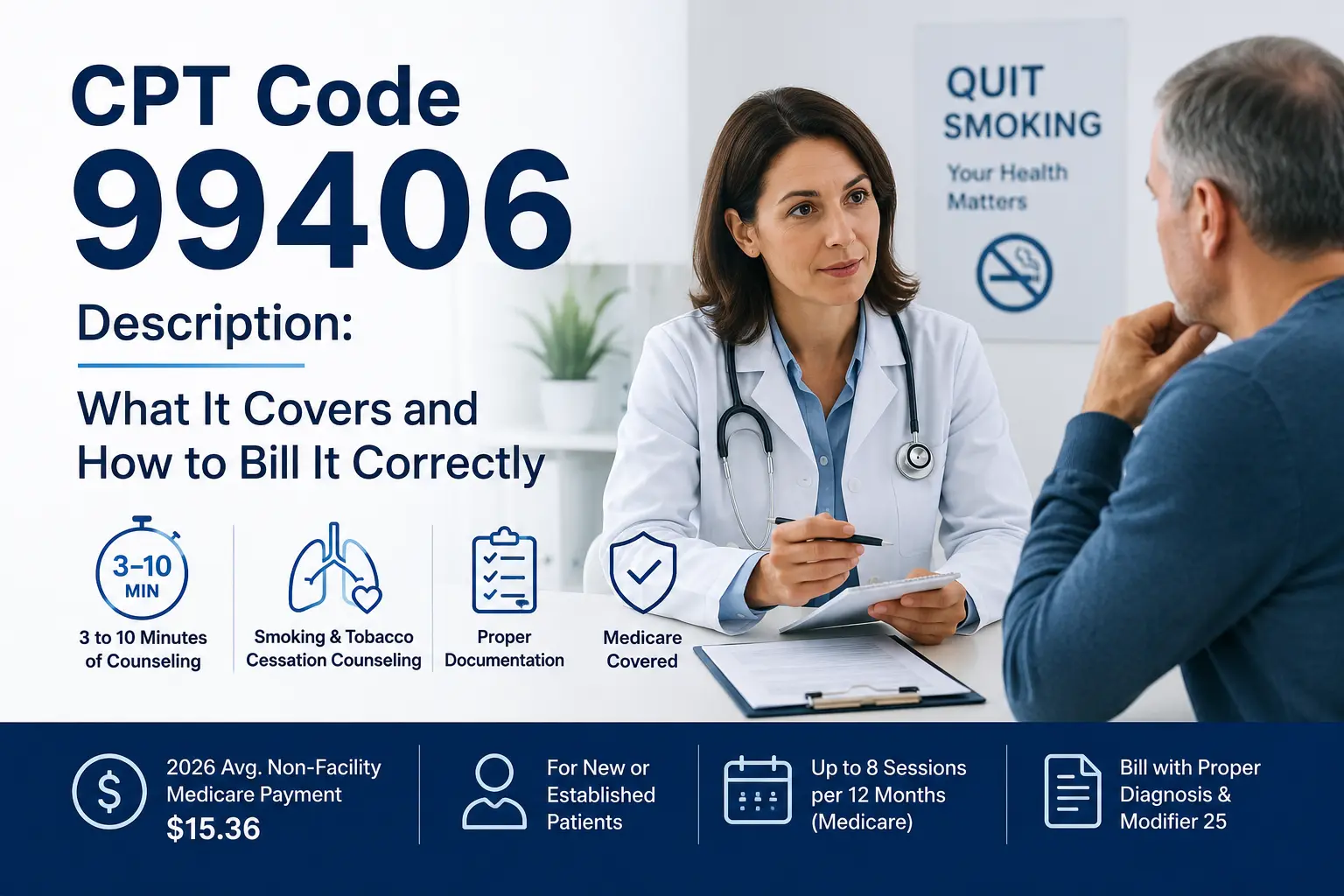
CPT code 99406 reports intermediate tobacco use cessation counseling lasting more than three minutes and up to ten minutes. The CMS short descriptor reads “Behav chng smoking 3 to 10 min.” A physician or qualified healthcare professional delivers the counseling face to face, and the visit sits inside the Behavior Change Interventions, Individual code family alongside 99407, which covers sessions longer than ten minutes.
That is the short answer. Here is what actually determines whether the claim pays.
Table of Contents
ToggleWhat Counts as Billable Time Under 99406
The clock starts when counseling begins, not when the visit begins. Three minutes is the floor. Ten minutes is the ceiling. Go over ten minutes and you bill 99407 instead, not 99406 twice.
The counseling itself has to cover specific ground. A quick “you should quit smoking” comment during a physical does not qualify. The documentation needs to show:
- Current tobacco use status, including product type (cigarettes, vaping, smokeless)
- Health risks discussed with the patient
- Cessation strategies offered, including behavioral techniques and pharmacotherapy options
- The patient’s stated readiness to quit and any agreed next step, such as a quit date
- Total time spent, stated explicitly in minutes
Miss the time documentation and the claim is vulnerable even if the counseling happened. Auditors look for the number, not an estimate.
When 99406 Pairs With an E/M Visit
Most 99406 claims do not stand alone. A physician runs the counseling during a preventive visit or alongside a separate evaluation and management service. When that happens, append modifier 25 to the E/M code to show the two services are distinct.
The counseling time cannot overlap with the time supporting the E/M code. If a provider spends twelve minutes on a visit and folds tobacco counseling into that same conversation without separating it out, the note will not support both claims. Documentation needs a clear line between the E/M work and the cessation counseling work.
medical coding
Modifier errors are one of the most common reasons cessation counseling claims deny. Our coders review every E/M and behavior change pairing before submission to confirm the documentation supports both codes. See how our Medical Coding Services team handles it.
2026 Medicare Reimbursement for CPT 99406
The national average non facility payment for 99406 sits around $15.36 in 2026, based on a total of 0.46 RVUs and the current conversion factor. Facility payment runs lower, closer to $10.69, because the practice expense component drops when the facility absorbs overhead. Actual payment shifts by locality once the practice adjusts for the geographic practice cost index, so treat these as national averages rather than a number to expect in every state.
The code carries no global period. Because it sits in the E/M category, there is no post operative restriction to track, which simplifies scheduling compared to procedural codes.
Medicare treats tobacco cessation counseling as a covered preventive service when the practice bills it with an appropriate tobacco use diagnosis code, such as F17.210 for nicotine dependence with cigarettes. When the diagnosis linkage is correct, the beneficiary owes no copay and no deductible. Coverage allows two quit attempts per twelve month period, with up to four counseling sessions per attempt. Both 99406 and 99407 count toward that eight session annual maximum, so a practice tracking a patient’s cessation program needs to watch the combined count, not just one code in isolation.
| Code | Time Range | 2026 Average Non-Facility Rate |
|---|---|---|
| 99406 | 3 to 10 minutes | $15.36 |
| 99407 | More than 10 minutes | See payer fee schedule |
Common Reasons 99406 Claims Get Denied
Four patterns account for most of the denials we see on this code:
- Mismatched CPT to ICD-10 linkage. The tobacco use diagnosis has to support medical necessity for the counseling. A vague or missing diagnosis code is an easy denial for the payer to issue.
- Missing modifier 25 on the paired E/M code. Without it, the payer assumes the counseling was rolled into the visit and denies 99406 as duplicative.
- Time documentation under three minutes or missing entirely. If the note does not state the minutes, some payers deny outright rather than request clarification.
- Billing 99406 twice in one visit instead of moving to 99407. Once total counseling time crosses ten minutes, the higher code applies. Repeating 99406 signals an error to automated claim review systems.
Private payers frequently add their own wrinkles on top of Medicare’s rules, including specific modifier requirements when a practice bills 99406 alongside vaccine administration codes like 90471 or 90472. Checking payer specific policy before submission catches most of these before they turn into a denial.
free audit
Denials on codes like 99406 rarely come from one mistake. They come from small documentation and modifier gaps that compound across a full patient panel. Docscare’s AAPC certified coders build the documentation checks into the workflow before a claim ever leaves the building.
Frequently Asked Questions
What is the CPT code 99406 description?
CPT 99406 describes intermediate smoking and tobacco use cessation counseling, delivered face to face for more than three minutes and up to ten minutes, to a new or established patient.
Is CPT 99406 the same as CPT 99407?
No. 99406 covers three to ten minutes of counseling. 99407 covers sessions longer than ten minutes. They are not billed together for the same counseling episode.
Does Medicare cover CPT 99406?
Yes. Medicare Part B covers tobacco cessation counseling for beneficiaries who use tobacco, with no copay or deductible when billed with a supporting tobacco use diagnosis. Coverage includes up to eight sessions per twelve month period across 99406 and 99407 combined.
Do I need modifier 25 with CPT 99406?
You need modifier 25 on the evaluation and management code, not on 99406 itself, whenever the counseling is billed alongside a separately identifiable E/M service on the same date.
What ICD-10 code pairs with CPT 99406?
The diagnosis depends on the patient’s specific tobacco use, but F17.210, nicotine dependence with cigarettes, is one of the most common pairings. The diagnosis must reflect the patient’s documented tobacco status.
How much does Medicare pay for CPT 99406 in 2026?
The national average non facility payment is approximately $15.36, based on 0.46 total RVUs. Facility payment and payment in specific localities will vary from that average.