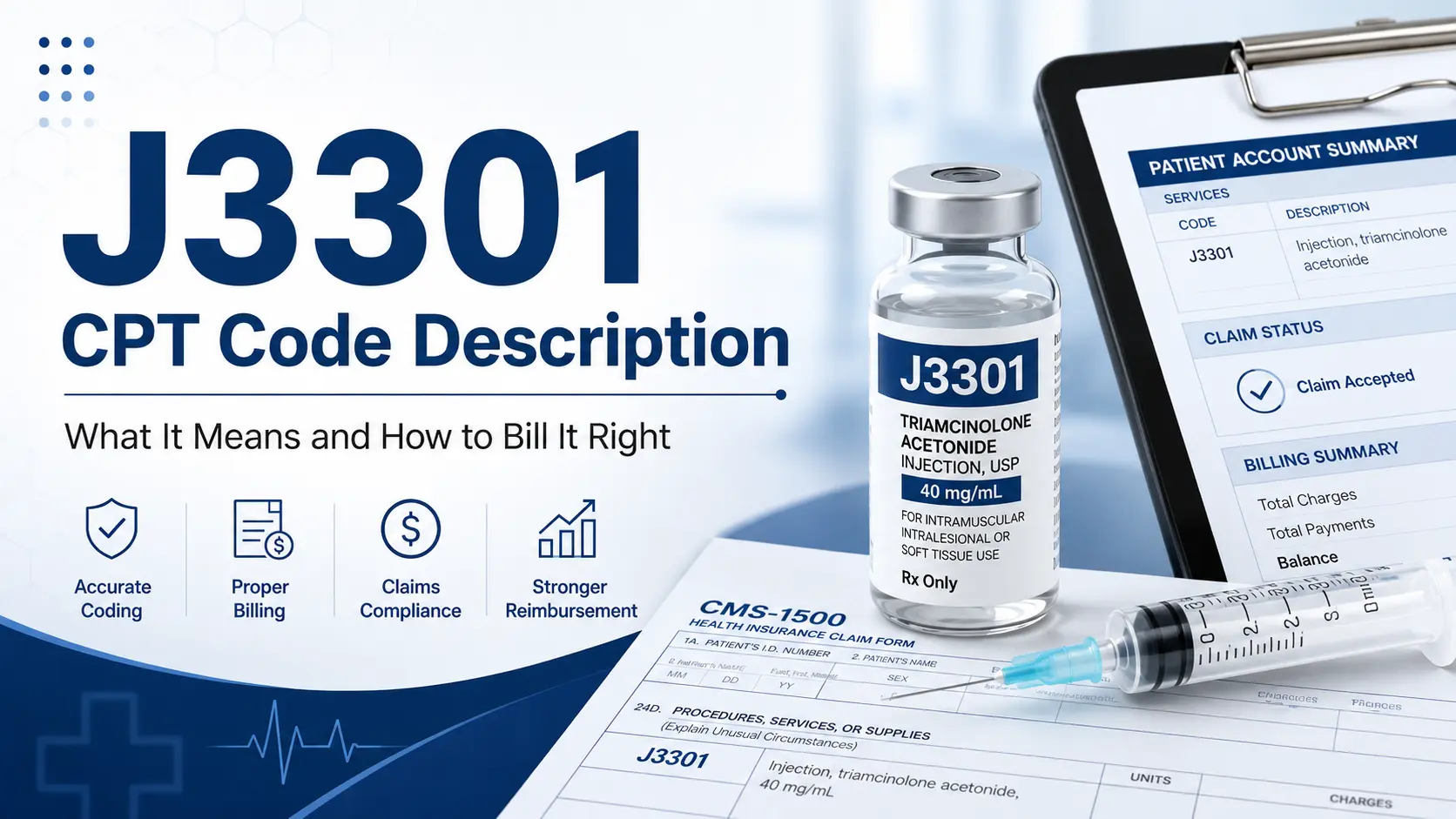
Search “J3301 CPT code” and most results skip the one fact that actually prevents denials: J3301 isn’t a CPT code at all. It’s an HCPCS Level II code, and that distinction changes how you should think about billing it.
Direct answer: J3301 is the HCPCS Level II code for an injection of triamcinolone acetonide, not otherwise specified, at 10 mg per unit. Billers commonly call it a CPT code because CPT and HCPCS Level II codes appear side by side on the same claim form, but they come from two different code sets maintained by two different processes.
Get that one distinction wrong in your documentation and a clean claim turns into a denial you didn’t see coming.
Table of Contents
ToggleWhat Does J3301 Actually Cover?
J3301 covers the drug supply only. It represents 10 mg of triamcinolone acetonide, the generic version of brand name products like Kenalog 10 and Kenalog 40. The code does not cover the injection procedure itself and does not cover an evaluation and management visit on the same day.
Triamcinolone acetonide is a corticosteroid. Physicians use it to calm inflammation and suppress overactive immune response. You’ll see J3301 most often in these settings:
- Orthopedics, for joint and soft tissue injections
- Dermatology, for keloids, psoriasis, and chronic eczema
- Rheumatology, for arthritis flare management
- Pain management, for epidural and intra articular injections
- Ophthalmology, for certain inflammatory eye conditions
Because J3301 only reports the drug, you need a separate code for the administration. CPT Code 20610 (major joint injection) and CPT Code 96372 (therapeutic injection, subcutaneous or intramuscular) are the two you’ll pair it with most.
J3301 vs J3300: Don’t Mix These Up
This is where a lot of claims go sideways. J3300 and J3301 both describe triamcinolone acetonide, but they are not interchangeable.
| Code | Description | Unit Value | Formulation |
|---|---|---|---|
| J3301 | Triamcinolone acetonide, not otherwise specified | 10 mg per unit | Standard, preserved formulation (most Kenalog vials) |
| J3300 | Triamcinolone acetonide, preservative free | 1 mg per unit | Preservative free formulation |
Check the vial label before you code. A preservative free vial billed under J3301, or a standard vial billed under J3300, will get flagged during payer review even when the clinical documentation is otherwise perfect.
How to Calculate J3301 Units
One unit of J3301 equals 10 mg. That means your unit count depends entirely on the dose given, not on the volume of the injection.
A quick example: Kenalog 40 is labeled at 40 mg per mL. If the physician administers 1 mL, that’s 40 mg of drug, which converts to 4 units of J3301. If the physician gives 0.5 mL of the same vial, that’s 20 mg, or 2 units.
A three step process to get it right every time:
- Confirm the concentration on the vial label (mg per mL).
- Multiply the concentration by the mL amount actually administered.
- Divide the total mg by 10 to get your unit count.
Document the mg dose in the clinical note itself, not just in the billing system. When the note says “injected 40 mg triamcinolone acetonide” instead of just “Kenalog injection given,” your coder has everything needed and your claim has a paper trail if a payer ever asks for records.
FREE CHECK
Unit calculation errors are one of the top reasons injectable drug claims get denied. Our AAPC certified coders review every J code claim for accurate dosage to unit conversion before it goes out the door. Explore Medical Coding Services to see how we catch these errors before payers do.
Modifiers That Apply to J3301
Most payers want a modifier on every J3301 line, and the anatomical ones are usually mandatory rather than optional.
- RT — right side, for a right knee or right shoulder injection
- LT — left side
- 50 — bilateral procedure, when the same injection is given on both sides in one visit. Many payers reimburse bilateral joint injections at 150 percent when modifier 50 is applied correctly.
Waste modifiers are where J3301 gets genuinely confusing. JW (drug wasted) and JZ (no drug wasted) apply to single dose vials under CMS policy. Kenalog 10 is not on the CMS single dose container list as of 2026, so JW and JZ typically do not apply to it. Check the current CMS list before applying either modifier, because a misapplied waste modifier triggers a claim edit almost every time.
Common J3301 Denial Reasons
We see the same five issues repeat across practices that struggle with injectable drug billing:
- Unit mismatch. The billed units don’t match the documented mg dose.
- Missing NDC. Many commercial payers and Medicaid programs require the National Drug Code on the claim line, not just the HCPCS code.
- J3300 and J3301 confusion. Billing the wrong CPT code for the vial’s formulation.
- Missing administration code. Submitting J3301 alone without CPT Code 20610 or 96372 attached.
- Medical necessity gaps. No diagnosis code on the claim that supports why the injection was medically necessary.
Every one of these is preventable at the documentation stage. None of them require better technology to fix. They require a consistent process, applied the same way on every claim.
Denial patterns like these rarely show up on one claim. They show up across hundreds of claims, quietly costing a practice thousands of dollars a month. We help practices trace injectable drug denials back to the documentation gap causing them and fix the process, not just the individual claim. Schedule a free revenue cycle audit to see where your J code claims are leaking revenue.
The Bottom Line on J3301 CPT Code
J3301 looks simple on the surface. Ten milligrams, one unit, standard corticosteroid injection. The complexity lives in the details: the right modifier, the right unit math, the right code alongside it, and documentation that backs up every line on the claim. Get those four things right consistently and J3301 becomes one of the most predictable codes in your injectable drug billing, not one of the most denied.
Frequently Asked Questions
Is J3301 a CPT code or an HCPCS code?
J3301 is an HCPCS Level II code, not a CPT code. People commonly call it a CPT code because both code types appear together on medical claims, but CMS maintains HCPCS Level II codes separately from the CPT code set published by the AMA.
What is the full J3301 description?
The official descriptor is “Injection, triamcinolone acetonide, not otherwise specified, 10 mg.” It represents the drug supply only, billed in 10 mg units.
How many units of J3301 do I bill for a 40 mg Kenalog injection?
Four units. Divide the total mg administered by 10, since each unit of J3301 equals 10 mg of triamcinolone acetonide.
What’s the difference between J3301 and J3300?
J3301 covers the standard, preserved formulation of triamcinolone acetonide at 10 mg per unit. J3300 covers the preservative free formulation at 1 mg per unit. Check the vial label to confirm which formulation was used before coding the claim.
Do I need a modifier on every J3301 claim?
Anatomical modifiers like RT, LT, or 50 usually apply when the injection targets a specific side or joint. Waste modifiers JW and JZ generally do not apply to Kenalog 10, since CMS does not list it as a single dose container as of 2026. Confirm current CMS guidance before applying any waste modifier.
What CPT code do I bill alongside J3301?
J3301 reports the drug only. Bill the administration separately using CPT Code 20610 for a major joint injection or CPT Code 96372 for a therapeutic subcutaneous or intramuscular injection, depending on the site and method used.