
Medical Billing Services in Pennsylvania
DocsCare provides expert medical billing services in Pennsylvania for practices navigating Highmark, Independence Blue Cross, UPMC Health Plan, and HealthChoices MCO requirements. Our Pennsylvania-focused billing team maintains a 96% clean claim rate, tracks claims against the state’s 45-day prompt-payment timeline, and helps reduce denials and aging A/R. If your denial rate exceeds 15% or accounts receivable stretches beyond 60 days, we can help recover revenue and improve cash flow.
Medical Billing Support Built Around Measurable Results
Supporting medical practices across Illinois and all 50 states with certified billing, coding, compliance, and revenue cycle expertise.
Clean Claim Rate
Claims are reviewed for coding, payer, and submission accuracy before entering the reimbursement cycle.
Select any company factWhat Makes Pennsylvania Medical Billing Different
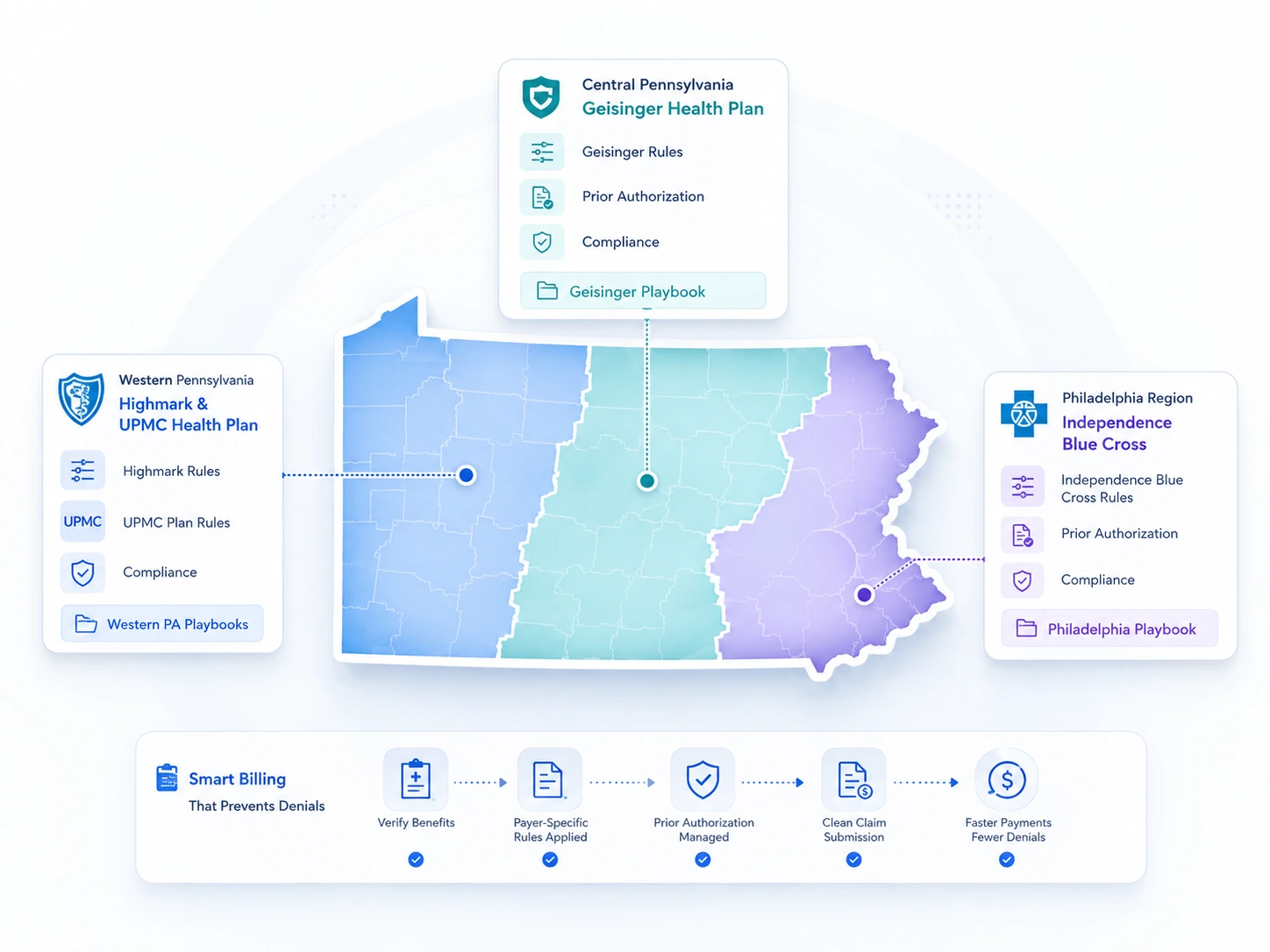
Pennsylvania isn’t a single insurance market. It’s three or four regional ones stitched together. Independence Blue Cross controls the Philadelphia five county area. Highmark and UPMC Health Plan split western Pennsylvania between two competing hospital systems. Geisinger Health Plan dominates the central part of the state. Together, Highmark and Independence Blue Cross cover close to 53 percent of Pennsylvania’s insured population on their own.
That regional split matters for billing. A prior authorization rule that works for a Pittsburgh practice billing UPMC Health Plan won’t necessarily apply to a Philadelphia practice billing Independence Blue Cross. We build payer specific playbooks by region instead of treating Pennsylvania as one generic market, because honestly, most billing vendors skip this step and it shows up as unnecessary denials.
Laws That Apply to Billing for Medical Services in Pennsylvania
Three rules shape how claims move through the Pennsylvania system. Select each checkpoint to see where payment timing, payer routing, privacy, and patient billing requirements enter the claim process.
Act 68: The 45-Day Prompt-Pay Rule
Pennsylvania’s Quality Health Care Accountability and Protection Act, known as Act 68, requires licensed insurers and managed-care plans to pay a clean claim within 45 days of receipt. Missing that window can leave the insurer responsible for interest on the unpaid balance. HealthChoices Medical Assistance and CHIP managed-care plans follow the same core 45-day standard. When a payer will not confirm whether a claim qualifies as clean, the matter may be escalated through the Pennsylvania Insurance Department.
HealthChoices and Medical Assistance Billing
Pennsylvania’s Medicaid program is commonly called Medical Assistance, while its managed-care programs operate under the HealthChoices name. Rather than billing the Commonwealth directly in every case, providers submit claims to the member’s assigned managed-care organization. Each MCO maintains its own authorization, credentialing, network, claims-submission, and fee-schedule requirements. Eligibility and the member’s current plan should therefore be confirmed before a claim is submitted.
Federal Layers That Still Apply
HIPAA governs how protected health information moves through eligibility checks, coding, claim submission, payment posting, denial follow-up, and patient billing. The No Surprises Act establishes federal protections involving many emergency services, certain out-of-network services delivered at in-network facilities, and qualifying air ambulance services. These requirements operate alongside Act 68 and HealthChoices rules rather than replacing them.
This section is provided for general educational purposes and is not legal advice. Payer contracts, official program manuals, and individual claim circumstances may create additional requirements.
How Our Pennsylvania Medical Billing Process Works
- Eligibility and benefits verification. We confirm active coverage, plan type, and prior authorization requirements before the appointment, cutting down on eligibility related denials before they happen.
- Coding and charge entry. CPC certified coders assign CPT, ICD-10, and HCPCS codes and enter charges within 24 to 48 hours of the encounter.
- Claim scrubbing. Every claim runs through payer specific edits, including Highmark, Independence Blue Cross, UPMC Health Plan, and HealthChoices MCO rules, before it ever leaves our system.
- Submission and clean claim tracking. We submit electronically and start the Act 68 clock ourselves, so we know exactly which claims are approaching day 45 before the payer does.
- Denial management and appeals. Denied claims get a root cause review within 48 hours and a written appeal with supporting documentation, not a generic resubmission.
- A/R follow up and patient statements. We chase aging claims past 30 days and send clear, itemized patient statements for any remaining balance.
- Reporting. Monthly reports show your clean claim rate, days in A/R, denial rate by payer, and collections against expected reimbursement.
The Pain Points Pennsylvania Practices Bring to Us
These operational problems rarely stay isolated. Denials, delayed payments and staff pressure eventually converge into one larger revenue-cycle problem.
Denial rates that don’t match the effort going into them
Most practices we onboard run a 15% to 25% denial rate before we start. Common causes include eligibility gaps, coding mismatches, missing HealthChoices prior authorization, timely-filing misses and modifier errors.
A/R that keeps stretching
Claims sitting past 60 days tie up cash needed for payroll and supplies. We flag claims approaching Pennsylvania’s 45-day prompt-payment mark and pursue prompt-pay action when a payer defaults without cause.
Billing staff turnover
Train a biller for four months and you may be searching for a replacement within a year and a half. Every cycle costs productivity and institutional knowledge. Outsourcing removes that cycle from your practice.
HealthChoices complexity
Medical Assistance practices must navigate authorization rules across multiple HealthChoices MCOs. We maintain a current authorization matrix for major Pennsylvania HealthChoices plans, so your front desk is not guessing.
Compliance anxiety
HIPAA requirements, CMS rule changes and Pennsylvania Insurance Department guidance all shift over time. Missing one update can mean an audit. We monitor these changes as part of the service—not as a separate line item.
Why Outsource Medical Billing Services in Pennsylvania?
In-house billing means salaries, software licenses, clearinghouse fees and the overhead of managing it all—with no guarantee the output improves. Outsourcing shifts that cost to a percentage of what you actually collect, which means our incentive lines up with yours: we only do well when your claims get paid.
|
Compare
Factor
|
Traditional Model
In-House Billing
|
Managed Solution
Outsourced to DocsCare
|
|---|---|---|
|
01
Cost Structure
|
−
Fixed salaries, software and overhead regardless
of collections.
|
Percentage of collections, with no setup fees.
|
|
02
Staff Turnover Risk
|
−
The practice absorbs recurring hiring, training
and productivity costs.
|
A dedicated billing team without placing a hiring
burden on your practice.
|
|
03
HealthChoices MCO Expertise
|
−
Knowledge depends on one or two individual staff
members.
|
A maintained authorization matrix covering major
Pennsylvania MCOs.
|
|
04
Act 68 Tracking
|
−
Manual monitoring that is often reactive rather
than preventative.
|
Every applicable claim is tracked against
Pennsylvania’s 45-day payment deadline.
|
|
05
Denial Management
|
−
Follow-up competes with front-desk, scheduling and
other administrative duties.
|
Dedicated denial review initiated within 48 hours.
|
Medical Billing Services for Small Practices in Pennsylvania
If you run a solo or small group practice, most of what you need from a billing partner comes down to two things: someone catches denials before they become write offs, and someone tracks the Act 68 clock so you’re not chasing payers manually. We work with practices from a single provider up to 15, with no minimum claim volume and no long term contract requirement. If your practice bills fewer than 500 claims a month, this section is written for you specifically: you don’t need enterprise RCM software, you need a team that knows Highmark’s rules from Independence Blue Cross’s rules and doesn’t treat your practice like a rounding error.

Specialties We Bill for Across Pennsylvania
Every specialty has different coding requirements, payer rules and denial patterns. Our billing workflows are built around the way each type of practice actually operates.
Internal Medicine
Preventive, chronic-care and evaluation coding support.
→Cardiology
Procedure, diagnostic and cardiovascular claim workflows.
→Mental & Behavioral Health
HealthChoices carve-outs and authorization requirements.
→Orthopedics
Surgical, imaging and musculoskeletal coding support.
→Dermatology
Medical, surgical and cosmetic service distinctions.
→Pediatrics
Well-child visits, vaccines and pediatric payer rules.
→OB/GYN
Global maternity, preventive and procedural billing.
→Family Medicine
Full-spectrum outpatient and preventive-care billing.
→ Complete Specialty Directory Don’t See Your Specialty Here? Explore DocsCare’s complete range of specialty-specific medical billing solutions. View All Specialties →How We Charge
DocsCare uses a percentage-of-collections model, typically 4% to 9% depending on specialty mix and claim volume. There is no setup fee and no charge for claims that do not get paid. Our pricing aligns our performance with your practice: we succeed when your claims are collected.
revenue
Frequently Asked Questions
If your question is not answered here, contact our billing team directly. Most questions get a same-day response.
What laws apply to billing for medical services in Pennsylvania?
The main one is Act 68, the Quality Health Care Accountability and Protection Act (40 P.S. Section 991.2166). It requires insurers and managed care plans to pay clean claims within 45 days, with 10 percent annual interest owed on late payments. HealthChoices Medical Assistance and CHIP plans follow the same deadline.
How long do Pennsylvania insurers have to pay a clean claim?
45 days from receipt. Miss it, and the payer owes 10 percent annual interest on the unpaid balance until the claim is paid in full.
What is HealthChoices and how does it affect medical billing?
HealthChoices is Pennsylvania’s mandatory managed care program for Medical Assistance recipients. You bill the assigned MCO, such as AmeriHealth Caritas, Geisinger Health Plan, or UPMC Health Plan, rather than the state directly, and each MCO sets its own prior authorization rules.
How much does it cost to outsource medical billing services in Pennsylvania?
Most vendors charge a percentage of collections, generally 4 to 9 percent. Docs Care Org uses this model with no setup fees, so cost scales with what you actually collect.
What is a clean claim rate and why does it matter in Pennsylvania?
A clean claim processes and pays on the first submission, with no errors or missing documentation. Act 68’s 45 day clock only starts once a claim qualifies as clean, so a low clean claim rate extends your real payment timeline even under the law’s cap.
Do you bill for Highmark, Independence Blue Cross, and UPMC Health Plan?
Yes, along with Geisinger Health Plan and the major HealthChoices MCOs. Together, Highmark and Independence Blue Cross alone cover more than half of Pennsylvania’s insured population.
What's the best medical billing service in Pennsylvania for a small practice?
Look for a partner that understands HealthChoices MCO rules and the Act 68 deadline without requiring a long contract. We work with practices of 1 to 15 providers on a percentage of collections basis with no minimum volume.
How long does it take to switch medical billing companies?
Usually 30 to 45 days, covering payer enrollment checks, EHR and clearinghouse setup, an A/R review, and a short parallel run before the old process shuts off.
Is outsourced medical billing HIPAA compliant?
It needs to be. Ask any vendor for a signed Business Associate Agreement and their breach notification process before you sign anything.
What specialties does Docs Care Org bill for in Pennsylvania?
50 plus specialties nationwide, including internal medicine, cardiology, mental and behavioral health, orthopedics, dermatology, pediatrics, and OB/GYN practices across Pennsylvania.
Get Your Free Billing Audit
A dedicated billing specialist reviews the last 90 days of your Pennsylvania claims, flags where Act 68’s 45-day clock is working against you, and shows you exactly where denials are coming from.
