
Medical Billing Services in Vermont That Keep Claims Moving and Cash Flowing
Docscare provides medical billing services in Vermont for independent physicians, small group practices, and behavioral health clinics that want cleaner claims and faster payment without adding staff. We handle coding, claim submission, payment posting, denial management, credentialing, and A/R follow-up against the payer rules Vermont practices actually bill under: Green Mountain Care through DVHA and Gainwell, Medicare through National Government Services, and commercial plans from Blue Cross and Blue Shield of Vermont and MVP Health Care.
Revenue cycle
at a glance.
One experienced team managing billing, coding, credentialing, and payer follow-up.
Clean claim ratio on first submission
First-pass acceptance rate
Average revenue increase
Certified coders
Solo providers to large groups
What Do Medical Billing Services in Vermont Include?
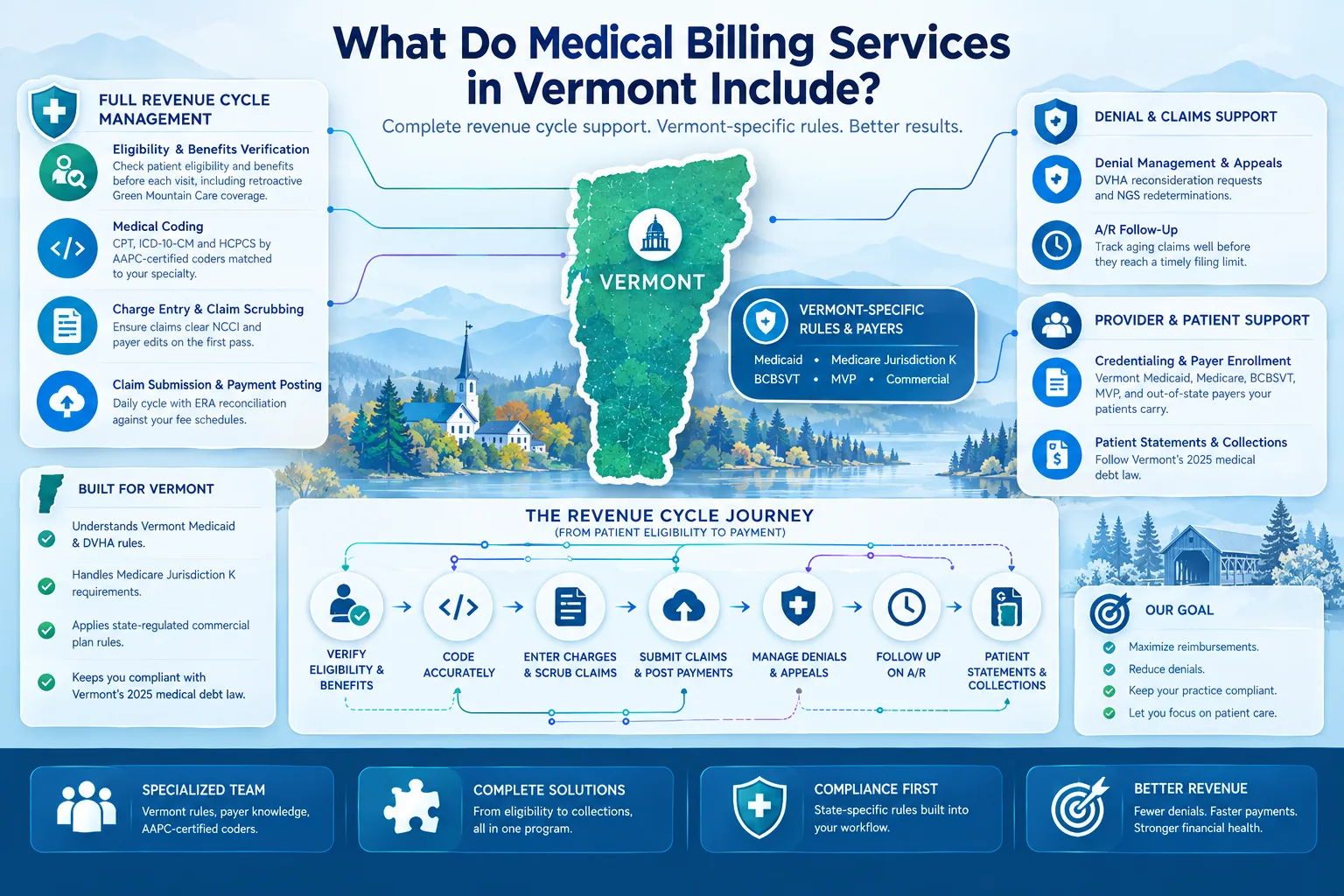
Medical billing services in Vermont cover the full revenue cycle a practice would otherwise run in-house, handled by a team that knows Vermont Medicaid, Medicare Jurisdiction K, and state-regulated commercial plan rules. At Docscare, that includes:
- Eligibility and benefits verification before each visit, including checks for retroactive Green Mountain Care coverage.
- Medical coding in CPT, ICD-10-CM, and HCPCS by AAPC-certified coders matched to your specialty.
- Charge entry and claim scrubbing so claims clear NCCI and payer edits on the first pass.
- Claim submission and payment posting on a daily cycle, with ERA reconciliation against your fee schedules.
- Denial management and appeals, including DVHA reconsideration requests and NGS redeterminations.
- A/R follow-up on aging claims well before they reach a timely filing limit.
- Credentialing and payer enrollment with Vermont Medicaid, Medicare, BCBSVT, MVP, and out-of-state payers your patients carry.
- Patient statements and collections support that follow Vermont’s 2025 medical debt law.
Every Vermont account runs inside our full-service medical billing program, with the state-specific rules below built into the workflow from day one.
Why Does Medical Billing in Vermont Work Differently?
Vermont has a small, concentrated payer mix, and that concentration cuts both ways. Fewer payers means fewer rulebooks to learn, but each payer carries a bigger share of your revenue.
Green Mountain Care Follows Its Own Rulebook
Department of Vermont Health Access (DVHA)DVHA sets Medicaid policy and reimbursement, while Gainwell Technologies processes claims and handles provider enrollment as the state's fiscal agent.
Read additional revenue loss audit rules
Three rules drive revenue loss: a 6-month timely filing window, a 90-day reconsideration window with Gainwell, and strict payer-of-last-resort guidelines requiring primary EOBs.
Medicare Jurisdiction K
MedicareNGS processes Vermont's Medicare Part A and Part B claims as the MAC for Jurisdiction K. NGS local coverage determinations, redetermination forms, and enrollment timelines apply to your providers.
BCBSVT and MVP Volume
CommercialBlue Cross and Blue Shield of Vermont and MVP Health Care are the carriers behind Vermont Health Connect plans and the main source of commercial coverage, including the Vermont State Employees Health Plan.
Cross-Border Patients
Multi-StatePractices near the Connecticut River, Bennington County, and the Canadian border regularly see patients covered by New Hampshire, New York, or Massachusetts plans.
Provider Enrollment Services
Docscare ServicesOut-of-state Medicaid in particular needs its own enrollment before you can bill it. We check coverage at intake and handle out-of-state provider credentialing during onboarding.
Retroactive Eligibility
Medicaid WorkflowWhen a patient's coverage is back-dated, you can bill for that period, but the claim needs the Notice of Decision attached to get past the filing limit.
Which Vermont Billing Laws Changed the Rules in 2025 and 2026?
Vermont has rewritten a lot of billing ground rules since 2024. Here’s what affects claims and collections right now.
| Change | Effective | What it means for your billing |
|---|---|---|
| Act 111: prior authorization waiver for primary care orders | Jan 1, 2025; expanded Jan 1, 2026 | Providers contracted as primary care providers with state-regulated plans can order most medically necessary services without prior auth. Prescription drugs and out-of-network services are excluded, and the claim must follow the plan's submission rules to bypass the PA edit. |
| Act 111: claims editing standards | Jan 1, 2026 | State-regulated plans must base claim edits on nationally recognized standards such as CMS NCCI. Edits outside those standards give you grounds to dispute. |
| Act 111: payment policy notice | In effect | Plans must give at least 60 days' advance notice of payment policy changes that affect provider contracts, and providers can object in writing. |
| Act 108: telehealth payment parity | Jan 1, 2025 | Commercial plans pay audio-visual and audio-only telehealth at parity. Place of service and modifier choices still decide whether parity shows up on the remittance. |
| Act 21 (S.27): medical debt and credit reporting | July 1, 2025 | Credit bureaus can't report or keep medical debt on Vermonters, and large health care facilities and medical debt collectors can't furnish it. |
| OneCare Vermont closure | After 2025 | The all-payer ACO wound down, taking its attribution reports and population health payments with it. Workflows built around OneCare need retiring. |
| AHEAD model withdrawal | Announced July 2026 | Vermont left the federal AHEAD model and is redirecting reform toward the Rural Health Transformation Program. Fee-for-service billing remains the main payment path for now. |
One detail practices miss: Act 111’s prior authorization protections apply to state-regulated commercial plans such as BCBSVT and MVP exchange plans and the state employee plan. They don’t apply to Medicaid, Medicare, or large group plans, according to the Vermont Medical Society’s Act 111 summary. The same order can need prior auth for one patient and not the next, so we sort it at scheduling. The Department of Financial Regulation’s Act 111 implementation FAQ covers plan obligations in detail.
Medical Billing Services for Small Practices in Vermont
Most Vermont practices are small, and many sit in rural counties where an experienced biller is hard to hire and harder to replace. When that one person takes a vacation or leaves, claims stop going out. With Vermont Medicaid’s six-month filing limit, a backlog turns into write-offs faster than most owners expect.
Our medical billing services for small practices in Vermont are built around that reality:
- No single point of failure. A dedicated billing specialist owns your account, with a team behind them that already knows your payer mix.
- Primary care revenue capture. With a large Medicare population, Annual Wellness Visits, chronic care management, and transitional care management add meaningful revenue when documentation supports them. Our coding review flags visits where it does.
- Act 111 claim flagging. If your providers are contracted as PCPs, we apply each plan’s claim requirements so a waived prior auth doesn’t turn into a denial.
- Credentialing that keeps pace with hiring. When you add a clinician, we handle Vermont Medicaid, Medicare, and commercial enrollment and track each application, so billing starts as soon as payers approve.
- Predictable cost. You pay a percentage of what we collect, with no setup fees, instead of carrying a salary, benefits, billing software, and training for in-house staff.

How Does Outsourcing Medical Billing Work for a Vermont Practice?
Moving to outsourced medical billing shouldn't disrupt your schedule. Most practices are fully onboarded within 3 to 5 business days, and you keep working in the EHR you already use. Here's the process:
Free billing audit
Revenue and compliance review
We review recent claims, denials, and A/R aging, then show you where Vermont-specific rules are costing you money.
Onboarding and access
System setup & mapping
We sign a Business Associate Agreement on day one, connect to your EHR or practice management system, and map your payer contracts.
Clean claim submission
Daily scrubbing & filing
Coders review each encounter, claims pass scrubbing against NCCI and payer edits, and we submit daily.
Payment posting and follow-up
Underpayment recovery
We post ERAs, catch underpayments against your contracted rates, and work every open claim well ahead of its filing deadline.
Denials, appeals, and reporting
Fast turnaround & metrics
We investigate and resubmit denials within 24 to 48 hours and send regular reports on collections, denial rate, and days in A/R.
Let our team handle your billing workflow while you focus on patient care.
Medical Billing and Collection Services in Vermont After Act 21
Patient balances keep growing as deductibles rise, and Vermont changed the collections playbook in 2025. Under Act 21, medical debt stays off Vermonters’ credit reports, so the threat of a credit hit no longer moves anyone to pay. Clear statements and easy payment options do.
Our medical billing and collection services in Vermont focus on what still works:
- Itemized statements that show what insurance paid and why the patient owes the remaining balance.
- Reminders on a set schedule, with payment plans for larger balances.
- Referring patients to hospital financial assistance policies or Green Mountain Care screening when a coverage gap is the real problem.
- Accounts receivable follow-up that works insurance balances first, so patients only receive bills for what they truly owe.
Don't let recoverable revenue quietly age out.
A missed Medicaid filing window or a misapplied Act 111 exemption rarely gets reversed once the appeal clock runs out. Our denial management team tracks DVHA's 90-day reconsideration window and NGS redetermination deadlines on every open claim, so recoverable revenue doesn't quietly age out. Let's look at your current denial patterns together.
In-House vs. Outsourced Billing in Vermont: How Do They Compare?
Medical billing services outsourcing in Vermont appeals most to practices where hiring is the bottleneck. Here’s how the two models compare on the factors that matter day to day.
| Factor | In-house billing | Outsourced with Docscare |
|---|---|---|
| Staffing | You recruit, train, and replace billers in one of the country's smallest labor markets | A dedicated specialist plus a backup team |
| Coverage during absences | Claims pause when your biller is out | Work continues every business day |
| Vermont rule tracking | Staff learn DVHA, NGS, and Act 111 changes on their own time | We monitor payer and state updates as part of the job |
| Cost structure | Salary, benefits, software, clearinghouse fees, and training | Percentage of collections, no setup fee |
| Coding credentials | Depends on who you can hire | AAPC-certified coders matched by specialty |
| Reporting | Often manual or inconsistent | Regular reports on collections, denials, and A/R |
| Visibility | Full day-to-day control | You keep access to your system and see every claim |
In-house billing still makes sense for larger groups with stable, experienced staff. For a small or mid-size Vermont practice, the math often favors outsourcing once you count benefits, software, and turnover. A free audit shows you the actual numbers for your practice.
Medical Specialties We Bill for in Vermont
Docscare supports 45 medical specialties. For Vermont practices, that includes family medicine, internal medicine, pediatrics, behavioral and mental health, OB/GYN, cardiology, orthopedics, dermatology, pulmonology, and urgent care. Behavioral health needs particular care in Vermont because Medicaid supervised billing rules apply to some provider types and follow their own manual, and we code and bill those claims accordingly.
Explore all specialtiesChoose your practice type
Medical Billing and Collection Services in Vermont After Act 21
We’re headquartered in Austin, Texas, and serve Vermont practices remotely through your existing systems. We don’t claim a Vermont office. What we bring is a billing process tuned to Vermont’s payers and results you can verify:
- 99% clean claim ratio and 99% first-pass acceptance rate, so fewer claims come back for rework.
- 30% average revenue increase for clients, driven by fewer denials and tighter follow-up.
- AAPC-certified coders matched to your specialty rather than generalists.
- A dedicated specialist who knows your providers, your payer contracts, and your problem claims by name.
- HIPAA compliance built in, with a signed BAA before we touch any patient data.
- One team for billing, coding, credentialing, and A/R, so you never coordinate between vendors.
Opening a new Vermont practice? Start with our payer enrollment checklist for new practices, which lists the documents to gather before you apply.
Get Your Vermont Billing Reviewed
Vermont's payer rules have shifted repeatedly since 2024, and small practices feel every missed update in their cash flow. Docscare handles your billing, coding, and follow-up against current DVHA, NGS, and Act 111 requirements, so your team can stay focused on patients. Talk with our team about a free billing audit for your practice.
Frequently Asked Questions
If your question is not answered here, contact our billing team directly. Most questions get a same-day response.
How much do medical billing services in Vermont cost?
Docscare charges a percentage of the revenue we collect for you, with no setup fees and no long-term contract. Your rate depends on specialty, claim volume, and which services you need, and we quote it after a free billing audit so the number reflects your actual practice.
What is the timely filing limit for Vermont Medicaid?
When Vermont Medicaid is the primary payer, claims are due within 6 months of the date of service. When Medicare pays first, you have 6 months from Medicare’s payment or denial date. Reconsideration requests must reach Gainwell within 90 days of the original denial.
Who processes Medicare claims in Vermont?
National Government Services (NGS) processes Medicare Part A and Part B claims for Vermont as the A/B Medicare Administrative Contractor for Jurisdiction K. NGS policies, local coverage determinations, and appeal forms apply to Vermont providers.
Does Vermont's Act 111 remove prior authorization for every provider?
No. Act 111 waives prior authorization for most medically necessary services ordered by providers contracted as primary care providers with state-regulated commercial plans. Prescription drugs and out-of-network services are excluded, and the waiver doesn’t apply to Medicaid, Medicare, or large group plans.
Can I outsource medical billing services in Vermont if my practice is small?
Yes. Small and solo practices benefit most because outsourcing removes the risk of one biller holding up all claims. You get a dedicated specialist, AAPC-certified coders, and a backup team for a percentage of collections instead of a full salary.
How long does it take to switch billing companies?
Most practices are fully onboarded within 3 to 5 business days. We connect to your existing EHR or practice management system, so there’s no new software to learn. Credentialing for new providers runs on each payer’s own timeline.
