
Medical Billing Services In Virginia
A physician practice in Virginia doesn’t bill the same way a practice in Ohio or Georgia does. The Commonwealth runs its own Medicaid managed care system, its own balance billing statute, and a payer mix that shifts depending on whether you’re seeing patients in Arlington, Norfolk, or Roanoke. Docscare provides medical billing services in Virginia built around that reality: claim submission, coding, denial management, and credentialing handled by a team that already knows which Cardinal Care plan is going to flag a claim before it gets denied. Practices that move their billing to Docscare see an average 30% increase in collected revenue, and we submit at a 99% clean claim ratio, meaning fewer claims bounce back before a payer ever looks at them.
Revenue cycle
at a glance.
One experienced team managing billing, coding, credentialing, and payer follow-up.
Clean claim ratio on first submission
Average revenue increase
Billing, coding and credentialing
MCOs, TRICARE and commercial payers
Solo providers to large groups
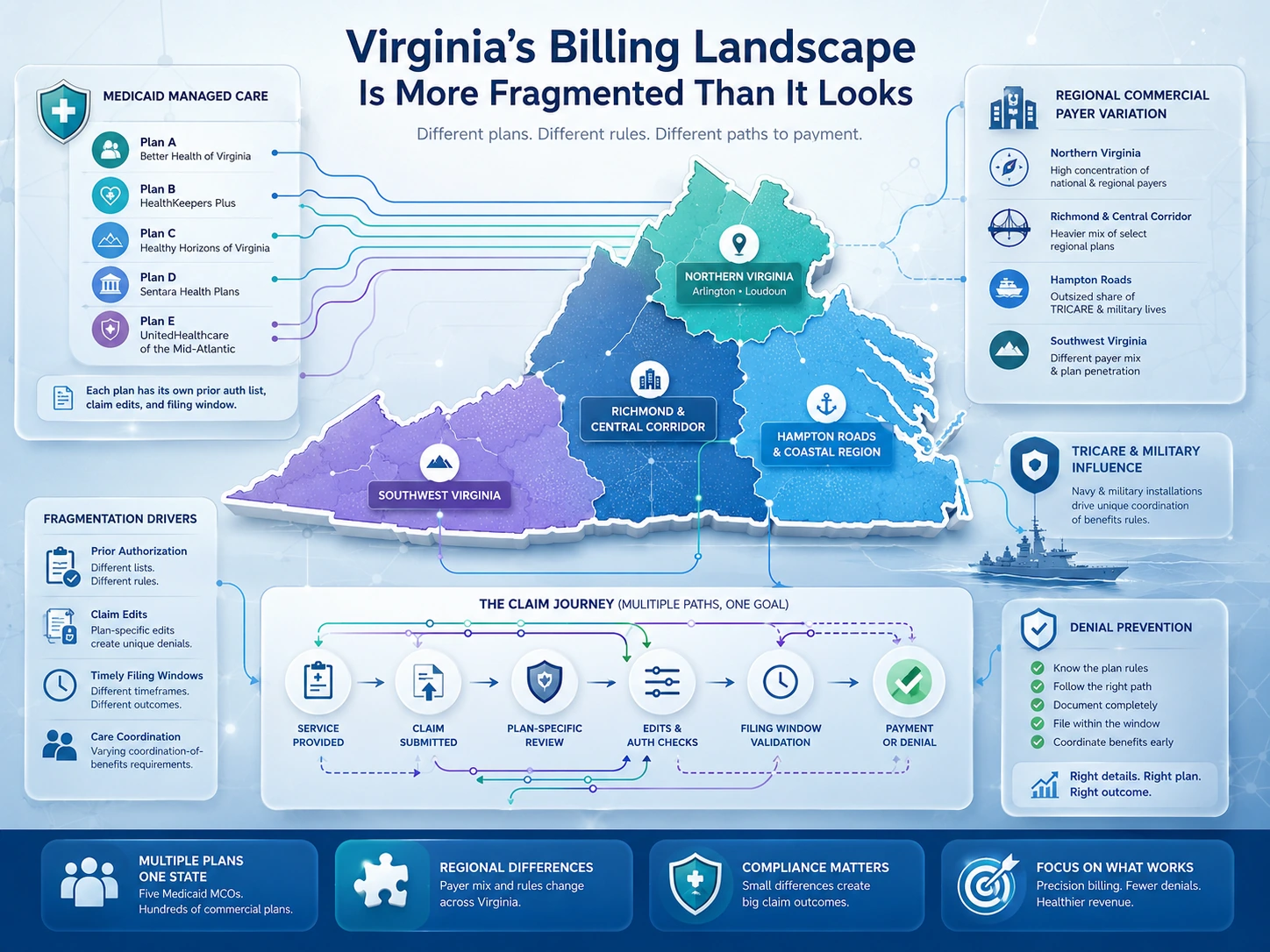
Virginia Billing Landscape Is More Fragmented Than It Looks
Ask a biller in most states what “Medicaid” means and you’ll get one answer. Ask a biller working Virginia claims, and the answer depends on which of five managed care organizations the patient happens to be enrolled with. Since July 2025, Virginia’s Cardinal Care Managed Care program has run through Aetna Better Health of Virginia, Anthem HealthKeepers Plus, Humana Healthy Horizons of Virginia, Sentara Health Plans, and UnitedHealthcare of the Mid-Atlantic. Each of those five plans sets its own prior authorization list, its own claim edits, and its own timely filing window. A claim built for Anthem’s requirements doesn’t automatically clear Sentara’s, even though both plans are technically administering the same state program.
Layer regional payer variation on top of that. A Northern Virginia practice near Arlington or Loudoun County routes a meaningful share of commercial claims through CareFirst BlueCross BlueShield, a payer that barely shows up on the radar of a practice in Southwest Virginia. Hampton Roads carries an outsized share of TRICARE claims because of the region’s Navy and military installations, which brings its own coordination-of-benefits rules into play. Richmond and the central corridor lean heavily on Anthem and Sentara commercial plans. None of this is exotic information, but it’s the kind of detail that gets missed by a billing vendor running a one-size-fits-all national process, and it’s exactly where claims start getting denied for reasons that have nothing to do with the care that was actually delivered.
What Laws Apply to
Medical Billing in Virginia?
Virginia billing compliance sits at the intersection of state insurance code and federal healthcare law. Here’s what governs the claims a Virginia practice submits.
Balance billing prohibition
Va. Code § 38.2-3445.01Effective January 1, 2021, out-of-network providers cannot balance bill patients for emergency services or qualifying non-emergency care delivered at an in-network facility.
Read payment dispute details
When the provider and carrier cannot agree on payment, either side may request arbitration through Virginia’s State Corporation Commission. The dispute is evaluated using a commercially reasonable payment standard drawn from comparable claims data.
State employee plan protections
State lawVirginia state employee health plan members receive parallel balance billing protections specific to that plan population.
Claims handling and prompt payment
ClaimsCarriers must notify providers of claim issues within the required window. Interest may accrue when properly submitted claims remain unpaid beyond the applicable payment period.
Medical debt collection protections
CollectionsMedical facilities, licensed providers, and collection companies working on their behalf are restricted from reporting medical debt to consumer reporting agencies.
Federal No Surprises Act
Federal lawFederal surprise billing protections also cover self-funded ERISA plans that may fall outside Virginia’s state-law jurisdiction.
HIPAA privacy and security
Federal lawAny outsourced billing vendor handling Virginia patient data must follow federal privacy and security rules and have a signed Business Associate Agreement in place.

What Fragmented Billing Actually Costs a Practice
The revenue leakage from payer complexity rarely shows up as one dramatic loss. It shows up as a slow accumulation: a claim that sits three weeks past its filing deadline because nobody flagged the MCO-specific window, a denial that never gets appealed because the front desk is already behind on the next batch, a new provider who can’t bill for four months because credentialing paperwork stalled. None of these individually breaks a practice. Together, they’re usually the difference between a practice that’s profitable and one that’s treading water despite a full schedule.
Days in accounts receivable is the metric that tends to expose this fastest. A practice with a disciplined denial-management process typically keeps A/R days in a manageable range; a practice without one watches that number climb every quarter as unworked denials pile up behind current claims. By the time an owner-physician notices the cash flow problem, the underlying cause is often eighteen months of accumulated billing debt that’s much harder to untangle than it would have been to prevent.
How Docscare Structures Billing for Virginia Practices
- Payer mapping and enrollment. Before a single claim goes out, we document which of the five Cardinal Care MCOs, which commercial carriers, and whether TRICARE applies to your patient population, and configure claim routing to match.
- Coding and charge entry. AAPC-certified coders assign CPT, ICD-10, and HCPCS codes against current payer-specific edits, not a generic rule set applied across every state.
- Clean claim submission. Claims go out within 24 hours of documentation being finalized, formatted to each payer’s specific submission requirements to avoid a rejection before the claim is even reviewed.
- Denial management and appeals. A denied claim gets triaged immediately: identify the reason, correct the underlying issue, and refile or appeal within the payer’s timely filing window, tracked against Virginia’s prompt-payment interest provisions.
- Credentialing and re-credentialing. New providers and specialty additions get enrolled across the relevant MCOs and commercial payers in parallel, rather than sequentially, which is usually where multi-month delays creep in.
- Reporting and reconciliation. You see what’s paid, what’s pending, and what’s aged without requesting a report, on a cadence that matches how often you actually want to look at it.
Don’t let credentialing delays stall your revenue.
We manage CAQH profiles, MCO enrollment, and re-credentialing timelines so your providers can start billing sooner.
Medical Billing Services for Small Practices in Virginia
A solo or two-physician practice runs into a version of Virginia’s billing complexity that a large health system simply doesn’t feel the same way. A hospital system has a department; a small practice has one biller who also answers phones, and when that person is out for a week, claims stop moving. Layer five separate MCOs, each with its own rules, onto a staff that small, and the administrative burden stops being proportional to the practice’s size.
What a small Virginia practice actually needs from a billing partner looks different from what a large group needs. Reporting has to be readable in a few minutes by an owner-physician, not built for a hospital finance department. Pricing needs to scale down without hitting an enterprise minimum that makes outsourcing pointless at low claim volume. And responsiveness matters more, not less: when a front-desk staffer has a question about a denied Sentara claim, a billing partner that takes three days to respond costs a small practice more, proportionally, than it costs a 40-provider group. Docscare works with practices starting at a single physician, and our reporting and communication are built around that reality rather than scaled down from an enterprise product.

Medical Billing Outsourcing in Virginia : How the Switch Works
Most Virginia practices evaluating outsourcing are weighing the same three variables: cost, control, and consistency.
| Factor | In-House Billing | Outsourced Billing |
|---|---|---|
| Staffing risk | Turnover stalls claims until a replacement is hired and trained. | A team covers the account; no single point of failure. |
| MCO expertise | Limited to what current staff has learned on the job, often for one or two plans. | Coders track edits and prior-authorization rules across all five Cardinal Care MCOs and commercial payers. |
| Cost structure | Fixed salary, benefits, and software costs regardless of claim volume. | Typically a percentage of collections, so cost scales with what is actually collected. |
| Denial follow-up | Often deprioritized when staff is busy with patient-facing work. | Dedicated denial management as a core function, not an afterthought. |
| Credentialing | Usually handled reactively, after a provider is already hired. | Managed proactively, in parallel with hiring. |
A few signs typically indicate a Virginia practice is past the point where in-house billing still makes sense: denial rates that keep climbing despite the same staff working the same process, a provider who’s been credentialed with only two or three of the five Cardinal Care MCOs because enrollment with the rest never got finished, or an owner-physician who genuinely doesn’t know the practice’s current days-in-A/R number.
A transition to outsourced billing typically runs two to four weeks. Week one covers payer setup and clearinghouse connections. Weeks two and three run a parallel process alongside whatever the practice currently has in place, so nothing falls through during the handoff. Full transition happens once claims are moving cleanly through the new process. Practices retain ownership of their patient data throughout and can request claim-level reporting at any point, not just at contract renewal.
Medical Specialties We Bill for in Virginia
Your practice is matched with coders who understand its procedures, documentation standards, payer edits, and specialty-specific denial patterns.
Explore all specialtiesChoose your practice type
Regional Considerations Across Virginia
Virginia is not one uniform healthcare market. Payer mix, patient demographics, claim requirements, and reimbursement challenges can change significantly from one region to another.
Northern Virginia
Arlington · Fairfax · Loudoun
A higher concentration of commercial and federal employee plans, including CareFirst BlueCross BlueShield alongside Anthem and Sentara. Practices also see more out-of-state patients and payers, increasing coordination-of-benefits complexity.
Hampton Roads
Norfolk · Virginia Beach · Chesapeake
The region’s Navy and military presence creates a significant share of TRICARE claims, bringing distinct referral, coordination, and timely-filing requirements.
Richmond & Central Virginia
Richmond · Central communities
A commercial payer mix led by Anthem and Sentara, alongside a broad Cardinal Care Medicaid population distributed across all five managed-care organizations.
Roanoke & Southwest Virginia
Roanoke · Southwest communities
Lower payer density than northern and coastal Virginia, with regional claim patterns in which managed-care organizations represent a larger share of the local Medicaid population.
Charlottesville Region
Charlottesville · Surrounding communities
Academic-medicine referral patterns intersect with commercial and Medicaid billing, while Cardinal Care enrollment periods may follow a different regional calendar.
Local payer knowledge helps reduce preventable denials, identify plan-specific requirements, and accelerate reimbursement.

Common Billing Mistakes That Cost Virginia Practices Revenue
A handful of patterns show up repeatedly in practices that come to Docscare after managing billing in-house or through a prior vendor:
- Treating the five Cardinal Care MCOs as interchangeable. Each has its own prior authorization list, timely filing window, and claim edits. Submitting identical claims across all five produces avoidable denials.
- Letting denials sit unworked. A denied claim isn’t dead, but Virginia’s prompt-payment interest provisions only help a practice that actually resubmits or appeals within the required window.
- Under-documenting medical necessity. Payers increasingly request supporting documentation before paying, especially on diagnostic and behavioral health claims, and a claim without it stalls regardless of how correctly it was coded.
- Delaying credentialing until a provider starts seeing patients. MCO and commercial payer enrollment can take 90 to 120 days, and claims filed before enrollment finalizes get denied outright rather than delayed.
- Missing regional payer shifts. A practice that hasn’t updated its payer contracts to reflect the Molina-to-Humana transition that took effect in July 2025, for example, is still routing claims to a plan that no longer covers those patients.
Built for Better Billing in Virginia
One experienced team managing the details that influence reimbursement, payer coordination, and practice growth.
Faster, Cleaner Claims
Fewer rejections help practices receive payments sooner.
All Five Cardinal Care MCOs
One billing relationship replaces five separate payer workflows.
One Coordinated Team
Billing, coding, and credentialing managed in one place.
Boutique-Level Support
The same people learn and support your account every month.
Right-Sized for Every Practice
Dedicated service for solo physicians and provider groups alike.
Frequently Asked Questions
If your question is not answered here, contact our billing team directly. Most questions get a same-day response.
What laws apply to medical billing in Virginia?
Virginia’s balance billing law (Va. Code § 38.2-3445.01) bars out-of-network providers from balance billing patients for emergency care and certain non-emergency services at in-network facilities. Carrier prompt-payment rules (§ 38.2-3407.15) require timely claim handling, and medical debt collection protections (§ 59.1-444.4) bar reporting medical debt to credit bureaus. Federal HIPAA and the No Surprises Act apply on top of these.
Does Virginia require medical billing companies to be licensed?
Medical billing companies aren’t insurers or providers, so Virginia doesn’t require a separate billing-company license. The practice itself remains responsible for compliance, and it’s worth confirming any billing partner’s coders carry current AAPC or equivalent certification.
How many Medicaid managed care plans operate in Virginia?
Five, as of July 2025: Aetna Better Health of Virginia, Anthem HealthKeepers Plus, Humana Healthy Horizons of Virginia, Sentara Health Plans, and UnitedHealthcare of the Mid-Atlantic. Humana replaced Molina Healthcare in that lineup effective July 1, 2025.
How much does outsourcing medical billing cost in Virginia?
Outsourced billing is typically priced as a percentage of collections rather than a flat fee, so cost scales with what the practice actually collects rather than claim volume alone. Exact pricing depends on specialty, claim volume, and scope of services.
Can Docscare bill Virginia Medicaid and Cardinal Care MCO claims?
Yes. We handle enrollment and claim submission across all five Cardinal Care MCOs, along with commercial payers and TRICARE.
What happens if a Virginia patient receives a surprise bill?
Under Virginia’s balance billing law, a patient generally owes only their in-network cost-sharing amount for covered emergency and certain non-emergency out-of-network services. The provider and carrier resolve the remaining amount directly, through the SCC’s arbitration process if needed.
How long does it take to switch billing companies in Virginia?
Does Docscare work with small practices in Virginia?
Keep Billing Complexity From Becoming Lost Revenue.
Docscare handles coding, claim submission, denial follow-up, and credentialing for practices across the Commonwealth—giving your team one accountable partner for the entire billing process.
Clean claim ratio
