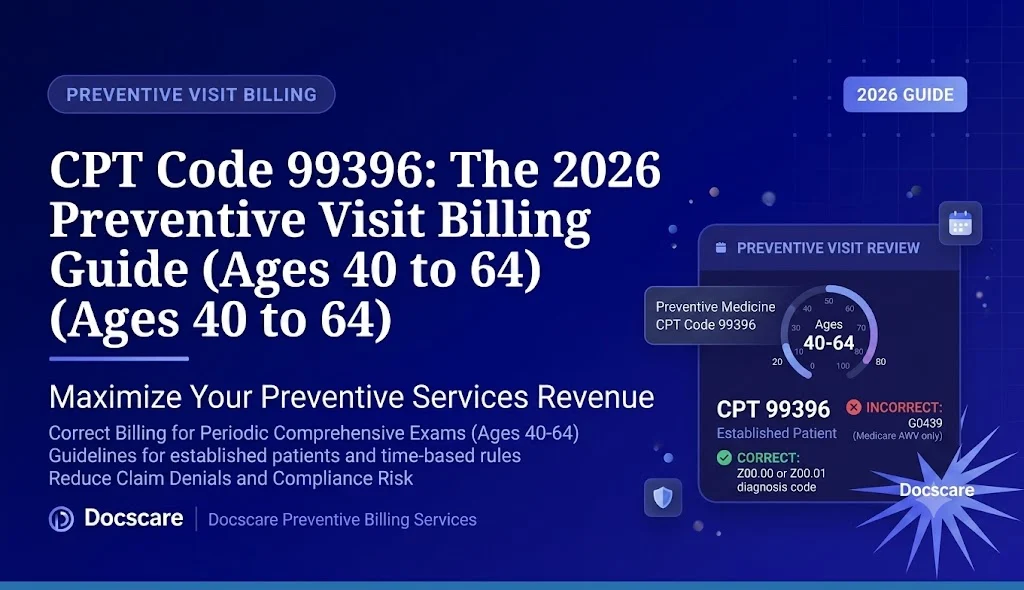
CPT Code 99396 is the routine physical for an established patient between 40 and 64 years old. That age range isn’t a detail, it’s the entire identity of the code, and it’s the number one reason these claims get denied. Bill 99396 for a 38 year old or a 66 year old and the claim bounces back with an age mismatch denial you cannot appeal, because it is a coding error, not a coverage dispute. Get the age right and the rest of the visit’s straightforward. Get it wrong and no amount of documentation saves the claim. So this guide starts where the denials start: the age.
Here is what CPT Code 99396 covers, the exact age rule and the codes on either side of it, why Medicare won’t pay it, and the handful of mistakes that turn a routine physical into a denied claim.
FREE CHECK
Losing preventive visits to age or Medicare denials?
Table of Contents
ToggleWhat Is CPT Code 99396?
CPT Code 99396 is a periodic comprehensive preventive medicine visit for an established patient aged 40 to 64. In plain terms, it’s the annual physical for a midlife adult who has been seen by your practice before. The visit covers an age and gender appropriate history, a full physical exam, counseling and anticipatory guidance, risk factor reduction, and ordering any labs or screenings the patient is due for. It’s preventive care, health maintenance, not a visit built around a symptom or a complaint.
That preventive nature drives the coding. Because the visit is not about a problem, the primary diagnosis is a preventive Z code, Z00.00 or Z00.01, rather than a condition. And because it is a physical, it is a hands on, in person service, payers do not recognize it as a telehealth visit. This kind of preventive work sits at the center of primary care, which is why our family medicine billing services and internal medicine billing services lean on getting it right.
The Age Rule: CPT Code 99396 Is Only for Ages 40 to 64
This is the heart of the code and the heart of the denials. 99396 applies to one age band and one only: established patients 40 through 64. Step outside it and the claim denies automatically. That’s the whole game. Here is the full preventive family so you always pick the right one.
| Code | Patient and Age | When to Use It |
|---|---|---|
| 99395 | Established, 18 to 39 | The younger adult preventive visit |
| 99396 | Established, 40 to 64 | This code, the midlife preventive visit |
| 99397 | Established, 65 and older | Switch to this the moment the patient turns 65 |
| 99386 | New patient, 40 to 64 | Same age band, but for a patient new to your group |
Two age traps catch practices most. The first is patient status: CPT Code 99396 is for established patients, so a patient who’s new to your group in the same 40 to 64 band belongs to CPT Code 99386, not 99396. The second is the 65 birthday. The day a long time patient turns 65, the correct code becomes 99397, and continuing to bill CPT Code 99396 generates age mismatch denials that pile up in accounts receivable. Track age transitions in scheduling, not just at billing, so the code is right before the claim ever goes out.
FREE CHECK
Want us to catch age and status mismatches before they deny?
Why Medicare Will Not Pay CPT Code 99396
Here is the rule that surprises new billers: traditional Medicare doesn’t cover CPT Code 99396 at all. Medicare statute excludes routine physicals from coverage, so a CPT Code 99396 claim for a traditional Medicare patient denies every time. You can confirm the rate any covered payer uses on the CMS physician fee schedule. Medicare has its own preventive pathway, and you bill those codes instead: G0402 for the Welcome to Medicare visit in the first year of Part B, G0438 for the initial Annual Wellness Visit, and G0439 for each subsequent Annual Wellness Visit. Route every traditional Medicare patient to that pathway. The full detail lives in the CMS Medicare preventive services guidance. One exception is worth checking: some Medicare Advantage plans cover CPT Code 99396 as a supplemental benefit, so verify the specific plan before you bill or write it off.
Billing a Problem With the Physical: Modifier 25
Patients rarely keep a physical purely preventive. They just don’t. Halfway through the exam, a patient mentions their knee has been swelling, or their blood pressure reading is high enough to manage today. When you address a significant, separate problem during the preventive visit, you can bill both services. You report CPT Code 99396 for the physical and a problem visit, such as 99214, with modifier 25 appended to the problem code, never to CPT Code 99396.
The catch is documentation, and it is where audits land. The problem visit has to stand on its own in the record, its own history, its own exam, its own decision making, separate from the preventive work. Using the same exam findings to support both the physical and the problem visit, what auditors call double dipping, is the single most common audit finding for this code. Tell the patient in advance, too, that the problem portion may apply to their deductible or copay even though the physical is covered without cost sharing.
The CPT Code 99396 Denials We Prevent
Most CPT Code 99396 denials come from a short, predictable list. Coding and documentation errors are the leading denial category across healthcare, with industry denial rates between 10 and 15 percent, per 2026 denial benchmarks. Here are the ones that hit preventive claims.
| Common Mistake | What It Causes | How We Prevent It |
|---|
Patient is under 40 or over 64Automatic age mismatch denial you cannot appealWe check date of birth against the code on every preventive claim, and switch to 99395, 99397, or 99386 as the age and status require
Billing 99396 to traditional MedicareAutomatic denial; Medicare excludes routine physicalsWe route Medicare patients to the Annual Wellness Visit codes G0438 or G0439, and verify Medicare Advantage coverage before billing 99396
Wrong diagnosis codeMedical necessity denialWe use Z00.00, or Z00.01 sequenced first when abnormal findings appear, not a problem based code
Modifier 25 on 99396 instead of the problem codeBundling denial on the same day E/MWe append modifier 25 to the problem visit, such as 99214, and never to 99396
Same note supports both the physical and the problemThe top audit finding for this codeWe document the preventive work and the problem work as separate, independently supported services
Billing it more than once in the frequency windowFrequency denialWe verify the last preventive date, since most payers allow one per calendar year or per 365 days
The 2026 rules add two wrinkles worth building into your workflow. Under the current ICD-10 sequencing, Z00.01 has to be listed first when the physical turns up abnormal findings, not Z00.00. And CMS refreshed its Annual Wellness Visit guidance in early 2026 with new detail on social determinants screening and the G2211 add on, which matters if you run one preventive workflow for both commercial and Medicare patients. When a claim still slips through and denies, our denial management services work it back and fix the pattern.
How Docscare Keeps Your Preventive Visits Clean
We bill preventive medicine the way it actually pays, around the age band, the Medicare substitution, and the modifier 25 documentation rule, not just a code number. Our AAPC-certified coders check the patient’s age and status against the code, route Medicare patients to the Annual Wellness Visit pathway, use the right preventive Z code, keep modifier 25 on the problem visit and off 99396, and confirm the problem note stands on its own. When a claim denies, we work it back and fix the root cause.
We’re a US based medical billing company in Austin, Texas, fully HIPAA compliant, running a 99 percent clean claim rate with a 97.45 percent first pass acceptance rate. Preventive visits are high volume in primary care, so getting the age, the payer, and the modifier right across hundreds of physicals a month is the difference between full payment and a stack of age mismatch denials. See how it fits into our full medical coding services.
FREE PREVENTIVE BILLING REVIEW
Let us review a sample of your 99396 claims for age, status, Medicare routing, and modifier 25 errors, then show you exactly where the revenue is leaking. No cost, no obligation.
Frequently Asked Questions
What is CPT code 99396?
CPT Code 99396 is a periodic comprehensive preventive medicine visit, a routine physical, for an established patient between 40 and 64 years of age. It covers an age and gender appropriate history, a full exam, counseling, risk factor reduction, and the ordering of any needed labs or screenings. It is a wellness visit, not a problem visit, so the primary diagnosis is a preventive Z code, Z00.00 or Z00.01, rather than a symptom or condition.
What age is CPT code 99396 for?
CPT 99396 is only for established patients aged 40 through 64. Age defines this code, and getting it wrong is the single most common reason these claims deny. A patient aged 18 to 39 belongs to 99395, and a patient 65 or older belongs to 99397. The day a long time patient turns 65, you switch to 99397, because billing CPT Code 99396 for a 65 year old produces an automatic age mismatch denial that cannot be appealed.
Does Medicare cover CPT Code 99396?
No. Traditional Medicare does not cover CPT Code 99396, because routine physicals are excluded from coverage by statute. For Medicare patients you bill the Annual Wellness Visit pathway instead: G0402 for the Welcome to Medicare visit, G0438 for the initial Annual Wellness Visit, and G0439 for each subsequent one. Some Medicare Advantage plans do cover 99396 as a supplemental benefit, so verify with the specific plan before you bill it.
Can you bill CPT Code 99396 and a problem visit on the same day?
Yes. When a patient comes in for the preventive visit and also raises a significant, separate problem, you can bill both. You report the preventive CPT Code 99396 and the problem visit, such as 99213 or 99214, with modifier 25 appended to the problem code, never to 99396. The catch is documentation: the note has to support the problem visit independently of the preventive work. Reusing the same history and exam for both is the top audit finding for this code.
What diagnosis codes are used with CPT Code 99396?
99396 uses preventive Z codes, not problem codes. The primary diagnosis is Z00.00, an encounter for a general adult medical exam without abnormal findings, or Z00.01 when abnormal findings are discovered during the visit. Under the 2026 ICD-10 sequencing rules, Z00.01 must be listed first when abnormal findings are present. Using a problem based diagnosis as the primary code for a preventive visit triggers a medical necessity denial