If your coder just typed “cystoscopy” into the claim form and picked the first code that came up, stop. CPT code 52000 is the code most practices reach for, and it’s correct more often than not. But it’s also one of the most denied codes in urology billing, because it carries a special label that most billing software doesn’t flag: separate procedure.
That label means Medicare and every commercial payer treat 52000 as a component code. The moment your urologist does anything beyond looking, a biopsy, a stent, a dilation, 52000 gets bundled into the more specific code and the claim for 52000 gets rejected. Understanding exactly what the code covers, what it excludes, and what it pays in 2026 is the difference between a clean claim and a resubmission.
Table of Contents
ToggleWhat Does CPT Code 52000 Cover?
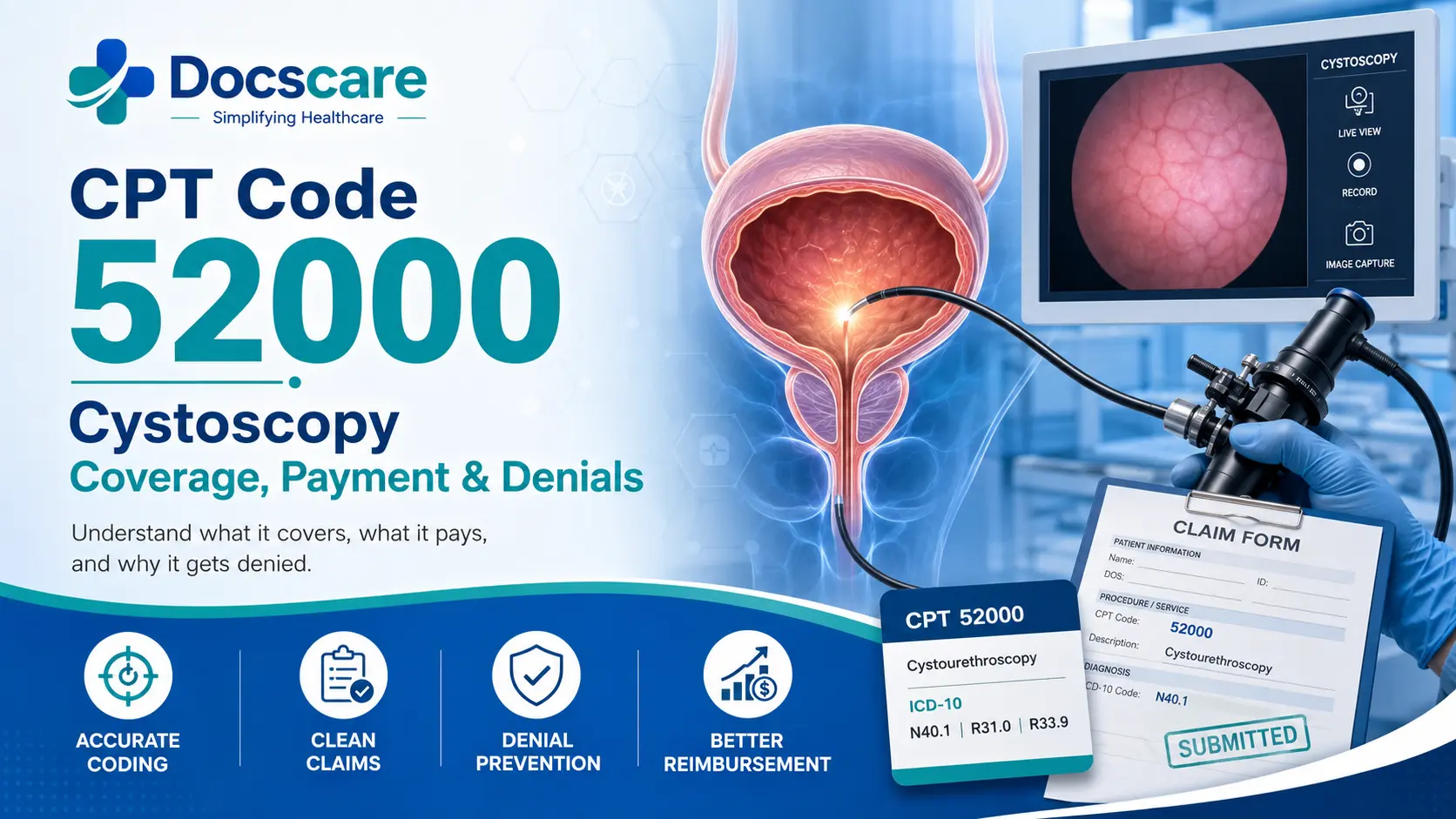
CPT code 52000 covers a diagnostic cystourethroscopy: a visual exam of the urethra and bladder using a rigid or flexible scope, with no treatment performed. The physician inserts the scope through the urethra and examines the bladder neck, trigone, ureteral orifices, and bladder mucosa. Irrigation used to keep the view clear is included in the code. So is basic urethral measurement to confirm the scope will pass.
Practices bill 52000 for lower urinary tract workups. Hematuria, recurrent UTIs, unexplained pelvic pain, and suspected bladder tumors are the most common reasons a physician orders one. If the exam ends there, with findings documented but nothing done to treat them, 52000 is the right code.
What CPT Code 52000 Does Not Cover
This is where claims fall apart. CPT 52000 excludes:
- Biopsy of bladder or urethral tissue (code 52204)
- Fulguration of lesions (52214 or 52224)
- Tumor resection (52234 through 52240)
- Ureteral stent insertion (52332) or removal (52310)
- Urethral dilation (52281)
- Botox injection into the bladder (52287)
- Stone or foreign body removal
- Evacuation of obstructing clots (52001)
If any of these happen during the same encounter, that procedure code replaces 52000. You don’t bill both. The National Correct Coding Initiative runs an automatic edit that catches 52000 sitting next to any of these codes and denies it outright, before a single reviewer reads the operative note.
Bundling one wrong code with 52000 can cost your practice a full claim, not just a line item. Our Medical Coding Services team reviews every cystoscopy note against current NCCI edits before submission, so you catch the conflict before the payer does.
How Much Does CPT Code 52000 Pay in 2026?
Payment depends entirely on where the procedure happens. Under the 2026 Medicare Physician Fee Schedule, CPT 52000 pays close to $216 in an office setting and roughly $71 in a facility such as a hospital outpatient department or ambulatory surgery center. The gap exists because the office rate folds in the practice expense (the scope, the room, the supplies) that a facility bills separately through its own outpatient payment.
| Setting | Approximate 2026 Medicare Rate |
|---|---|
| Office (POS 11) | $216 |
| Ambulatory Surgery Center (POS 24) | $71 |
| Hospital Outpatient (POS 22) | $71 |
Commercial payers set their own contracted rates, typically a percentage of Medicare, so always verify the fee schedule for each payer rather than assuming Medicare parity.
Cystoscopy Codes Compared: 52000 vs the Codes It’s Confused With
| CPT Code | What It Reports | Bills With 52000? |
|---|---|---|
| 52000 | Diagnostic cystoscopy, exam only | N/A |
| 52001 | Cystoscopy with clot evacuation | No, replaces 52000 |
| 52204 | Cystoscopy with biopsy | No, replaces 52000 |
| 52281 | Cystoscopy with urethral dilation | No, replaces 52000 |
| 52332 | Cystoscopy with ureteral stent placement | No, replaces 52000 |
The pattern holds across nearly every code in the 52000 through 52356 range. If the encounter note describes any intervention beyond looking, code the intervention and drop 52000 from the claim entirely.
Why Do Cystoscopy Claims Get Denied?
Three reasons account for most CPT Code 52000 denials we see when we audit a urology billing file:
- The claim lists 52000 alongside a therapeutic code. The NCCI edit fires automatically. No documentation review happens first.
- The operative note doesn’t specify scope type. Payers increasingly want to see whether the physician used a flexible or rigid scope, not just that a cystoscopy occurred.
- Medical necessity isn’t tied to a diagnosis code. A cystoscopy without a documented symptom, such as hematuria or recurrent infection, reads as unsupported to a payer’s algorithm.
Fixing all three is a documentation problem before it’s a coding problem. Coders can only bill what the note supports.
A Quick Documentation Checklist
Before you submit a CPT Code 52000 claim, confirm the note includes:
- Scope type (flexible or rigid)
- Every structure examined (urethra, bladder neck, trigone, ureteral orifices, mucosa)
- Findings, even if normal
- The diagnosis driving the exam (hematuria, recurrent UTI, and so on)
- Explicit confirmation that no biopsy, dilation, stent, or other intervention occurred
FREE CHECK
Getting 52000 right on paper still leaves money on the table if your documentation habits don’t change. Our coders work directly with your physicians to close the gaps that trigger denials, what it pays in 2026 is the difference between a clean claim and a resubmission
Frequently Asked Questions
What is CPT code 52000 used for?
CPT code 52000 reports a diagnostic cystourethroscopy, a visual exam of the urethra and bladder with a cystoscope, performed with no treatment or intervention during the same visit.
Can you bill CPT Code 52000 with a biopsy code?
No. When a physician takes a biopsy during the same cystoscopy, code 52204 replaces 52000. Billing both triggers an automatic NCCI denial.
How much does CPT Code 52000 pay under Medicare in 2026?
Roughly $216 in an office setting and $71 in a facility setting, based on the 2026 Medicare Physician Fee Schedule. Commercial rates vary by contract.
Does CPT Code 52000 cover a flexible or rigid cystoscope?
Both. The code applies regardless of scope type, but 2026 documentation standards increasingly expect the note to state which one the physician used.
Why did my cystoscopy claim get denied?
The most common reasons are billing 52000 next to a therapeutic cystoscopy code, missing scope type documentation, or a missing diagnosis that supports medical necessity for the exam.