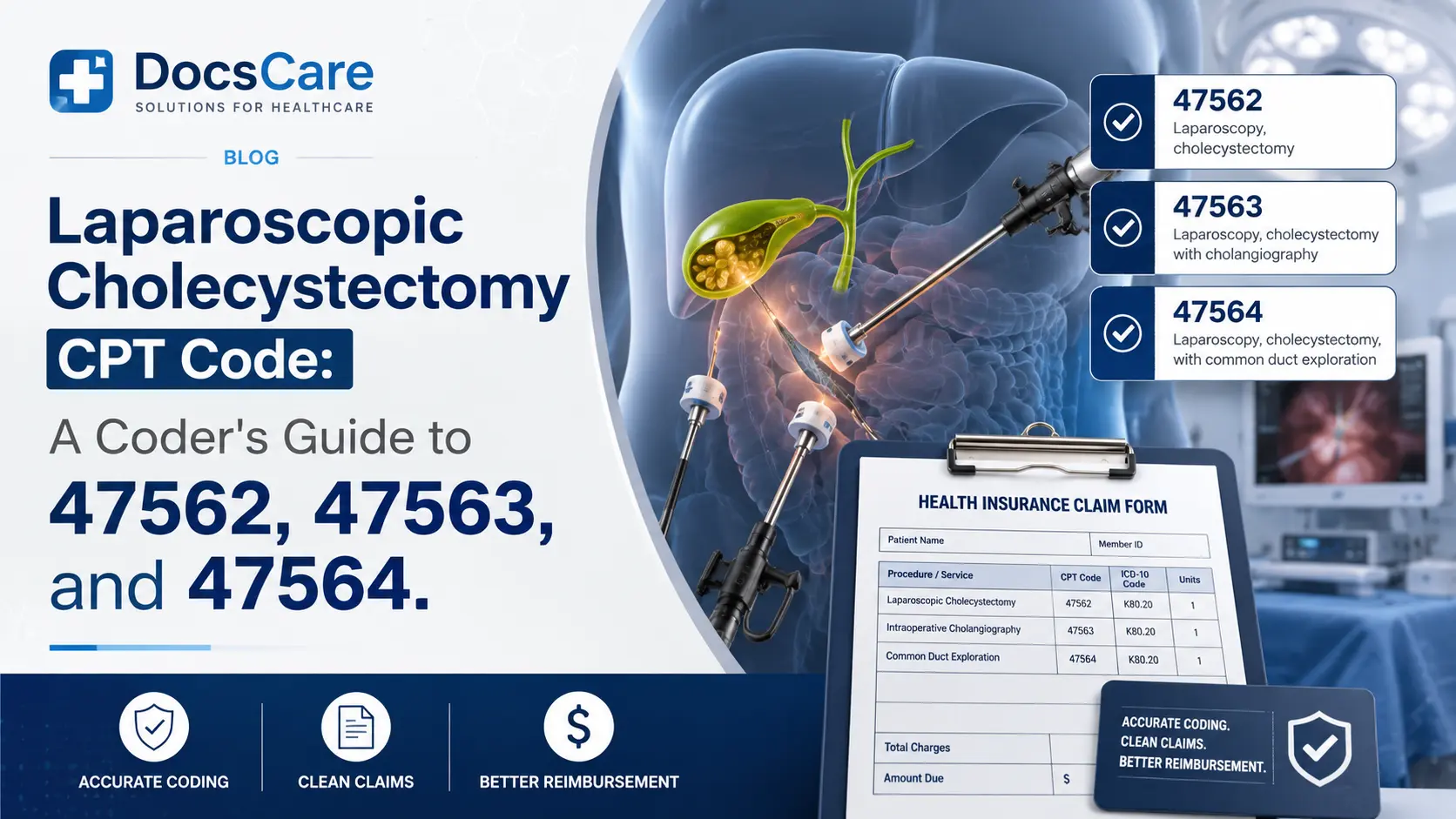
The CPT code for a standard laparoscopic cholecystectomy is 47562. If the surgeon performs an intraoperative cholangiogram, the code changes to 47563. If the surgeon explores the common bile duct, it becomes 47564. Three codes, three distinct clinical pictures, and one wrong choice is enough to trigger a denial or an audit flag.
Gallbladder removal ranks among the most common general surgery procedures in the country. That volume is exactly why coding errors on this claim type add up fast for a practice. This guide walks through how to pick the right code, what documentation each one requires, and where claims most often fall apart.
Table of Contents
ToggleWhat Is the CPT Code for Laparoscopic Cholecystectomy?
CPT Code 47562 covers a routine laparoscopic gallbladder removal with no additional imaging and no bile duct exploration. The surgeon dissects the hepatocystic triangle, ligates the cystic duct and artery, and removes the gallbladder through a small incision, usually near the umbilicus.
Three questions, asked in order, get a coder to the correct answer every time.
- Did the procedure stay laparoscopic, or did the surgeon convert to open?
- Did the surgeon perform intraoperative cholangiography, meaning contrast was injected into the cystic or common bile duct under fluoroscopic guidance with images obtained and interpreted?
- Did the surgeon go beyond imaging and physically intervene in the duct, such as stone extraction, a balloon sweep, or a choledochotomy?
The operative report is the only source of truth. Passive visualization of the duct during dissection does not count as exploration. Read the note before you touch the claim.
CPT Code 47562 vs 47563 vs 47564: How to Choose
| CPT Code | What It Covers | Trigger |
|---|---|---|
| 47562 | Standard laparoscopic cholecystectomy | No cholangiography, no duct exploration |
| 47563 | Laparoscopic cholecystectomy with cholangiography | Contrast injected and imaged under fluoroscopy |
| 47564 | Laparoscopic cholecystectomy with common bile duct exploration | Stone extraction, basket retrieval, balloon sweep, or choledochotomy |
These three codes form a hierarchy. Each higher code already includes the work of the lower ones, so they should never appear together on the same claim. If a separate radiologist reads the cholangiogram, the surgeon still bills 47563 for the injection and the procedure, while the radiologist bills a separate supervision and interpretation code. Two different providers, two different roles, two different claims.
What Documentation Supports Each CPT Code?
Payers deny cholecystectomy claims for a small number of repeat reasons, and nearly all of them trace back to thin documentation rather than a genuinely wrong code choice.
For CPT Code 47562 to pass medical necessity review, the operative note needs to show symptomatic gallstones confirmed by imaging, acute or chronic cholecystitis, or biliary dyskinesia requiring surgery. An incidental finding of asymptomatic gallstones on an unrelated scan is one of the most frequent denial triggers our team sees, because most payers do not consider it a standalone indication for elective removal.
For 47563, the note needs explicit language confirming contrast injection and fluoroscopic imaging, not just a mention that the duct was visualized. For 47564, the note needs to describe the specific intervention performed, whether that is a transcystic stone extraction with a wire basket or a choledochotomy with primary repair.
medical coding services
Miscoded cholecystectomy claims cost practices real revenue every month, usually from thin documentation rather than a genuinely wrong CPT choice. Our medical coding services team reviews every operative note against payer specific requirements before a claim ever goes out, so 47562, 47563, and 47564 get applied correctly the first time.
What Happens When a Procedure Converts From Laparoscopic to Open?
If the surgeon starts laparoscopically and converts to an open approach, report only the open code. That means CPT 47600 for a standard open cholecystectomy, 47605 with cholangiography, or 47610 with common bile duct exploration. Do not report a laparoscopic code alongside the open code on the same claim. Billing both is duplicate billing and one of the more common audit findings in general surgery coding, and CMS National Correct Coding Initiative guidance is direct on this point: the failed laparoscopic attempt is not separately reportable once conversion happens.
One exception exists. If a diagnostic laparoscopy happens at a genuinely separate encounter from a later open cholecystectomy, modifier 58 allows the two to be reported separately as a staged procedure. That is a narrow scenario, not a workaround for a same day conversion.
Common Modifiers on Cholecystectomy Claims
- Modifier 22 signals increased procedural service for a genuinely difficult case, such as a severely inflamed or gangrenous gallbladder densely adherent to surrounding organs. This modifier draws audit attention, so the operative note must describe the added complexity in specific terms, not just state that the case was hard.
- Modifier 51 applies when a cholecystectomy is billed alongside another procedure in the same session.
- Modifier 52 applies when the procedure was reduced or not completed as originally planned.
- Modifier 58 applies to the staged procedure scenario described above.
Adhesiolysis performed as a routine part of the dissection does not get its own code. It only becomes separately reportable when the operative note documents that the adhesions significantly extended the complexity and time of the case, and even then it typically shows up as modifier 22 rather than an additional line item.
Why Claims Get Denied: The Patterns Behind the Numbers
Denials on this code family follow a short list of repeat causes: missing medical necessity documentation, code mismatches between the operative note and the claim, missing modifiers, and duplicate billing after an open conversion. Understanding the top reasons insurance claims get denied across surgical billing more broadly helps explain why this particular code family shows up so often in denial reports. A practice that tightens documentation on cholecystectomy claims usually sees the same discipline pay off across its entire surgical caseload.
Is the CPT Code Different for Robotic Assisted Cholecystectomy?
No. Robotic assistance describes the surgical technique, not a separately billable service. A robotic cholecystectomy still gets coded as 47562, 47563, or 47564 depending on what actually happened during the case. Some commercial payers track robotic utilization through a separate HCPCS Level II tracking code, but that code exists for reporting purposes and does not change the underlying CPT Code selection or reimbursement.
How CPT Codes Connect to the Bigger Billing Picture
A cholecystectomy claim rarely lives in isolation. Getting the CPT code right is one piece of a chain that includes accurate ICD-10 linkage, clean claim submission, and follow up if a payer pushes back. Understanding how ICD-10 and CPT codes work together on a single claim helps coders see why a technically correct CPT code can still deny if the diagnosis code does not support medical necessity.
Once a claim goes out clean, the work shifts to tracking it through to payment. That is where revenue cycle management becomes the connective layer between coding accuracy and actual cash in the practice’s account. A practice that codes well but does not follow claims through the full cycle still leaves money on the table.
coding services team
Cholecystectomy coding looks simple until an operative note gets vague or a case converts to open mid surgery. Our coding services team at Docscare specializes in general surgery billing, with AAPC certified coders who read every note against current NCCI edits before a claim goes out.
The Bottom Line
CPT Code 47562, 47563, and 47564 cover three distinct clinical scenarios, and the operative note tells you which one applies every time. Get the documentation right, apply modifiers only when the note supports them, and never let a converted case go out with both a laparoscopic and an open code on the same claim. If your team’s denial rate on general surgery claims has been climbing, this code family is a good place to start the audit. For practices working through recurring denial management issues, cholecystectomy claims are frequently one of the top three contributors, and cleaning up documentation here tends to produce a fast, measurable drop in denials.
FAQ Section
What is the CPT code for laparoscopic cholecystectomy?
The standard CPT code is 47562. If the surgeon performs an intraoperative cholangiogram, the correct code becomes 47563. If the surgeon explores the common bile duct, the correct code is 47564.
Can 47562 and 47563 be billed together?
No. These codes form a hierarchy where each higher code already includes the elements of the lower ones. Billing more than one on the same claim is duplicate billing.
What CPT code applies if a laparoscopic cholecystectomy converts to open surgery?
Only the open code applies: 47600 without cholangiography, 47605 with cholangiography, or 47610 with common bile duct exploration. The laparoscopic code is not separately reportable once conversion happens.
Is the CPT code different for a robotic assisted cholecystectomy?
No. Robotic assistance is a technique, not a separately billable service. The same 47562, 47563, or 47564 hierarchy applies based on what the surgeon actually performed.
What is the most common reason CPT Code 47562 gets denied?
Missing or thin medical necessity documentation. Incidental, asymptomatic gallstones found on an unrelated scan typically do not satisfy most payers’ criteria for elective removal.