Your biller keys in 93000 for every ECG the clinic runs. Most of those claims pay. A handful come back denied, a few get reduced, and nobody has time to work out why the same code behaves three different ways.
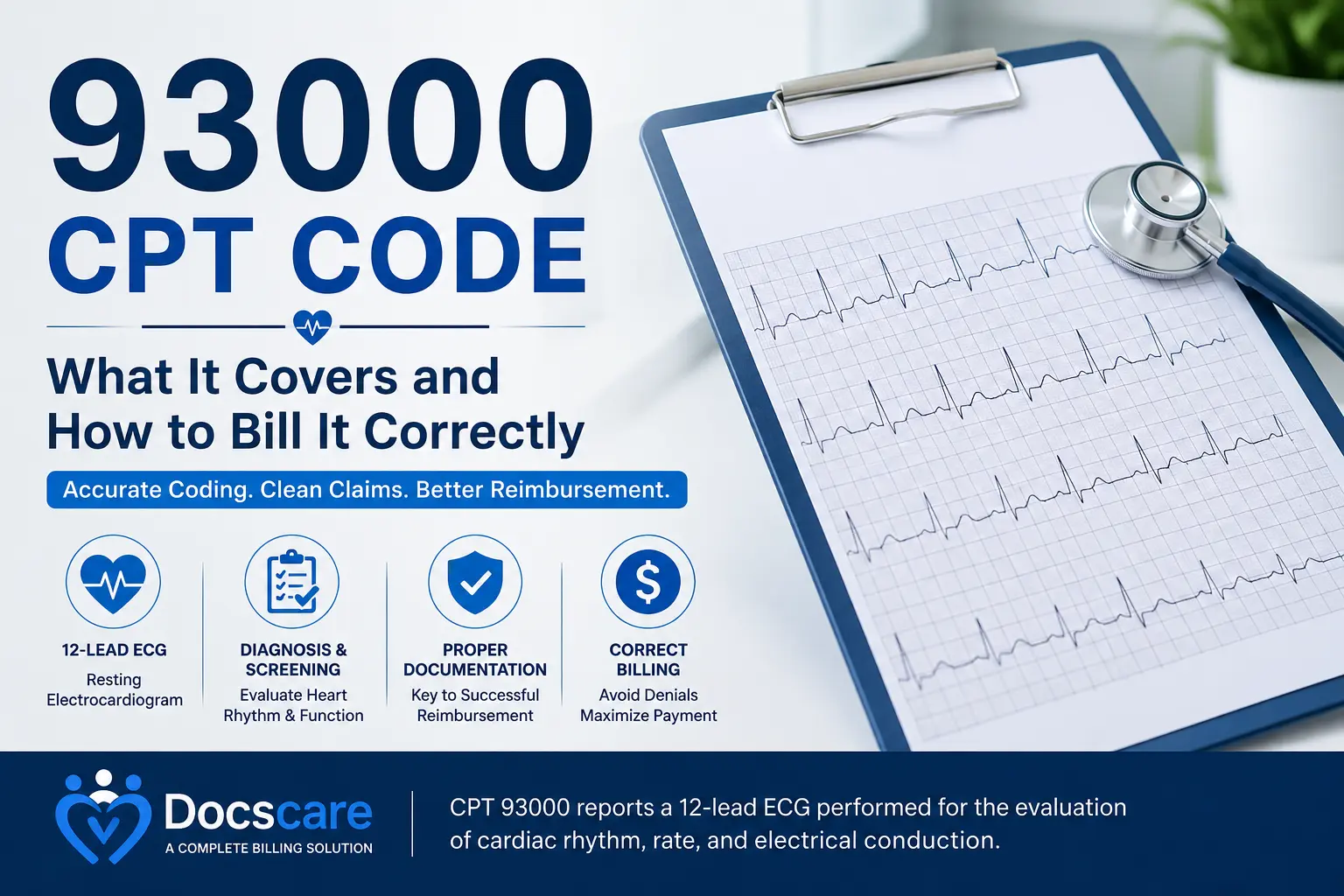
CPT Code 93000 reports a routine electrocardiogram with at least 12 leads, including the tracing, the physician interpretation, and a written report, all performed and billed by one entity. If your practice did not do all three parts, 93000 is the wrong code.
This guide walks through the descriptor, the sibling codes, the modifier trap that catches most primary care practices, and the five denial patterns we see repeatedly on ECG claims.
Table of Contents
ToggleWhat is the 93000 CPT code?
The official AMA descriptor reads: “Electrocardiogram, routine ECG with at least 12 leads; with interpretation and report.”
Break that into the three things a payer expects to find in the chart:
- The tracing. Ten electrodes on the patient, 12 recorded views of cardiac electrical activity, captured on equipment your practice owns or leases.
- The interpretation. A qualified provider reads the tracing and reaches a clinical conclusion.
- The report. A signed, written interpretation stored in the record. Not a note that says “ECG normal.” A report with findings, comparison to any prior study, and clinical significance.
“At least 12 leads” sets a floor, not a ceiling. Adding right sided leads (V3R, V4R) or posterior leads (V7 through V9) does not change the code or add units. You still bill one 93000.
A rhythm strip using one to three leads is a different family entirely. That’s 93040, 93041, and 93042. Check the current CPT descriptor each January, because the annual release can revise language inside a family without retiring the code.
93000 vs 93005 vs 93010: which one do you bill?
Pick the code by who performed which component. One entity doing everything bills 93000. Split the work between two entities and you split the code.
| ECG Code Selection by Component Performed | ||
|---|---|---|
| Code | What It Covers | Who Bills It |
| 93000 | ECG tracing, interpretation, and written report | One entity that performs all three components, typically an office-based practice with its own ECG equipment |
| 93005 | ECG tracing only, without interpretation or written report | The facility or entity that owns the equipment and provides the staff who acquire the tracing |
| 93010 | ECG interpretation and written report only | The physician or qualified practitioner who interprets a tracing acquired by another entity |
The clinical service is identical in all three rows. Only the billing arrangement changes.
Here’s the scenario that generates audits. A hospitalist rounds on an inpatient, reads an ECG that hospital nursing staff ran on hospital equipment, and bills 93000. The hospital already billed the technical portion. That group just billed a global code for professional work only, which reads as upcoding to a Medicare auditor reviewing high volume ECG claims. The correct code is 93010.
Diagnosis pairing sits underneath every one of these decisions, so it helps to understand how ICD-10-CM and CPT codes work together before you touch the modifier fields.
Does CPT Code 93000 need modifier 26 or TC?
No. Never append modifier 26 or modifier TC to 93000, and ignore any guide that tells you otherwise.
CMS assigns 93000 a PC/TC indicator of 4, which designates it a global test only code. The indicator means dedicated codes already exist for each component, so the modifiers carry no information the code doesn’t already contain. UnitedHealthcare states the same rule in its Medicare Advantage professional and technical component policy: modifiers 26 and TC are not used on the 93000 family because the intent sits inside the descriptors.
Watch this one. Appending 26 to 93000 when you meant 93010 produces one of two outcomes depending on payer logic. Either the claim denies, or it overpays and surfaces later in a recoupment. Neither one is a good week.
For the same reason, skip modifier 26 on 93010 and modifier TC on 93005. Those codes already carry indicators 2 and 3.
One modifier does matter on ECG claims. NCCI procedure to procedure edit files bundle the rhythm ECG tracing (93040) into the 12 lead tracing when both hit the same date of service. Billing both without modifier 59 on the appropriate code and separate documented medical necessity returns a bundling denial.
Which place of service code applies?
Place of service drives the payment rate, and getting it wrong costs real money on a code this common.
Bill POS 11 (office) when your practice owns the machine, your staff runs the test, and your physician reads it. Bill POS 21 or 22 when the facility owns the equipment, and switch the code to 93010 while you’re at it.
Practices that leave POS on autopilot lose roughly $6 to $14 per claim. Run 40 ECGs a week and that pattern quietly drains five figures a year.
Cardiology practices carry the highest volume here, which is why place of service errors show up first among the cardiology billing problems we see most often.
Medical coding
Split component errors on ECG claims repeat every week until someone catches the pattern, and they rarely show up as a single dramatic denial. Our medical coding services team checks place of service logic, modifier use, and diagnosis pairing before claims leave the building. Ask us to review your last 30 ECG claims and we’ll show you what the scrubber missed.
Which ICD-10-CM codes support medical necessity for 93000?
Match the diagnosis to the documented symptom or condition, not to the visit type. Diagnosis selection causes more 93000 denials than any other field on the claim.
Commonly supported indications include:
R07.9chest pain, unspecifiedR00.0tachycardia, unspecifiedR00.1bradycardia, unspecifiedR55syncope and collapseR06.02shortness of breathI10essential hypertension (coverage varies by contractor, so check your local article)I48.91unspecified atrial fibrillation
Medicare does not cover a screening ECG on an asymptomatic patient. The one exception is the single screening electrocardiogram tied to the Initial Preventive Physical Examination, reported with G0403, G0404, or G0405.
Run an ECG at a preventive visit with no documented symptom and the claim moves to patient responsibility. If you expect that outcome, get an Advance Beneficiary Notice signed before the test and append modifier GA. Collecting the signature after the fact does not work.
Preoperative ECGs need their own documentation trail: the underlying cardiac condition or risk factor, the planned surgery, and a date close enough to the procedure to count as relevant.
Can you bill 93000 with an office visit on the same day?
Yes, when the visit stands on its own. Append modifier 25 to the E/M code, never to 93000.
Modifier 25 tells the payer that the evaluation and management service was significant and separately identifiable from the diagnostic test. The chart has to back that up. A note that documents history, exam, and medical decision making addressing the presenting problem supports the E/M. A note that only says “ECG performed, reviewed, normal” does not.
Payers audit this pairing aggressively because the volume is enormous. Document the E/M work as its own narrative rather than folding it into the test result.
What documentation do payers require?
Four items, every time.
- A clinical indication recorded before the test, linked to the diagnosis code on the claim.
- The completed 12 lead tracing retained in the record and retrievable on request.
- A signed interpretation and report from the qualifying provider, dated the same day where possible.
- Confirmation that the same entity performed both the technical and professional work.
Miss item three and the service becomes a review rather than an interpretation. Payers do not reimburse a review separately, because that work already sits inside the visit payment.
Why 93000 claims get denied, and the fix for each
| Five Repeating Denial Patterns on ECG Claims | ||
|---|---|---|
| Denial Pattern | Root Cause | Fix |
| Medical Necessity Reason Code 50 |
The diagnosis does not support the ECG, or the documented indication was routine screening. | Code the documented symptom or condition. When Medicare noncoverage is expected, issue an ABN and apply modifier GA when appropriate. |
| Bundling Reason Code 97 |
CPT 93040 is reported alongside CPT 93000 on the same date of service. | Report the 12-lead ECG code alone unless a distinct service is separately necessary and fully documented. Apply modifier 59 only when payer and NCCI rules permit it. |
| Component Conflict | The global code is billed after a tracing-only or interpretation-only component code, or the reverse. | Confirm which entity performed the tracing and which provider completed the interpretation before submitting the claim. |
| Missing Information Reason Code 16 |
The claim contains an incorrect place of service, or the signed interpretation and written report are missing. | Verify the place of service during intake and require the completed, signed ECG report before releasing the claim. |
| Patient Responsibility Reason Code 49 |
The ECG was performed as part of a routine or screening examination without a covered diagnostic indication. | Obtain an ABN when required, or report the appropriate IPPE screening service when the patient and encounter meet Medicare requirements. |
Most practices treat these as one off appeals. They aren’t. Each pattern repeats until someone changes the workflow that produces it, which is why denial management support starts with pattern analysis rather than appeal letters.
How much does Medicare pay for 93000?
Payment lands in the mid teens to low twenties per claim in office settings, and roughly half that in facility settings where the hospital bills the technical portion separately.
Recent reporting puts the office rate near $17 to $22 and the facility rate near $8 to $11. Treat those as ballpark figures only. Your actual allowable depends on your MAC locality and the current conversion factor, both of which move annually. Pull your own number from the CMS Physician Fee Schedule Look Up Tool before you use any figure in a contract negotiation or a revenue projection.
Low unit value plus high volume is exactly the profile where small error rates compound. A 6 percent denial rate on a $1,000 procedure gets noticed immediately. The same rate on an $18 ECG runs for years.
The version that keeps your claims clean
Bill 93000 when you do the tracing and the interpretation and produce a signed report. Bill 93010 when you only read the tracing. Bill 93005 when you only ran it. Skip modifiers 26 and TC entirely on this family, match the diagnosis to a documented symptom, and check place of service before release.
That’s the whole rule set. Practices that follow it hold a clean claim rate above 95 percent on ECG claims without doing anything clever.
medical coding
If your ECG denials keep landing in the same bucket, the problem sits in coding logic, not in appeal volume. Docscare’s AAPC certified coders handle CPT and ICD-10-CM selection for primary care and cardiology practices across Texas, and we hold a 99 percent clean claim rate on first submission. Schedule a 15 minute review and we’ll show you where your ECG claims leak revenue.
Frequently asked questions
What is the 93000 CPT code description?
Electrocardiogram, routine ECG with at least 12 leads; with interpretation and report. The code covers the tracing, the physician interpretation, and the signed written report performed and billed by a single entity.
What is the difference between 93000, 93005, and 93010?
93000 is the global code covering all components. 93005 covers the tracing only, without interpretation or report. 93010 covers the interpretation and written report only. Choose based on which components your practice performed.
Does CPT 93000 need modifier 26 or TC?
No. CMS assigns 93000 a PC/TC indicator of 4, meaning global test only. Dedicated component codes already exist, so appending modifier 26 or TC causes a denial or an overpayment depending on payer logic.
Can you bill 93000 and an office visit on the same day?
Yes, when the evaluation and management service is significant and separately identifiable. Append modifier 25 to the E/M code, not to 93000, and document the visit work independently of the test result.
Does Medicare cover a screening EKG?
Generally no. Medicare covers one screening electrocardiogram as part of the Initial Preventive Physical Examination, reported with G0403, G0404, or G0405. Routine screening ECGs outside that benefit fall to the patient.
How much does Medicare reimburse for 93000?
Roughly $17 to $22 in office settings and $8 to $11 in facility settings, varying by MAC locality. Verify your specific allowable through the CMS Physician Fee Schedule Look Up Tool.
Why was my 93000 claim denied?
The five common causes are unsupported diagnosis, bundling with 93040, a component conflict with a facility claim, wrong place of service, and screening exclusion. Each one traces back to a repeatable workflow gap rather than a one off error.