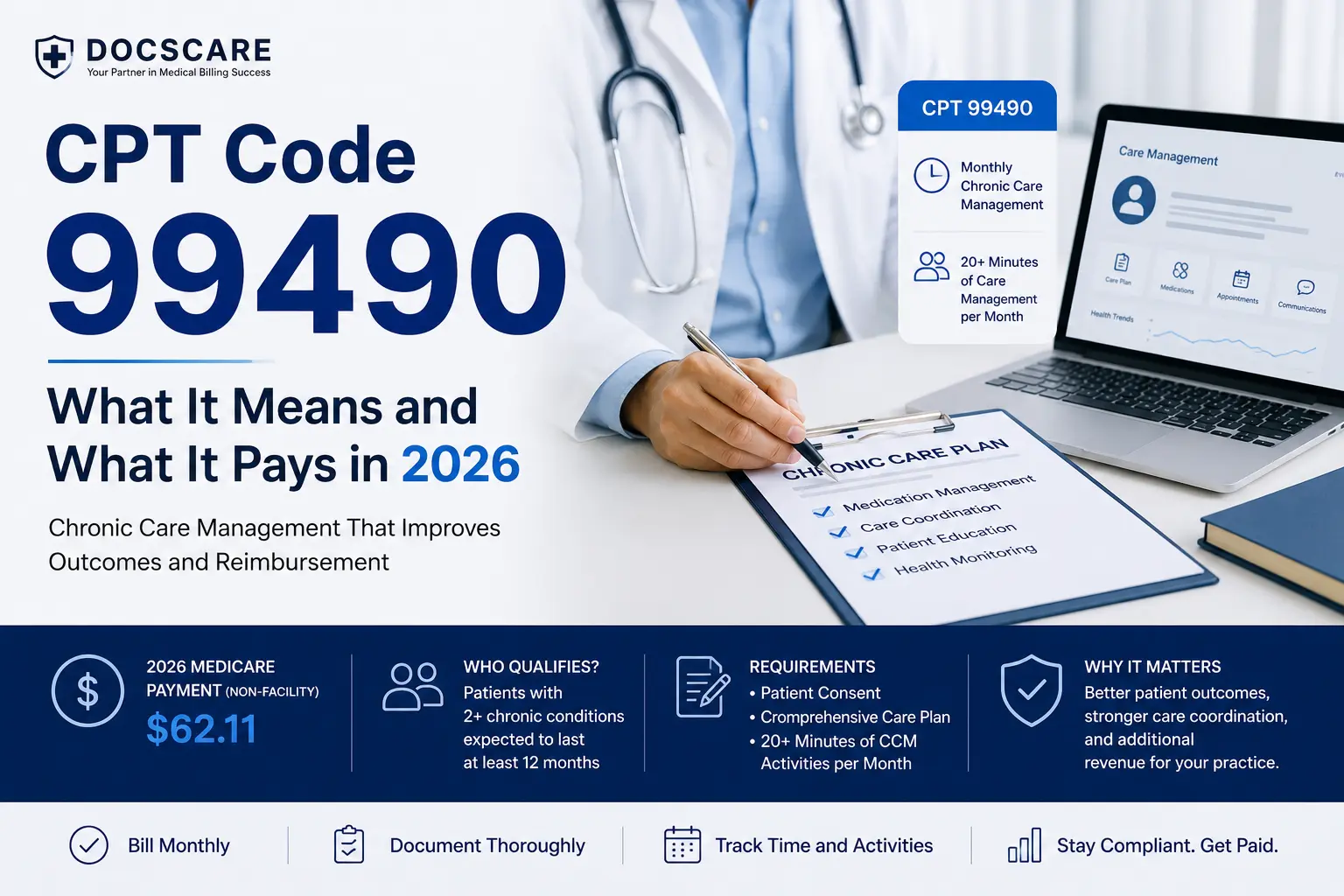
CPT Code 99490 is the base billing code for non complex chronic care management. It covers the first twenty minutes of clinical staff time a physician’s team spends coordinating care each month for a patient with two or more chronic conditions. In 2026, the national average non facility reimbursement for CPT 99490 sits close to sixty six dollars per patient per month, though your exact rate depends on where you practice.
That single code, billed correctly across a full patient panel, turns into real revenue. A practice managing one hundred eligible patients on 99490 alone can generate over six thousand dollars a month before add on codes even enter the picture. Most practices never capture the full amount, and the reason is rarely the code itself. It’s the documentation around it.
This guide walks through what 99490 requires, what it pays this year, and how it compares to the other codes in the chronic care management family. If your team needs a second set of eyes on coding accuracy across your panel, our medical coding services team can run that review for you.
Table of Contents
ToggleWhat Does CPT 99490 Require?
CMS built four requirements into the 99490 code description. Miss any one of them and the claim is vulnerable to denial.
- The patient has two or more chronic conditions expected to last at least twelve months, or until death.
- Those conditions place the patient at significant risk of death, an acute flare up, or a functional decline.
- A comprehensive, individualized care plan exists and gets established, monitored, and revised as needed.
- Clinical staff spend at least twenty minutes per calendar month on non face to face care coordination, directed by a physician or qualified healthcare professional.
The physician does not need to personally perform the twenty minutes. A nurse, medical assistant, or care coordinator can do the work, as long as a physician or QHP directs it under general supervision. That’s what makes 99490 scalable across a panel in a way that physician performed codes are not.
How Much Does CPT 99490 Pay in 2026?
Reimbursement estimates for CPT 99490 vary across published sources, typically landing between sixty two and sixty six dollars nationally for 2026. That spread exists because facility versus non facility status and your Medicare Administrative Contractor’s geographic practice cost index both shift the final number. CMS also applied close to a ten percent increase to chronic care management codes across the board this year, one of the larger annual bumps the program has seen.
Don’t rely on a blog post for your exact number. Pull your locality specific rate directly from the CMS Physician Fee Schedule Look Up Tool, since a practice in rural Texas and a practice in downtown Austin can see meaningfully different figures for the same code.
CPT 99490 vs 99491 vs 99439: What’s the Difference?
| Code | Who Performs the Work | Time Required | 2026 National Average Rate |
|---|---|---|---|
| 99490 | Clinical staff under physician or qualified healthcare professional direction | First 20 minutes per calendar month | Approximately $66 |
| 99439 | Clinical staff under physician or qualified healthcare professional direction | Each additional 20 minutes; add-on to 99490, up to 2 units | Approximately $47–$50 |
| 99491 | Physician or qualified healthcare professional personally | First 30 minutes per calendar month | Approximately $89 |
99490 and 99491 cannot both be billed for the same patient in the same month. Pick the code that matches who actually does the work. If your nurse handles the coordination, you bill 99490. If the physician personally spends the time, 99491 pays more, but it also ties up the physician’s calendar in a way many practices can’t sustain across a full chronic care panel.
Medical coding
Billing the wrong code in the chronic care management family is one of the most common ways practices lose revenue without knowing it. Docscare’s medical coding services team reviews your CCM coding against CMS requirements every month, so 99490, 99439, and 99491 get applied correctly the first time.
Why CPT 99490 Claims Get Denied
Four issues account for most 99490 denials we see across client accounts. None of them are complicated to fix once a team knows to watch for them.
- Missing patient consent. CMS requires documented consent once, before CCM services begin, and it has to stay in the chart.
- Time logs that don’t add up. Twenty minutes has to be tracked and documented, not estimated after the fact.
- No active care plan on file. A care plan that exists but was never updated during the billed month won’t satisfy the requirement.
- Billing 99490 and 99491 in the same month for the same patient. Pick one code family per patient per month, not both.
If denials on your chronic care management claims are already piling up, our Explore Medical Coding Services team can trace the root cause across your last ninety days of claims and fix the pattern, not just the individual denial.
CCM billing is one piece of a larger picture. Practices that pair accurate CCM coding with disciplined revenue cycle management typically see the fastest turnaround from clean claim to actual deposit.
How Docscare Handles CCM Coding
Our AAPC certified coders check every CCM claim against four things before it goes out the door: documented consent, an active care plan, a complete time log, and the correct code for who performed the work. That review catches the errors above before a payer ever sees them, which is a faster fix than appealing a denial after the fact.
New to outsourcing part of your billing workflow? Start with how physician credentialing works, since a clean credentialing file is what makes clean CCM claims possible in the first place.
For a broader look at coding accuracy beyond CCM, see how CPT and ICD-10 codes work together on a standard claim.
Frequently Asked Questions
What is CPT code 99490 used for?
CPT 99490 bills for the first twenty minutes of non face to face chronic care management a clinical staff member provides each month for a patient with two or more chronic conditions.
How much does CPT 99490 pay in 2026?
The 2026 national average non facility rate lands close to sixty six dollars, though your locality specific rate from the CMS Physician Fee Schedule may differ.
Can a nurse bill CPT 99490?
A nurse or other clinical staff member can perform the qualifying time, but the service must be directed by a physician or qualified healthcare professional under general supervision. The physician bills the code, not the nurse.
What is the difference between 99490 and 99491?
99490 covers clinical staff time directed by a physician. 99491 covers time the physician or QHP personally spends. 99491 pays more per month, but it requires the physician’s own time rather than a delegated team member’s.
Can I bill 99439 with 99490 in the same month?
Yes. 99439 is the add on code for each additional twenty minutes beyond the first, up to two units per calendar month, for a maximum of sixty minutes of non complex clinical staff time.
Does CPT 99490 require patient consent?
Yes. Written or verbal consent is required once before CCM services start, unless the patient switches to a new CCM provider. That consent has to stay documented in the chart.
Why do CPT 99490 claims get denied?
Missing consent, incomplete time logs, an outdated care plan, and billing 99490 alongside 99491 for the same patient in the same month are the four most common denial triggers.
Medical coding
Chronic care management billing pays well when it’s coded right and denies often when it isn’t. Docscare’s medical coding team reviews CCM claims for accuracy every month, catching consent gaps and time log errors before they cost you reimbursement.