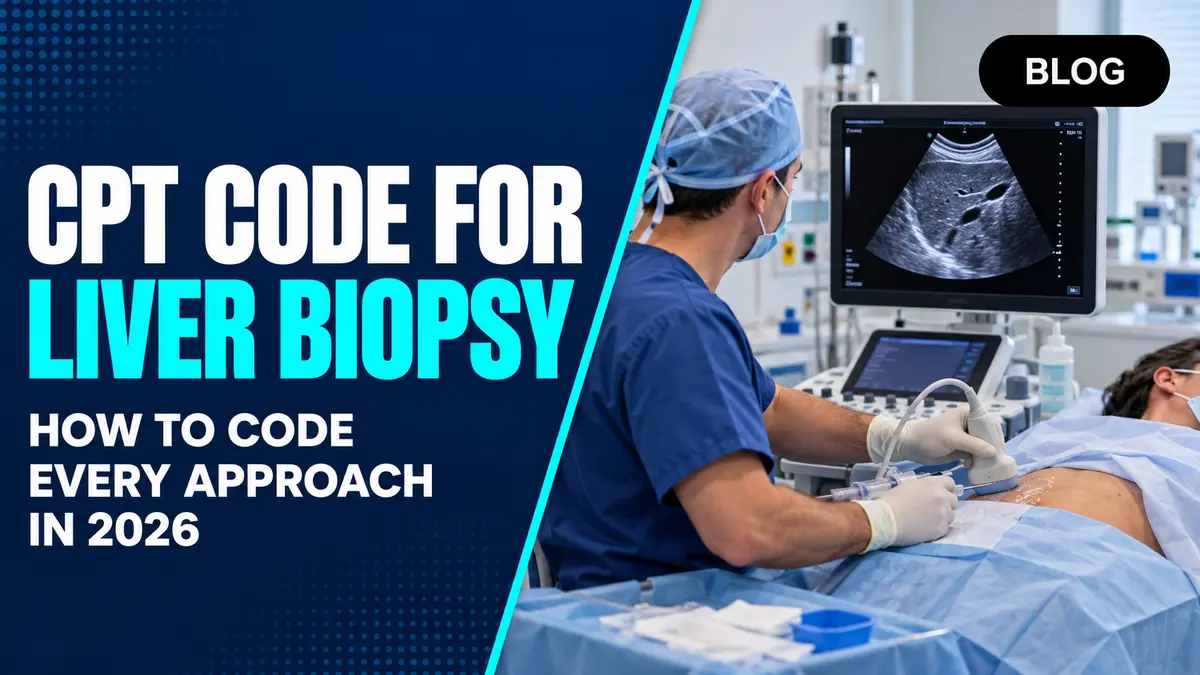
The CPT code for liver biopsy is 47000 when the physician passes a needle through the skin into the liver. That answer covers most claims, but it’s only the first decision. CT or ultrasound guidance gets its own code. A transjugular biopsy moves to 37200. A laparoscopic biopsy goes to unlisted code 47379, and a needle biopsy taken during another open operation uses add-on code +47001.
The approach drives everything else on the claim, and it’s where most liver biopsy denials start. Some of the most visible coding pages for this topic still list a laparoscopic cholecystectomy code or a deleted fine needle aspiration code as liver biopsy options. This guide sorts out each approach, the companion codes that belong with it, 2026 Medicare payment for 47000, and the documentation payers look for.
Liver Biopsy CPT Codes at a Glance
Match the documented approach to the right liver biopsy CPT code family before you look at anything else. The table shows the primary code, how imaging guidance is handled, and the most common trap for each approach.
| Approach | Primary CPT code | Imaging guidance | Common trap |
|---|---|---|---|
| Percutaneous needle (core) | 47000 | Report separately: 76942, 77012, +77002 or 77021 | Billing more than one guidance unit per encounter |
| Fine needle aspiration of a liver lesion | 10021, 10005, 10007, 10009 or 10011 | Built into the guided FNA codes | Using deleted code 10022 |
| Needle biopsy during another open operation | +47001 | Not applicable | Appending it to a laparoscopic procedure |
| Laparoscopic | 47379 | Not applicable | Reporting 47562 or 49321 instead |
| Transjugular | 37200 | 75970 for supervision and interpretation | Reporting 47000 for a catheter-based biopsy |
| Open wedge, standalone | 47100 | Not applicable | Using it for a laparoscopic wedge biopsy |
| Endoscopic ultrasound (EUS) | 43238 or 43242 | Included; don’t add 76942 or 76975 | Adding the imaging codes anyway |
CPT 47000: Percutaneous Needle Biopsy of the Liver
CPT 47000 reports a needle biopsy of the liver performed through the skin. An interventional radiologist, hepatologist or gastroenterologist advances a core needle into the liver and removes one or more tissue cores for pathology. The code covers a random biopsy for diffuse disease, such as fibrosis staging in metabolic dysfunction-associated steatohepatitis (MASH), and a targeted biopsy of a mass seen on CT or MRI.
Four billing facts shape every 47000 claim:
- 0-day global period. Follow-up on later days isn’t bundled into the procedure. A same-day E/M needs modifier 25 and must be significant and separately identifiable from the decision to do the biopsy.
- No imaging included. 47000 describes the biopsy only, so the guidance gets its own line, covered in the next section.
- One code per session for diffuse disease. Several passes through the same entry site to collect enough tissue still count as one 47000.
- 2026 Medicare payment. CMS assigns 47000 a work RVU of 1.61. At the 2026 conversion factor of $33.4009, the national unadjusted amount is about $287.92 in the office (non-facility) and $76.49 in a hospital or ASC (facility), before your locality adjustment. Check your own rate in the CMS Physician Fee Schedule lookup.
What about two separate lesions? When the radiologist samples two distinct liver lesions through separate needle placements, some payers accept a second line with modifier 59 or XS. Check the payer policy and the code’s medically unlikely edit (MUE) first, and make sure the report names each lesion with its segment and size.
Does CPT 47000 Include Imaging Guidance?
No. CPT 47000 doesn’t include imaging guidance, so you add the guidance code that matches the modality documented in the procedure note.
| Guidance documented | CPT code | Billing note |
|---|---|---|
| Ultrasound | 76942 | The most common pairing for random and targeted liver biopsies |
| Computed tomography (CT) | 77012 | Common for deep, small or hard-to-see lesions |
| Fluoroscopy | +77002 | An add-on code; rarely used for liver biopsy |
| Magnetic resonance (MR) | 77021 | Reserved for lesions visible only on MRI |
Chapter IX of the 2026 Medicare NCCI Policy Manual sets the unit rule. CMS allows one unit of service for any of these guidance codes per patient encounter, and the unit is the encounter, not the number of lesions, passes or samples. If the note shows two modalities, such as ultrasound to scout and CT to place the needle, report the guidance that actually directed the needle.
In a hospital or ASC, the radiologist bills the guidance code with modifier 26 and the facility reports the technical side. Our CPT 76942 billing guide covers the image-capture and reporting details payers expect for ultrasound guidance.
CT Scan Guided Liver Biopsy CPT Code
For a CT scan guided liver biopsy, report 47000 for the biopsy and 77012 for the CT guidance. 77012 covers the radiologist’s supervision and interpretation of the images used to plan and steer the needle, so localizing images taken on the table belong to it. The same NCCI chapter only allows a diagnostic study and needle guidance by the same modality on the same date when they cover different anatomic regions, so a separate abdominal CT billed alongside a CT-guided liver biopsy will usually fail.
Coding example. A patient with a 2.4 cm lesion in liver segment VII has a CT-guided core biopsy in a hospital outpatient department, with three passes through one coaxial needle. The radiologist’s professional claim shows 47000 and 77012-26. Code the lesion finding (R93.2) unless a confirmed pathology diagnosis is documented and available when you code the claim.
Ultrasound-Guided Liver Biopsy CPT Code
An ultrasound-guided percutaneous liver biopsy is 47000 + 76942. Payers expect a saved image showing the needle in the target and a written description of the guidance. A single line saying “under ultrasound guidance” rarely holds up when a payer requests records.
Core Needle Biopsy vs Fine Needle Aspiration of a Liver Lesion
Read the note for the technique as well as the organ. A core biopsy that removes a tissue cylinder goes to 47000. A fine needle aspiration (FNA) that collects cells for cytology belongs to the FNA family, where the code itself tells the payer which guidance was used:
- 10021: FNA without imaging guidance, first lesion
- 10005: FNA with ultrasound guidance, first lesion
- 10007: FNA with fluoroscopic guidance, first lesion
- 10009: FNA with CT guidance, first lesion
- 10011: FNA with MR guidance, first lesion
Each one has an add-on code for each additional lesion, and the guided codes already include the imaging, so don’t add 76942 or 77012 on top. Watch for outdated advice, too. Code 10022, which some liver biopsy pages still recommend, was deleted in 2019 when CPT moved to this guidance-specific series. If the physician performs both an FNA and a core biopsy in the same session, check NCCI edits before reporting both.
Hepatology Medical Billing Guide 2026?
A liver biopsy claim only pays when the approach, the guidance code and the modifiers match the procedure note. Docscare’s AAPC-certified coders check each interventional note against current NCCI edits before submission. Our Medical Coding Services help radiology and hepatology practices improve coding accuracy on 47000, 77012 and 37200 claims. Talk with our team about your procedure coding.
CPT 47001: Liver Biopsy During Another Major Procedure
CPT +47001 is an add-on code. You report it only alongside the primary procedure, when the surgeon takes a needle biopsy of the liver during another major operation, such as an open cholecystectomy or an open colectomy. It carries a ZZZ global indicator, so it follows the global period of the primary procedure and never stands alone.
The restriction that matters most: 47001 is for open procedures only. In its April 2024 Bulletin, the American College of Surgeons explains that AMA CPT Assistant has described 47001 as an open-approach code since it was established. Appending 47001 to a laparoscopic cholecystectomy is a coding error, even though older forum threads still suggest it.
What Is the CPT Code for Laparoscopic Liver Biopsy?
There’s no dedicated CPT code for a laparoscopic liver biopsy. If you’re looking for the lap liver biopsy CPT code, report unlisted code 47379 (unlisted laparoscopic procedure, liver). The same ACS guidance applies it to both of the usual scenarios:
- A lap liver biopsy during another laparoscopic procedure. Example: a laparoscopic appendectomy (44970) with a biopsy of a suspicious liver lesion. Report 44970 and 47379, and use 47001 as the comparison code for pricing.
- A laparoscopy performed only to biopsy the liver. Report 47379, not 49321. Code 49321 sits in the abdomen, peritoneum and omentum section of CPT, not the liver section, so it doesn’t describe the service. Use 49321 as the comparison code for charges.
Two errors keep surfacing in published content. One widely shared article lists 47562 as the laparoscopic liver biopsy code, but 47562 is a laparoscopic cholecystectomy; our guide to how laparoscopic gallbladder removal is coded covers that family. Others recommend 49321 as the default. Either mistake can lead to a denial or a recoupment.
How to Get a 47379 Claim Paid
- Send the operative report, and make sure it states the laparoscopic approach, the liver segment and the technique (wedge or core).
- Name the comparison code (47001 or 49321) and describe why the work, time and risk are similar.
- Set the charge in line with the comparison code instead of picking a number.
- Add a short description, such as “laparoscopic core needle biopsy of liver, segment IV,” in the claim’s additional-information field (Item 19 on the CMS-1500 or its electronic equivalent).
- Track the claim closely, since unlisted codes go to manual review and pay more slowly.
Transjugular Liver Biopsy CPT Code
A transjugular liver biopsy (TJLB) reaches the liver through the internal jugular vein and a hepatic vein instead of through the skin over the liver. Interventional radiologists choose it when coagulopathy, low platelets or ascites make a percutaneous pass risky. Because it’s a catheter-based procedure, the coding comes from the vascular section, not from 47000.
| CPT code | What it reports | When to report it |
|---|---|---|
| 37200 | Transcatheter biopsy | Every TJLB, for the biopsy itself |
| 75970 | Supervision and interpretation of the transcatheter biopsy | When the same physician supervises and interprets; add modifier 26 in a facility |
| 36011 | Selective venous catheter placement, first order branch | When the catheter is selectively placed into the hepatic vein |
| 75889 | Hepatic venography, wedged or free, with hemodynamic evaluation | When wedged and free hepatic pressures are measured and the gradient is documented |
| 75891 | Hepatic venography, wedged or free, without hemodynamic evaluation | When venography is performed and interpreted without pressure measurements |
| 76937 | Ultrasound guidance for vascular access | Only when the note documents evaluation of access sites, vessel patency, real-time needle entry and a saved image |
| 99152, +99153 |
Moderate sedation by the physician performing the procedure | When an independent trained observer assists and intraservice time reaches at least 10 minutes |
The venography lines need the most care. The NCCI manual tells providers to report diagnostic venography performed on the same date as a percutaneous intravascular intervention with modifier 59 or XU, and only when it’s medically necessary rather than the contrast injections needed to perform the biopsy. In practice, that means the note should show a diagnostic purpose, such as measuring the hepatic venous pressure gradient to evaluate portal hypertension.
Payment also differs by claim type. On the professional claim, 75970, 36011 and the venography codes pay separately. On a hospital outpatient claim, Medicare packages those services into the 37200 APC payment, so the facility shouldn’t expect separate reimbursement for them.
Open Wedge Liver Biopsy: CPT 47100
When a surgeon removes a wedge of liver tissue through an incision as a standalone operation, report 47100. It’s a surgical code with its own global period, so routine post-op visits are bundled. A wedge biopsy done laparoscopically still goes to 47379, and a needle biopsy taken during a different open operation goes to +47001.
EUS-Guided Liver Biopsy CPT Codes
Some gastroenterologists sample the liver with endoscopic ultrasound (EUS), passing a needle through the stomach or duodenal wall into the left or right lobe. Code it from the EUS family, not from 47000:
- 43238: EGD with EUS-guided FNA or biopsy, when the ultrasound exam is limited to the esophagus, stomach or duodenum and adjacent structures
- 43242: EGD with EUS-guided FNA or biopsy, when the ultrasound exam covers the esophagus, stomach and duodenum (or the jejunum after surgical alteration)
CPT instructs coders not to report 76942 or 76975 with these codes because the ultrasound work is part of the EUS service, a point AAPC’s GI imaging coding guidance also spells out alongside the 43238 versus 43242 split.
What Changed for Liver Biopsy Coding in 2026?
The 2026 CPT update didn’t create a new liver biopsy code, so the codes in this guide still apply. The liver change to know is new Category I code 47384 for percutaneous irreversible electroporation (IRE) ablation of liver tumors. It replaced Category III code 0600T, includes imaging guidance and carries a 0-day global period, as the ACS summary of CPT 2026 changes explains.
Why does that matter to a biopsy coder? When a radiologist biopsies a tumor and ablates it in the same session, code each service from its own documentation and check NCCI edits between 47000 and the ablation code before you submit.
ICD-10 Codes That Support a Liver Biopsy Claim
The CPT code tells the payer what the physician did. The ICD-10-CM code tells them why. Link each biopsy to the most specific diagnosis in the record:
| Clinical reason | ICD-10-CM code |
|---|---|
| MASH (nonalcoholic steatohepatitis) | K75.81 |
| MASLD or fatty liver, not elsewhere classified | K76.0 |
| Alcoholic cirrhosis without ascites | K70.30 |
| Cirrhosis, unspecified or other | K74.60, K74.69 |
| Chronic viral hepatitis C | B18.2 |
| Elevated liver transaminase levels | R74.01 |
| Abnormal imaging finding of the liver | R93.2 |
| Hepatocellular carcinoma | C22.0 |
| Secondary malignancy of the liver | C78.7 |
| Liver transplant rejection | T86.41 |
Two details catch coders. K76.0 carries an Excludes1 note for K75.81, so fatty liver and MASH aren’t reported together. And when the pathologist stages fibrosis in a MASH patient, ICD-10-CM asks for an additional hepatic fibrosis code from K74.0-.
Pathology is a separate claim. The pathologist reports the tissue exam, typically 88307 for a liver biopsy, and the physician who performed the biopsy doesn’t bill it.
Modifiers You’ll Use on Liver Biopsy Claims
- 26: professional component of 76942, 77012, 75970 or the venography codes in a hospital or ASC
- TC: technical component only, when a site bills the equipment and staff side separately
- 59 or XS: a separate lesion or site, when the documentation supports a distinct service
- XU or 59: medically necessary diagnostic venography on the same date as a TJLB
- 25: a significant, separately identifiable E/M on the same day as a 0-day global procedure like 47000
- 52: a reduced service, when the physician completes only part of the planned biopsy
- 53: a discontinued procedure in the physician setting (hospitals and ASCs use 73 or 74 instead)
Why Do Liver Biopsy Claims Get Denied?
Most denials trace back to a short list of mismatches between the code set and the note:
| Coding error | What happens | How to fix it |
|---|---|---|
| 47000 billed for a transjugular biopsy | Denial, or recoupment after audit | Report 37200 with 75970 and the supported catheter codes |
| +47001 added to a laparoscopic procedure | Denial; the add-on describes an open approach | Report 47379 with a comparison code |
| Two guidance codes on one encounter | Second guidance line denied | Report one unit of the guidance that directed the needle |
| 76942 or 76975 billed with an EUS code | Bundling denial | Drop the imaging code; 43238 and 43242 include it |
| Missing modifier 26 in a facility | Rejection or overpayment request | Split professional and technical components |
| Deleted code 10022 used for FNA | Invalid code rejection | Use 10021 or the 10005 to 10012 series |
| Nonspecific diagnosis on a lesion biopsy | Medical necessity denial | Code the specific imaging finding or confirmed pathology diagnosis |
Liver biopsies share payers and policies with the rest of a liver practice’s workload, including elastography and paracentesis. See how our hepatology billing services handle those claims together.
If these denials have already landed, our team can work denied claims back to payment with corrected codes and the records payers ask for.
Documentation Checklist for Liver Biopsy Claims
A coder shouldn’t have to guess any of these details. Before the claim goes out, confirm the note shows:
- The approach: percutaneous, transjugular, laparoscopic, open or EUS.
- The technique: core biopsy or fine needle aspiration, with the needle gauge.
- The target: random sampling for diffuse disease, or a named lesion with segment and size.
- How many lesions were sampled and whether each used a separate needle placement.
- The imaging modality, with saved images and the physician’s interpretation.
- For TJLB, the catheter positions, venography findings, and any wedged and free pressures with the calculated gradient.
- Sedation details: who gave it, the independent observer, and start and stop times.
- The indication, linked to a specific ICD-10-CM diagnosis.
If your templates leave gaps, an outsourced medical coding team can flag them during pre-submission review and send the fixes back to your physicians.
The Bottom Line
Start with the approach in the note. A percutaneous core biopsy is 47000 plus one guidance code. A transjugular biopsy is 37200 with its supervision, catheter and venography companions. A laparoscopic biopsy is 47379, and a needle biopsy during an open operation is +47001. Mixing those families causes most liver biopsy denials, so a quick approach check before submission saves rework later.
Liver Biopsies
Liver biopsies, elastography and paracentesis each carry their own coding traps, and one wrong approach code can stall payment. Docscare’s hepatology billing team handles the CPT, ICD-10 and modifier decisions for liver practices and follows each claim through to payment to help reduce claim denials. Ask for a free review of your recent liver biopsy claims.
Frequently Asked Questions
What is the CPT code for liver biopsy?
CPT 47000 reports a percutaneous needle biopsy of the liver. Other approaches use different codes: 37200 for a transjugular biopsy, 47379 for a laparoscopic biopsy, +47001 for a needle biopsy during another open operation, and 47100 for a standalone open wedge biopsy.
What is the CPT code for a CT-guided liver biopsy?
Report 47000 for the biopsy and 77012 for the CT guidance. Bill one unit of 77012 per encounter, even when the radiologist makes several passes or samples more than one lesion. In a facility, add modifier 26 to 77012 on the physician’s claim.
What CPT codes are used for a transjugular liver biopsy?
Start with 37200 for the transcatheter biopsy and 75970 for its supervision and interpretation. Add 36011 for selective hepatic vein catheterization, 75889 or 75891 for hepatic venography with or without pressure measurements, and 76937 or moderate sedation codes only when the note meets their requirements.
What is the CPT code for a laparoscopic liver biopsy?
There’s no specific code. Report unlisted code 47379 and use 47001 (with another laparoscopic procedure) or 49321 (biopsy-only laparoscopy) as the comparison code for pricing. Don’t report 47562, which is a laparoscopic cholecystectomy.
Can CPT 47001 be billed by itself?
No. 47001 is an add-on code with a ZZZ global indicator, so it’s reported only with the primary procedure. AMA CPT Assistant guidance, summarized by the American College of Surgeons, limits it to liver biopsies taken during an open operation.
Is imaging guidance included in CPT 47000?
No. Add 76942 for ultrasound, 77012 for CT, +77002 for fluoroscopy or 77021 for MRI. The exceptions are the guided FNA codes (10005 to 10012) and EUS codes 43238 and 43242, which already include the imaging.
Who bills the pathology for a liver biopsy?
The pathologist bills the tissue exam on a separate claim, usually with 88307. The physician who performed the biopsy reports only the procedure and any guidance codes.