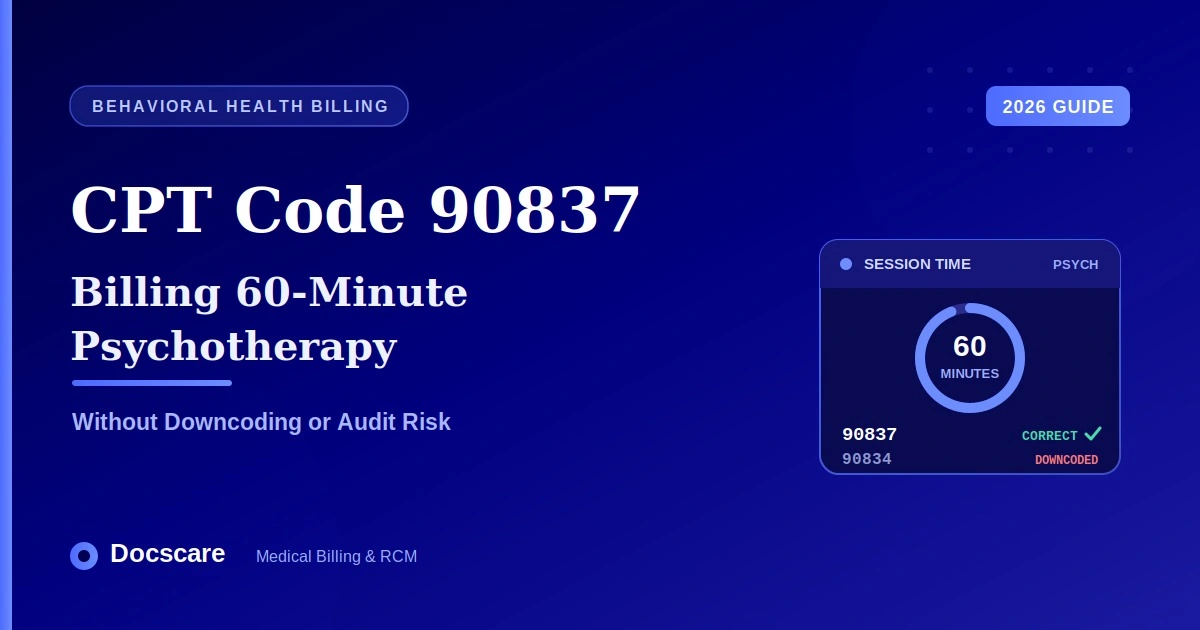
CPT Code 90837 is the code for individual psychotherapy that runs 53 minutes or more. The label says 60 minutes, but the billable line’s 53. Here is the tension every therapist knows: 90837 pays more than the shorter 90834, so payers watch it closely, and a lot of clinicians quietly downcode to 90834 to avoid an audit, even when the session clearly earned the higher code. That fear costs you real revenue on work you’ve already done.
This guide lays out exactly what CPT Code 90837 covers, the time rule that decides it, how it differs from 90834, what it pays in 2026, why it gets audited, and the one documentation habit that protects the code. It’s written for the behavioral health practices and solo therapists who bill this code week in and week out.
Table of Contents
ToggleFREE CHECK
Billing CPT Code 90834 when the session ran long?
What Is CPT Code 90837?
CPT 90837 is the code for individual psychotherapy lasting 53 minutes or more of direct, face-to-face time with the patient. The official descriptor reads “psychotherapy, 60 minutes with patient,” but under AMA midpoint time rules the code becomes billable at 53 minutes. It’s the therapy itself that counts: mental status assessment, therapeutic engagement, intervention, and behavior modification. Scheduling, documentation, and notes you write afterward don’t count toward the time.
It’s the longest of the three standard individual psychotherapy codes, and it carries the highest reimbursement of the three, which is exactly why payers scrutinize it. For how this fits a full behavioral health workflow, see our mental health billing services.
The CPT Code 90837 Time Rule
Psychotherapy codes follow the CPT time rule, and for CPT Code 90837 the number that matters is 53. Here are the three individual psychotherapy codes and their time bands.
| CPT Code | Face-to-Face Time | Description |
|---|---|---|
| 90832 | 16 to 37 minutes | Brief individual psychotherapy |
| 90834 | 38 to 52 minutes | Standard individual psychotherapy |
| 90837 | 53 minutes or more | Extended individual psychotherapy |
The rule’s exact. A 53-minute session is a CPT Code 90837. A 52-minute session is a 90834, even though it is one minute short. There’s no gray area and no rounding. Auditors know rounding up is the most common way practices get CPT Code 90837 wrong, so the time you record has to be real.
CPT Code 90834 vs 90837: The Time Decision That Drives Your Revenue
This is the comparison therapists ask about most, and the answer’s simpler than it looks. The only difference between 90834 and 90837 is session length. Not the modality, not the diagnosis, not the technique. You can deliver CBT, EMDR, or DBT under either code. Time is the dividing line.
| Factor | 90834 | 90837 |
|---|---|---|
| Session time | 38 to 52 minutes | 53 minutes or more |
| Reimbursement | Lower | Roughly 15 to 25 percent higher |
| Audit scrutiny | Routine | High, payers track overuse |
| Best fit | Standard weekly therapy | Trauma, crisis, complex or comorbid cases |
Here’s the part that costs practices money. Because CPT Code 90837 pays roughly 15 to 25 percent more, some therapists default to 90834 even after a genuine 55-minute session, worried that billing CPT Code 90837 invites a payer review. That’s downcoding, and it gives away revenue you legitimately earned. The correct approach is to bill the code the session actually supports and document the time so the higher code is defensible. Don’t round up, and don’t shrink down out of fear.
FREE CHECK
Want a second set of eyes on your psychotherapy coding?
When CPT Code 90837 Applies: Four Common Scenarios
These are the sessions where the extended time is both clinically real and billable, with the diagnosis that supports each.
| Scenario | Example ICD-10 | Why It Is a 90837 |
|---|---|---|
| Complex trauma processing | F43.10 (PTSD) | A 58-minute session working through trauma that cannot stop at minute 45; time and clinical need support 90837 |
| Severe depression, intensive phase | F33.2 (major depressive disorder, recurrent, severe) | Early intensive treatment where 55 minutes of focused work is clinically necessary |
| Multiple comorbid conditions | F41.1 + F43.23 (anxiety + adjustment disorder) | One 60-minute session addressing two conditions together justifies the extended time |
| Safety planning within therapy | F32.9 (major depressive disorder) | A 54-minute session that runs long for safety planning, documented as standard psychotherapy rather than a crisis code |
One boundary to watch. If a session meets the criteria for a psychiatric crisis, with a patient in high distress and a situation that is life threatening or highly complex, the crisis codes 90839 and 90840 may fit better than CPT Code 90837. Crisis is its own track, so don’t fold a true crisis session into a standard psychotherapy code.
What Does CPT Code 90837 Pay in 2026?
More than 90834, by roughly 15 to 25 percent, which is the whole reason the downcoding habit’s so costly. The Medicare national office (non facility) average for CPT Code 90837 runs around 154 to 160 dollars in 2026, with the rate inside a facility lower, and geographic adjustments shift the number by location. Commercial payers vary widely by contract and region. Treat any single figure as a starting point and confirm the current rate on the CMS physician fee schedule for your area and against your own payer contracts. Across a full caseload, billing the CPT Code 90837 sessions you actually deliver at the correct code is meaningful annual revenue.
Why CPT Code 90837 Gets Audited, and How to Protect It
Coding and documentation problems are the leading denial category across healthcare billing, with denial rates industry wide between 10 and 15 percent, according to 2026 healthcare denial benchmarks. For 90837 the scrutiny is sharper, because the code pays more and payers track who overuses it. Medicare publishes average session lengths by specialty and region, and an outlier who bills far more CPT Code 90837 than peers can draw a review. These habits protect the code.
- Record the exact time. Write the psychotherapy minutes on every session, plainly. “Psychotherapy time: 58 minutes” is defensible. A missing or vague time is the fastest way to a denied 90837.
- Count only therapeutic time. The 53 minutes is direct, face-to-face clinical contact. Leave out scheduling, note writing, and other admin work, so the recorded time holds up under review.
- Support the medical necessity. Note why the session needed the extended length, the trauma work, the complexity, the comorbid conditions, rather than only the time. Some payers expect a rationale for CPT Code 90837 over 90834.
- Match the diagnosis to the work. The ICD-10 code should support 60-minute care. A mismatched or minor diagnosis against a 90837 claim invites questions.
- Finally, review your own ratio. Check how often each clinician bills CPT Code 90837 versus 90834 before payers do. A periodic internal review catches outliers and documentation gaps early.
When denials or downcoding become a pattern instead of a one off, the cause is usually a documentation or coding workflow gap, which is exactly what denial management services are built to fix.
How Docscare Helps Behavioral Health Practices Bill CPT Code 90837 Right
Psychotherapy coding lives or dies on time documentation, and that’s where we focus. Our AAPC-certified coders review your sessions against the 53-minute rule, confirm the recorded time and medical necessity support the code, and make sure you bill the CPT Code 90837 sessions you actually deliver rather than downcoding to 90834 out of audit fear. We help you capture the full, accurate value of your clinical work while keeping every claim defensible.
We are US based in Austin, Texas, fully HIPAA compliant, and we run a 99 percent clean claim rate with a 97.45 percent first pass acceptance rate. For a behavioral health practice, that accuracy protects your busiest psychotherapy code and the revenue tied to it.
See how we support mental health billing services, or learn more about our medical coding services and revenue cycle management services.
FREE BEHAVIORAL HEALTH BILLING REVIEW
Find out how much revenue your practice loses to downcoded psychotherapy claims. We will review a sample of your 90834 and 90837 sessions, check the time documentation, and show you exactly where 90834 should have been 90837. No cost, no obligation.
Frequently Asked Questions
What is CPT code 90837 used for?
CPT 90837 reports individual psychotherapy of 53 minutes or more of face-to-face time with the patient. Despite the 60-minute label, the billable threshold starts at 53 minutes under AMA midpoint time rules. Therapists use it for substantive sessions like trauma processing, the intensive early phase of treatment, or complex cases that need more than a standard therapy hour.
What is the difference between CPT Code 90837 and 90834?
Only time. 90834 covers a 38 to 52 minute session and 90837 covers 53 minutes or more. The modality does not matter, you can deliver CBT, EMDR, or DBT under either code. If a session runs 52 minutes or less, you bill 90834. At 53 minutes or more, 90837 is correct.
How many minutes do you need to bill CPT Code 90837?
53 minutes of direct, face-to-face therapeutic time, at minimum. Documentation, scheduling, and paperwork done afterward do not count toward that total. If the session falls below 53 minutes by even one minute, the correct code is 90834.
How much does CPT Code 90837 reimburse in 2026?
More than 90834, by roughly 15 to 25 percent. The Medicare national office (non facility) average runs around 154 to 160 dollars in 2026, and commercial payers vary by contract and region. Check the current CMS fee schedule and your payer contracts for exact figures.
Why is CPT Code 90837 audited so often?
Because it pays more than 90834, payers watch for overuse. Medicare publishes average session lengths by specialty and region, and a provider who bills far more CPT Code 90837 than peers can trigger review. The protection is simple: record the exact psychotherapy time on every claim and bill the code the session actually supports, neither rounding up nor downcoding out of fear.