By DocsCare Billing Team, CPC · Published June 2025 · Last Updated June 2025
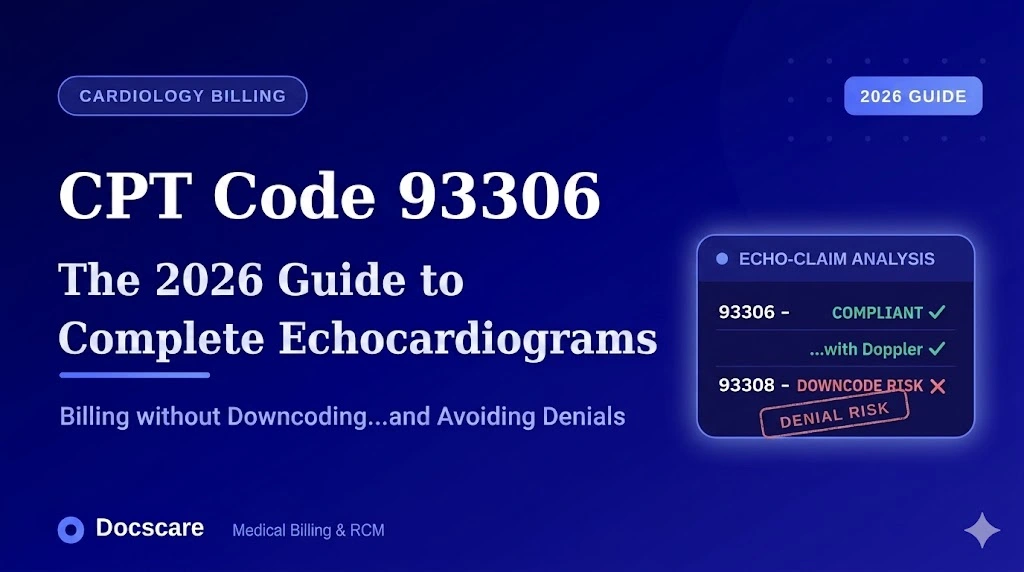
CPT 93306 is the code for a complete transthoracic echocardiogram with Doppler and color flow. It is one of the highest revenue codes a cardiology practice bills, and one of the easiest to lose money on. Most echo revenue does not leak through outright denials. It leaks through downcoding, when a study you performed in full gets paid as a lesser code because the report did not say the right words. A single missing line about Doppler can cut your reimbursement by 20 to 30 percent on a study you already did.
This guide explains exactly what 93306 covers, the four components you must document, how it differs from 93307, which modifiers apply, and the documentation that keeps a complete echo paid as a complete echo. It is written for the cardiology practices and billing teams that run these studies every day.
What Is CPT Code 93306?
CPT 93306 reports a complete transthoracic echocardiogram, or TTE, that includes 2D real-time imaging, M-mode recording, spectral Doppler, and color flow Doppler. The American Medical Association defines it as a complete echo with image documentation, M-mode, spectral Doppler, and color flow Doppler together in one code. In plain terms, it is the full adult heart study: the sonographer images every chamber and valve, and the Doppler measures how blood moves through them.
It is the routine echo code, because nearly every modern echocardiogram includes Doppler. That also makes it the code payers scrutinise most closely in cardiology. For how echo coding fits the full claim workflow, see our medical coding services overview.
The Echocardiogram Code Family: 93306 vs 93307 vs 93308
Three codes cover the bulk of transthoracic echo billing, and choosing the wrong one is the most common echo coding error. Here is how they relate.
| CPT Code | What It Covers |
|---|---|
| 93306 | Complete TTE with 2D, M-mode, spectral Doppler AND color flow Doppler |
| 93307 | Complete TTE without spectral or color Doppler |
| 93308 | Limited or follow up TTE (focused study, not a full exam) |
| 93303 | Complete TTE for congenital heart anomalies |
| 93320 / 93325 | Doppler add-on codes (do NOT use with 93306 if Doppler is already bundled) |
The line that matters most is 93306 versus 93307, and the only difference between them is Doppler. 93306 includes both spectral and color flow Doppler. 93307 is the same complete study without any Doppler. Because virtually every modern echo runs Doppler, 93306 is the code you bill on the vast majority of complete studies. If your sonographers run Doppler on every study but your coders default to 93307, or the report never confirms the Doppler, you are downcoding paid work. That gap is worth 20 to 30 percent of the claim.
The Four Components You Must Document for 93306
A 93306 claim needs all four imaging components performed and documented. Not three. All four. If spectral Doppler or color flow Doppler is missing from the study or the report, the code is 93307 or 93308, not 93306.
| Component | What the Report Must Show |
|---|---|
| 2D imaging | Real-time two-dimensional images of the heart with documentation |
| M-mode recording | Motion-mode tracing where performed |
| Spectral Doppler | Velocity and direction of blood flow, documented |
| Color flow Doppler | Color mapping of blood flow across valves and chambers, documented |
The trap is the templated report. An echo template that auto-populates “Doppler performed” while the interpreted findings never mention Doppler does not protect the claim. Auditors look for the interpretation, not the boilerplate. Add explicit language to the final report: study performed with spectral Doppler and color flow Doppler. That one sentence is the difference between 93306 and a downcoded 93307.
FREE CHECK
Want us to check whether your echo reports support 93306?
When 93306 Applies: Three Common Scenarios
These are everyday cardiology situations where a complete echo with Doppler is the right call, with the diagnosis that supports each.
| Scenario | Example ICD-10 | Why It Is a 93306 |
|---|---|---|
| Heart murmur workup | I35.0 (aortic valve stenosis) | Cardiologist orders a complete TTE with Doppler to find the source of a murmur; all four components performed |
| Chest pain evaluation | R07.9 (chest pain, unspecified) | ER physician orders a complete echo with Doppler to assess structure, function, and flow |
| Heart failure follow up | I50.9 (heart failure, unspecified) | Full reassessment of chambers and valves with Doppler, not a focused recheck, so 93306 not 93308 |
| Pre-op cardiac clearance | Z01.810 (pre-procedural cardiovascular exam) | Complete echo with Doppler before major surgery to assess cardiac risk; full study, so 93306 |
Notice the third row. A heart failure reassessment that evaluates the whole heart with Doppler is a 93306. The same patient coming back for a quick focused recheck of one finding is a 93308. The code follows the scope of the study, not the patient’s diagnosis.
The Add-On Trap: Do Not Bill 93320 or 93325 With 93306
Here is a mistake that triggers audits. 93306 already includes spectral and color flow Doppler. If your coders also append the standalone Doppler codes, 93320 for spectral or 93325 for color flow, on top of 93306, they are billing the same Doppler twice. Those add-on codes belong with 93307, the no-Doppler complete study, when Doppler was performed separately. With 93306, the Doppler is already in the code. Appending them is unbundling, and payers flag it fast.
What Does 93306 Pay?
Echo reimbursement runs higher than most office services, which is why downcoding hurts so much. A complete study with Doppler pays meaningfully more than the no-Doppler 93307, and that gap is the revenue you protect by documenting correctly. The exact rate depends heavily on your payer contracts, your locality, and whether you bill the global service or split it into professional and technical components. Check the current CMS physician fee schedule for your area rather than relying on a single national figure, because echo rates vary widely by setting.
Modifiers for 93306: The Professional and Technical Split
Echo is an imaging service, so the most important modifier question is who owns what. The study has two parts: the technical component, which is performing the scan and owning the equipment, and the professional component, which is interpreting the images and writing the report. When one entity does both, you bill 93306 with no modifier, the global service. When the work splits between two parties, split the code to match.“`html
| Modifier | When to Append It |
|---|---|
| 26 | Professional component only: the physician interprets and reports, but did not own the equipment |
| TC | Technical component only: the facility owns the equipment and performs the scan, no interpretation |
| 59 | Distinct procedural service, when the echo is separate from another procedure the same day |
| 76 | Repeat procedure, same physician, same day |
| 77 | Repeat procedure, different physician, same day |
| 52 | Reduced services, when the study scope was cut and no better code fits |
| 91 | Repeat clinical lab or diagnostic test, when the echo is repeated to verify a finding (uncommon for echo, but valid) |
| 53 | Discontinued procedure, when the echo was started but stopped for patient safety |
The 26 and TC split is the one that matters most in echo. A hospital based cardiologist who reads a study performed on the hospital’s machine bills 93306 with modifier 26, while the hospital bills the same code with modifier TC. Getting this wrong either double bills the global service or leaves half the payment uncollected. The other modifiers are situational: append them only when the documentation truly supports them, because a “just in case” modifier invites the audit it was meant to avoid.
Why 93306 Claims Get Denied or Downcoded
Coding and documentation problems are the leading denial category across healthcare billing, with denial rates industry wide sitting between 10 and 15 percent, according to 2026 healthcare denial benchmarks. For 93306, the money rarely vanishes through a flat denial. It erodes through downcoding and avoidable rejections. These are the repeat causes.
- Doppler not documented. This is the big one. When the report never explicitly confirms spectral and color flow Doppler, the claim quietly downcodes to 93307 and loses 20 to 30 percent.
- Weak medical necessity. Payers deny when the diagnosis does not explain why you ordered the echo. Spell out the symptoms or findings and tie them to the right ICD-10 code.
- Wrong code for a focused study. A limited recheck billed as 93306 belongs on 93308 instead. The code follows the scope of the exam, not the equipment in the room.
- Unbundled Doppler add-ons. Appending 93320 or 93325 to 93306 bills the same Doppler twice, since it is already inside the code.
- Finally, modifier errors on split billing. Missing the 26 or TC split, or billing the global service when only one component was actually performed.
When echo downcoding becomes a pattern rather than a one off, the cause is a documentation and charge-capture gap, which is exactly what denial management is built to fix.
How Docscare Helps Cardiology Practices Bill 93306 Right
Echo is too valuable to leave to a generalist biller. Our AAPC-certified coders review every echo report against the four-component rule before the claim goes out, confirm the Doppler language that separates 93306 from 93307, apply the 26 and TC split correctly for hospital based reads, and catch the bundled add-ons that trigger audits. We make sure a complete echo gets paid as a complete echo.
We are US based in Austin, Texas, fully HIPAA compliant, and we run a 99 percent clean claim rate with a 97.45 percent first pass acceptance rate. For a cardiology practice, that turns echo from a downcoding risk into reliable revenue.
See how our medical coding services handle specialty work like cardiology, or how coding fits the wider revenue cycle management workflow.
FREE CARDIOLOGY CODING AUDIT
Find out how much echo revenue your practice loses to downcoding. We will review a sample of your 93306 claims and reports and show you exactly where the Doppler documentation or modifier split is costing you. No cost, no obligation.
Frequently Asked Questions
What is CPT code 93306 used for?
CPT 93306 reports a complete transthoracic echocardiogram (TTE) with 2D imaging, M-mode recording, spectral Doppler, and color flow Doppler. It is the standard code for a full adult echo when all four imaging components are performed and documented, used to evaluate heart structure, valve function, and blood flow.
What is the difference between 93306 and 93307?
The only difference is Doppler. 93306 is a complete TTE that includes both spectral and color flow Doppler. 93307 is a complete TTE without any Doppler. Because virtually every modern echo includes Doppler, 93306 is the routine code, and defaulting to 93307 or failing to document the Doppler downcodes the claim and loses revenue.
What are the four components required for 93306?
A 93306 claim needs all four imaging components performed and documented: 2D real-time imaging, M-mode recording, spectral Doppler, and color flow Doppler. If spectral or color flow Doppler is missing from the study or the report, you cannot bill 93306 and should use 93307 or 93308 instead.
Does 93306 need modifier 26 or TC?
It depends on who owns what. Append modifier 26 when the physician only interprets the study and writes the report. Append modifier TC when the facility only performs the scan and owns the equipment. Bill 93306 with no modifier (global) when the same entity does both.
Why do 93306 claims get denied or downcoded?
The most common cause is documentation that does not explicitly confirm spectral and color flow Doppler, which downcodes the claim to 93307 and cuts reimbursement. Other causes are missing medical necessity, a diagnosis that does not justify the test, using 93306 for a focused follow up that should be 93308, and adding Doppler add-on codes that are already bundled.