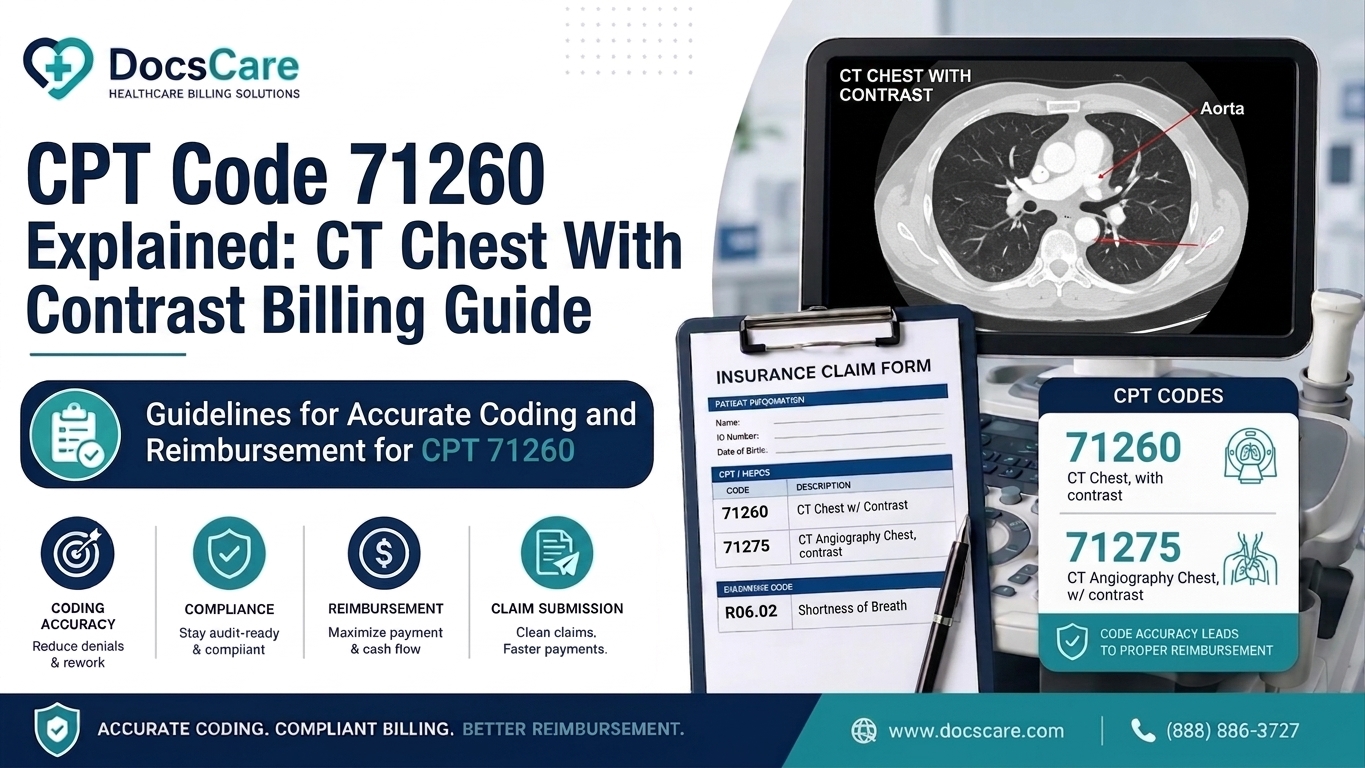
CPT code 71260 describes a computed tomography scan of the thorax performed with intravenous contrast material in practical terms, a CT chest scan that uses contrast dye to sharpen the images of the lungs, mediastinum, and chest vasculature. Physicians order it to investigate suspicious masses, infections, and vascular problems that a plain chest X-ray can’t fully explain.
For practices and billing teams, CPT 71260 is also one of the more denial-prone imaging codes on the fee schedule. Getting it right depends on documentation, the correct modifier, and a diagnosis code that actually supports the scan. This guide walks through what the code covers, when physicians use it, and how to code and bill it without triggering a rejection.
Table of Contents
ToggleWhat Does CPT Code 71260 Cover?
The official CPT descriptor for 71260 reads: “Computed tomography, thorax, diagnostic; with contrast material(s).” It reports a diagnostic CT scan of the chest cavity lungs, mediastinum, pleura, and chest wall captured after a radiologist or technologist administers IV contrast.
The American Medical Association maintains and updates the CPT code set each year, and the current descriptor for 71260 specifically calls out “diagnostic” to separate it from CPT 71271, the code used for low-dose CT lung cancer screening. It’s also distinct from CT angiography of the coronary arteries, which reports under its own dedicated codes because it targets the heart and coronary vessels rather than the chest generally.
In short: if a physician orders a general diagnostic CT of the chest and administers contrast, 71260 is very likely the correct code — as long as documentation supports why contrast was medically necessary.
CPT 71260 vs. 71250 vs. 71270: What’s the Difference?
The chest CT family has three related codes, and mixing them up is one of the fastest ways to trigger a denial or an audit flag.
| CPT Code | Descriptor | Use When |
|---|---|---|
| 71250 | CT thorax, diagnostic, without contrast | The scan is performed with no contrast at all |
| 71260 | CT thorax, diagnostic, with contrast material(s) | Contrast is administered for the entire study |
| 71270 | CT thorax, diagnostic, without contrast, followed by with contrast | Both a non-contrast and a contrast pass happen in the same session |
Payers generally treat 71250 and 71260 as mutually exclusive for a single encounter: billing both suggests the practice ran two separate studies where one combined study — 71270 — was actually intended. If both a non-contrast and a contrast pass happen in the same visit, 71270 is typically the correct single code, not 71250 plus 71260.
When Do Physicians Order CPT 71260?
Contrast-enhanced chest CT gives a clearer picture of soft tissue, blood vessels, and lymph nodes than a non-contrast scan, which is why physicians reach for it in specific clinical situations:
- Evaluating a lung mass or nodule found on X-ray or a prior scan
- Staging a known or suspected chest malignancy
- Investigating a chest infection that isn’t responding to standard treatment
- Assessing the mediastinum for enlarged lymph nodes or a mass
- Working up unexplained chest pain with a suspected vascular cause
- Following up on an abnormal finding from a previous imaging study
For example, a pulmonologist evaluating a patient with a persistent cough and an abnormal chest X-ray might order a CT thorax with contrast to get a clearer look at a mass near the mediastinum before deciding on a biopsy. The contrast helps separate blood vessels from soft tissue — detail a plain film can’t provide.
Whatever the reason, the ordering physician’s documentation needs to state it. A vague indication like “chest CT” without a clinical reason is one of the most common triggers for a medical necessity denial.
Documentation Requirements for CPT 71260
Because contrast administration carries its own medical necessity standard, documentation for CPT 71260 needs to cover more than just “CT chest was performed.” A defensible chart note typically includes:
- A specific clinical indication — the symptom, finding, or diagnosis prompting the scan
- The rationale for using contrast rather than a non-contrast study
- Relevant history, such as prior imaging, known malignancy, or an infection that isn’t clearing
- The radiologist’s findings, correlated back to the reason the scan was ordered
In-house and outsourced medical billing services both run into the same problem here: if the ordering physician’s note doesn’t connect the dots between symptom and scan, the coder has nothing to build a clean claim on. Practices that check for a clear indication before a claim goes out tend to see far fewer requests for additional documentation from payers.
MEDICAL CODING SUPPORT
Coding errors on CT chest claims — a missing modifier, thin medical necessity documentation, or a mismatched ICD-10 pairing — are a common source of radiology denials. Docscare’s AAPC-certified coding team reviews every CPT 71260 claim against current CPT and payer-specific rules before submission, which is part of how we maintain a 99% clean claim ratio for clients. If imaging denials are costing your practice time and revenue, a focused coding review is a good place to start.
Modifiers Commonly Used With CPT 71260
Modifiers show up on CPT 71260 claims more often than on many other imaging codes, mainly because chest CT is frequently billed alongside other same-day imaging. The ones billing teams should know:
- Modifier 26 (Professional Component) used when a radiologist bills only for interpreting the images, not for the equipment or technologist time
- Modifier TC (Technical Component) used by the facility or imaging center billing for the equipment, supplies, and technologist time
- Modifier 59 or XS (Distinct Procedural Service / Separate Structure) used when 71260 is billed alongside another same-day CT study, such as a CT abdomen and pelvis with contrast (CPT 74177), to show the two studies covered separate anatomical regions
Medicare’s Multiple Procedure Payment Reduction rules can also apply when more than one CT is billed for the same patient on the same day, reducing payment on the technical component of the lower-valued study. The exact reduction depends on the payer and the current fee schedule year, so billing teams should verify current policy rather than assume last year’s rules still apply.
Common Reasons CPT 71260 Claims Get Denied
Chest CT with contrast shows up often in denial reports, and the reasons tend to repeat across practices:
- Documentation that doesn’t clearly justify why contrast was medically necessary
- Billing 71250 and 71260 together instead of the combined code, 71270
- A missing or incorrect modifier when 71260 is billed with another same-day CT study
- An ICD-10 code that doesn’t support the reason for the scan
- Missing prior authorization, which some commercial payers require for advanced imaging before the scan is performed
These issues aren’t unique to chest CT — they line up closely with the most common reasons claims get denied across imaging and diagnostic billing generally. Catching them before submission, rather than fighting them on appeal, is almost always the cheaper path.
How Reimbursement Works for CPT 71260
CPT 71260 is paid under the Medicare Physician Fee Schedule, and the exact rate depends on several variables: whether the scan happens in a facility or non-facility setting, the geographic locality (through CMS’s geographic practice cost index), and whether the claim is for the professional component, technical component, or both.
Because these figures change with each fee schedule update and vary by MAC and locality, the safest approach is to check current rates directly through CMS’s Physician Fee Schedule Look-Up Tool rather than rely on a number from last year’s guide. Commercial payer reimbursement for 71260 is separately negotiated and can differ significantly from Medicare rates, which is another reason practices benefit from tracking payer-specific data instead of assuming one rate applies across the board.
CPT 71260 and ICD-10: Getting the Pairing Right
CPT codes describe what was done; ICD-10 codes describe why it was necessary. Payers use that pairing to decide whether a claim meets medical necessity, and a mismatch here is one of the more avoidable reasons a clean CPT code still gets denied.
For CPT 71260, the supporting ICD-10 code should reflect the actual clinical reason for the scan — a solitary pulmonary nodule, a known or suspected chest malignancy, a persistent or worsening infection, or an abnormal finding from a prior study. Practices that treat CPT and ICD-10 selection as one connected decision, rather than two separate ones, tend to see fewer denials. For a deeper look at how ICD-10 and CPT codes work together, see our related guide on coding pairs and medical necessity.
Best Practices for Coding CPT 71260 Correctly
A few habits consistently separate practices with clean CT chest claims from practices that spend hours reworking denials:
- Confirm contrast was actually administered before billing 71260 instead of 71250
- Require a specific clinical indication in the order, not just “CT chest”
- Check the payer’s current LCD or NCD policy before submitting, since coverage criteria vary by Medicare Administrative Contractor
- Apply the correct modifier whenever 71260 is billed alongside another same-day CT study
- Route complex or multi-code imaging claims through a certified coder rather than an automated scrubber alone
Track denial patterns tied to CPT 71260 specifically — not just imaging denials generally — as part of your revenue cycle management process. A recurring pattern usually points to a fixable documentation or workflow gap. Small, consistent checks like these tend to matter more than any single fix.
MEDICAL CODING SUPPORT
Getting CPT 71260 right the first time protects both your revenue and the time your staff would otherwise spend on appeals. Docscare’s coding specialists stay current on CPT, ICD-10, and payer-specific rules so your imaging claims go out clean the first time. Start with a coding review of your current CT chest claims to see exactly where denials are coming from.
Frequently Asked Questions
What does CPT code 71260 mean?
CPT code 71260 describes a diagnostic CT scan of the chest performed with intravenous contrast material. It’s used to evaluate the lungs, mediastinum, pleura, and chest wall in more detail than a non-contrast scan or a standard chest X-ray provides.
What’s the difference between CPT 71250 and CPT 71260?
CPT 71250 reports a chest CT without contrast, while CPT 71260 reports a chest CT with contrast. Payers generally treat the two as mutually exclusive for the same encounter — if both a non-contrast and a contrast pass are performed in one visit, CPT 71270 is typically the correct combined code instead.
Does CPT 71260 always require contrast?
Yes. Contrast administration is what distinguishes 71260 from 71250. If contrast wasn’t given, the correct code is 71250, not 71260, even if the rest of the study is identical.
Can CPT 71260 be billed with CPT 74177 (CT abdomen and pelvis)?
It can, when the two studies cover genuinely separate anatomical regions and each has its own supporting documentation. Billing teams typically append modifier 59 or XS to show the studies are distinct, and should expect Medicare’s Multiple Procedure Payment Reduction rules to apply to the technical component.
What modifier is used with CPT 71260?
The modifier depends on the billing scenario. Modifier 26 applies when only the professional interpretation is billed, TC applies when only the technical component is billed, and 59 or XS applies when 71260 is billed alongside another same-day CT study to show it covers a separate anatomical area.
Does Medicare cover CPT 71260?
Medicare covers CPT 71260 under the Physician Fee Schedule when documentation supports medical necessity. Coverage details and payment rates vary by Medicare Administrative Contractor and locality, so it’s worth checking current local coverage determinations before assuming a scan is covered.
What ICD-10 codes support CPT 71260?
The correct ICD-10 code depends on the clinical reason for the scan common examples include a pulmonary nodule, a known or suspected chest malignancy, or a persistent chest infection. The diagnosis code should match the reason documented in the order, not be selected generically after the fact.
Final Thought
CPT code 71260 is a five-digit number, but it carries real weight for reimbursement, compliance, and how quickly a practice gets paid. Practices that document contrast administration clearly, apply the right modifier, and pair the code with a supporting ICD-10 diagnosis tend to see fewer denials and faster payment. When coding gets complicated — bundled imaging, ambiguous documentation, payer-specific rules — a second set of certified eyes on the claim is often the difference between a clean claim and a rework.