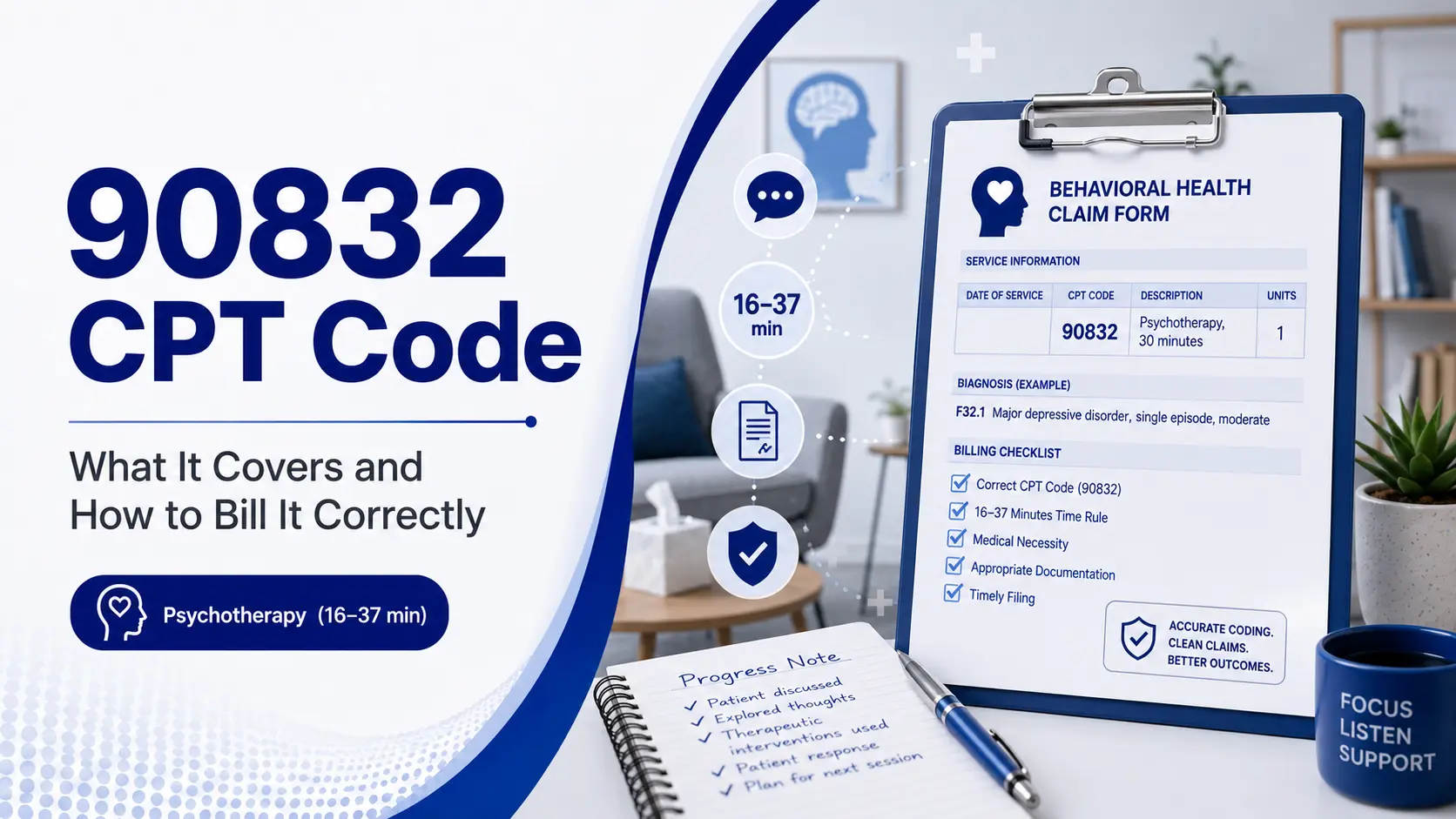
90832 CPT Code covers individual psychotherapy with a patient for approximately 30 minutes, specifically sessions where the face to face therapy time falls between 16 and 37 minutes.
Practice managers search this code constantly, and for good reason. It’s one of the most frequently billed psychotherapy codes in the country. It’s also one of the most frequently denied, not because the therapy didn’t happen, but because the note underneath the claim doesn’t hold up when a payer looks closely.
This guide covers what the code means, who can bill it, the exact time rules, documentation requirements, and the mistakes that trigger denials.
Table of Contents
ToggleWhat Does 90832 CPT Code Actually Cover?
90832 CPT Code is a psychiatry code maintained by the American Medical Association. It represents a standalone individual psychotherapy session, meaning no medication management or evaluation and management service happened alongside it. The therapy itself can use any evidence based approach: cognitive behavioral techniques, supportive counseling, insight oriented work, or behavior modification, as long as it’s delivered one on one and documented as psychotherapy rather than a check-in.
The code sits in a family of three individual psychotherapy codes that differ only by time:
- 90832 covers 16 to 37 minutes (the 30 minute code)
- 90834 covers 38 to 52 minutes (the 45 minute code)
- 90837 covers 53 minutes or longer (the 60 minute code)
You bill whichever code matches your documented face to face time, not your scheduled appointment length.
Who Can Bill 90832 CPT Code?
Any qualified mental health professional whose scope of practice includes independent psychotherapy can bill this code, subject to state licensure and individual payer credentialing. That typically includes:
- Psychiatrists
- Psychologists
- Licensed clinical social workers
- Licensed professional counselors
- Licensed marriage and family therapists
- Certain nurse practitioners with a mental health specialization
Payer rules on supervised or incident to billing vary, so verify credentialing requirements with each payer before you submit a claim under this code.
The Time Rule, Explained Clearly
This is where most denials start. CPT time based codes follow the AMA midpoint rule: you can bill a code once your documented time reaches the midpoint of its range, not just the low end.
A few concrete boundaries to know:
- Under 16 minutes of face to face psychotherapy time, no psychotherapy code is billable for that encounter.
- 16 to 37 minutes qualifies for 90832.
- 38 minutes or more requires you to move up to 90834, even if the visit was scheduled as a 30 minute slot.
Rounding a 15 minute session up to hit the threshold, or rounding a 40 minute session down to avoid billing 90834, counts as upcoding or downcoding. Payers run time audits specifically to catch this pattern, so treat the boundaries as fixed rules, not suggestions.
One more distinction that trips people up: the documented time must reflect direct psychotherapy contact only. Time spent on paperwork, care coordination, or reviewing records before or after the session doesn’t count toward the 16 to 37 minute window.
Documentation That Actually Survives an Audit
A note that says the patient came in, discussed anxiety, and received supportive therapy will not survive a payer review. It has no documented time and no clinical specificity, and that’s the exact combination reviewers flag first.
Your note needs four things every time:
- Start and stop time, or total face to face minutes. “Session conducted from 2:00 PM to 2:28 PM, 28 minutes of individual psychotherapy” is the format payers want to see.
- A specific ICD-10 diagnosis. Unspecified codes aren’t automatically wrong, but a specific diagnosis reduces audit scrutiny.
- The intervention itself. Name the technique. “Used cognitive restructuring to examine catastrophic thinking around an upcoming event” tells a reviewer what actually happened. “Supportive therapy provided” does not.
- Patient response. Even one sentence on how the patient engaged or responded closes the loop a reviewer is looking for.
90832 vs 90833: A Distinction Worth Getting Right
90832 is a standalone psychotherapy code used when no evaluation and management service happens in the same visit. 90833 is an add-on code for psychotherapy delivered alongside an E/M visit, such as a medication management appointment. You cannot bill 90833 by itself. It requires a primary E/M code, and only prescribers who can bill that E/M code (psychiatrists, PMHNPs, physician assistants) can use it. If a psychiatrist provides medication management and a brief 20 minute therapy component in the same visit, the correct billing is the E/M code plus 90833, not 90832 on its own.
Telehealth and 90832 CPT Code in 2026
90832 CPT Code is fully telehealth eligible under current Medicare policy, including audio only sessions when video isn’t accessible to the patient. Place of service coding affects the reimbursement rate: POS 10 (patient at home) generally pays more than POS 02 (patient at another location), so confirm your POS code matches where the patient actually was during the session.
Why 90832 CPT Code Denials Happen So Often
- No documented time. The single most common reason for denial. If the note doesn’t state start and stop time or total minutes, the claim has no time evidence to point to.
- Vague clinical content. Notes that describe the topic discussed but not the therapeutic intervention performed.
- Mismatched records. The scheduling system shows 45 minutes, the note says 30, and the claim bills 90834. Payers cross reference these fields during audits, and any inconsistency invites a records request.
- Wrong code for the actual time. Defaulting to 90837 out of habit, even when the documented session ran closer to 30 minutes.
Each of these is preventable with a documentation template that forces the four required fields into every note before it’s signed.
The Bottom Line
90832 CPT Code pays for 16 to 37 minutes of individual psychotherapy, and the code lives or dies on documentation, not on whether the session happened. Build your notes around start and stop time, a specific diagnosis, a named intervention, and patient response, and this becomes one of the more straightforward codes in your billing workflow instead of one of the riskiest.
Frequently Asked Questions
How much time do I need to bill 90832 CPT Code?
You need at least 16 minutes of documented face to face psychotherapy time. Sessions under 16 minutes aren’t billable under any psychotherapy code, and sessions reaching 38 minutes must be billed as 90834 instead.
Can I bill 90832 CPT Code for a telehealth session?
Yes. 90832 CPT Code is telehealth eligible under current Medicare policy, including audio only sessions in specific circumstances. Confirm your place of service code reflects where the patient was located.
What’s the difference between 90832 and 90833?
90832 CPT Code is a standalone psychotherapy code used on its own. 90833 is an add-on code that can only be billed alongside a primary evaluation and management code, typically by a prescriber combining medication management with a brief therapy component.
Why do 90832 CPT Code claims get denied so often?
The leading cause is missing or vague time documentation. Payers look for a specific start and stop time or total minutes, a documented intervention, and patient response before they’ll uphold the claim on audit.
Does the scheduled appointment length determine the code?
No. The code is determined by documented face to face psychotherapy time, not the length of the scheduled slot. A 45 minute appointment that included 35 minutes of actual therapy still bills as 90832, not 90834.