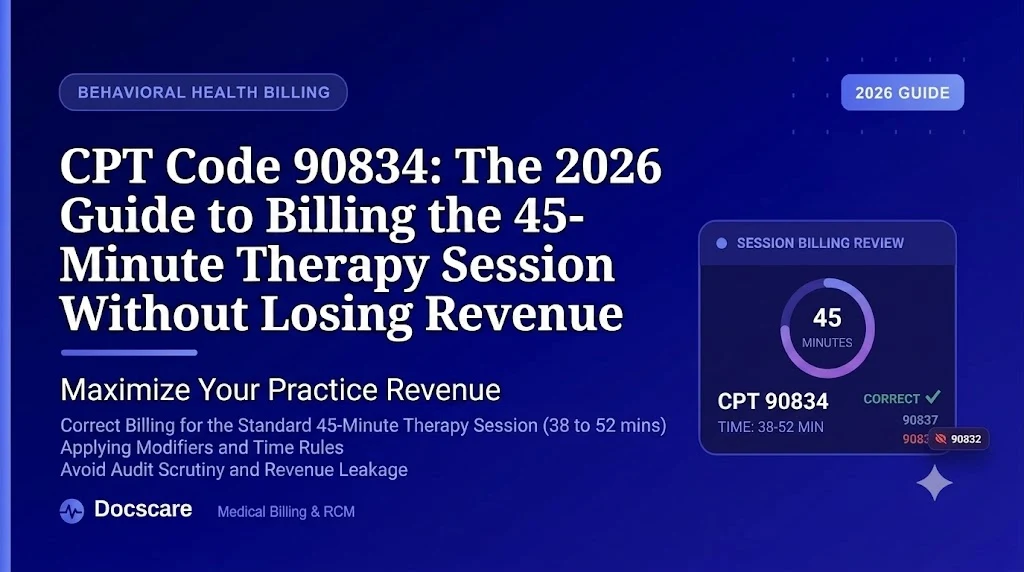
CPT Code 90834 is the code for individual psychotherapy that runs 38 to 52 minutes. It’s the everyday workhorse of outpatient mental health, the most billed therapy code there is, and most people know it as the 45-minute session. Here’s what trips practices up. Everyone watches the upper line, the jump to 90837 at 53 minutes. Almost nobody watches the lower one. A session that ends at 37 minutes quietly drops to 90832 and loses you about 36 dollars, and that cliff costs practices more in lost revenue over a year than the 90837 debate ever will.
This guide gives you the exact CPT Code 90834 time range, both boundaries that decide your pay, how it compares to 90837, what it reimburses in 2026, and the documentation that keeps every claim clean. It’s written for the behavioral health practices and solo therapists who bill this code more than any other.
Table of Contents
Toggle
What Is CPT Code CPT Code 90834?
CPT Code 90834 is the code for individual psychotherapy lasting 38 to 52 minutes of direct, face-to-face time with the patient. The AMA descriptor reads “psychotherapy, 45 minutes,” which is why everyone calls it the 45-minute session, but the billable range is actually 38 to 52. It covers insight oriented, behavior modifying, and supportive therapy in an outpatient setting, and it’s the backbone of routine weekly care, as the APA psychotherapy coding guidance lays out.
It’s the middle of the three timed individual psychotherapy codes and the one you’ll bill most. A wide range of licensed clinicians can use it, including psychologists, LCSWs, LPCs, LMFTs, LMHCs, psychiatrists, and PMHNPs. For how this fits a full behavioral health workflow, see our mental health billing services.
The CPT Code 90834 Time Range (and Both Boundaries That Cost You Money)
Code selection here is mechanical once you’ve documented the minutes. Here are the three timed individual psychotherapy codes and their bands.
| CPT Code | Face-to-Face Time | Description |
|---|---|---|
| 90832 | 16 to 37 minutes | Brief individual psychotherapy |
| 90834 | 38 to 52 minutes | Standard 45-minute psychotherapy |
| 90837 | 53 minutes or more | Extended individual psychotherapy |
Now the part that actually moves your revenue. 90834 has two edges, and crossing either one changes your code and your pay. Most guides only talk about the 53-minute line above. The 37-minute line below is the one that quietly drains routine practices.
| If the Session Runs | You Bill | What It Means for Pay |
|---|---|---|
| 37 minutes or less | 90832 | Drops a level. About 36 dollars less than 90834 on Medicare. |
| 38 to 52 minutes | 90834 | The correct code. Roughly 114 dollars on 2026 Medicare. |
| 53 minutes or more | 90837 | Steps up. Pays 15 to 25 percent more, but draws audit scrutiny. |
These boundaries are absolute. No rounding, no grace period, no payer discretion. A 37-minute session is a 90832, even though it feels like a short CPT Code 90834. A 53-minute session is a 90837. The minutes you document are the claim, so the clock decides, not the appointment slot you scheduled.
FREE CHECK
Want a second set of eyes on your code mix?
CPT Code 90834 vs 90837: When to Move Up a Code
This is the comparison every therapist asks about, and the rule is simple. The only difference between CPT Code 90834 and 90837 is session length. Not the therapy type, not the diagnosis. You can deliver CBT, DBT, or EMDR under either. Time is the line.
| Factor | 90834 | 90837 |
|---|---|---|
| Session time | 38 to 52 minutes | 53 minutes or more |
| Reimbursement | Roughly 114 dollars (Medicare 2026) | 15 to 25 percent higher |
| Audit scrutiny | Routine | High, payers track overuse |
| Best fit | Standard weekly therapy | Trauma, crisis, complex cases |
Here’s the discipline that protects you both ways. Don’t stretch a 50-minute session to 53 just to bill 90837, auditors flag that pattern fast, and it’s upcoding. But don’t reflexively bill CPT Code 90834 for a session that genuinely ran 55 minutes either, because that’s leaving money on the table. Bill the code the clock supports. For the full breakdown of the longer code, see our CPT 90837 guide.
When CPT Code 90834 Applies: Four Common Scenarios
These are the everyday sessions that land squarely in the 38 to 52 minute band, with the diagnosis that supports each.
| Scenario | Example ICD-10 | Why It Is a 90834 |
|---|---|---|
| Standard weekly CBT session | F41.1 (generalized anxiety) | A focused 45-minute session of cognitive behavioral therapy; the everyday backbone of 90834 |
| Ongoing depression management | F33.1 (recurrent depression, moderate) | A 48-minute supportive therapy session in steady treatment; squarely in the 38 to 52 band |
| Session that ends at 40 minutes | F43.23 (adjustment disorder) | Patient wraps early at 40 minutes; still 90834, because it cleared the 38-minute floor. |
| Telehealth therapy session | F90.0 (ADHD) | A 45-minute video session; 90834 with modifier 95 for audio and video |
For telehealth, CPT Code 90834 is fully eligible. Append modifier 95 for an audio and video session, and use the correct place of service code for the patient’s location. Telehealth modifier errors are one of the top denial drivers in mental health, so getting that pairing right matters as much as the time.
What Does CPT Code 90834 Pay in 2026?
The 2026 Medicare national average for CPT Code 90834 is roughly 114 dollars per session in the office setting, with geographic adjustments moving that up or down by location. Commercial payers typically run 100 to 175 dollars, and Medicaid 60 to 80 dollars depending on the state. Your actual rate also depends on your credential type and your contracts, so treat any single figure as a starting point and confirm the current number on the CMS physician fee schedule for your area. Across a full caseload, coding every session at the level the clock actually supports is where your real revenue lives.
Documentation That Keeps Every CPT Code 90834 Clean
Coding and documentation problems are the leading denial category across healthcare billing, with denial rates industry wide between 10 and 15 percent, according to 2026 healthcare denial benchmarks. For 90834, the time entry is the claim. These habits keep yours defensible.
- Record exact start and stop times. Not “45-minute session.” Write the actual clock times, every visit. This single element is what an auditor checks first, and the band you fall in is the entire basis for the code.
- Count only face-to-face therapy time. Scheduling, copay collection, intake review, and note writing don’t count. If 8 minutes of a 50-minute slot were administrative, your billable time is 42 minutes, and your note should show it.
- Match your times to the EHR schedule. When the note says one thing and the appointment log says another, payers notice. Keep them aligned, ideally with EHR time capture.
- Include a risk assessment. Document it even when negative, for example “patient denies suicidal or homicidal ideation.” Missing risk notes are a common CPT Code 90834 denial trigger.
- Finally, watch your code mix ratio. A typical distribution runs around 60 to 70 percent 90834, 20 to 30 percent 90837, and 5 to 15 percent 90832. If yours is far off that, review your time documentation before a payer does.
When denials over time documentation become a pattern instead of a one off, the cause is usually a coding or workflow gap, which is exactly what denial management services are built to fix.
How Docscare Helps Behavioral Health Practices Bill CPT Code 90834 Right
Psychotherapy coding lives or dies on the clock, and that’s where we focus. Our AAPC-certified coders check every session against the 38 to 52 minute band, catch the boundary cases that slip to 90832 or should move up to 90837, confirm your telehealth modifiers, and keep your documentation audit ready. You get paid for the work you actually did, no undercoding, no overcoding, no leaks.
We’re a US based behavioral health billing company in Austin, Texas, fully HIPAA compliant, running a 99 percent clean claim rate with a 97.45 percent first pass acceptance rate. For a therapy practice, that accuracy protects your single busiest code and the revenue tied to it.
See how we support mental health billing services, or read the companion CPT Code 90837 guide for sessions that run 53 minutes or longer.
FREE BEHAVIORAL HEALTH BILLING REVIEW
Find out how much revenue your practice loses to miscoded sessions. We’ll review a sample of your 90832, 90834, and 90837 claims, check the time documentation, and show you exactly where the code and the clock don’t match. No cost, no obligation.
Frequently Asked Questions
What is CPT code CPT Code 90834 used for?
CPT Code 90834 is the code for individual psychotherapy lasting 38 to 52 minutes of face-to-face time with the patient. Often called the 45-minute session, it is the most frequently billed outpatient mental health code. Therapists use it for standard weekly therapy, ongoing depression or anxiety management, and most routine individual sessions, whether in office or by telehealth.
What is the time range for CPT Code 90834?
38 to 52 minutes of direct, face-to-face therapeutic time. A session of 37 minutes or less drops to 90832. A session of 53 minutes or more moves up to CPT Code 90837. The boundaries are absolute, with no rounding and no grace period, so the minutes you document decide the code.
What is the difference between CPT Code 90834 and 90837?
Only time. CPT Code 90834 covers 38 to 52 minutes and 90837 covers 53 minutes or more. The therapy is the same, you can deliver CBT, DBT, or EMDR under either. If the session runs 52 minutes or less, it is CPT Code 90834. At 53 minutes or more, it is 90837, which pays more but draws closer payer review.
How much does CPT Code 90834 reimburse in 2026?
The 2026 Medicare national average is roughly 114 dollars per session in the office (non facility) setting, with geographic adjustments raising or lowering that by location. Commercial payers typically run 100 to 175 dollars, and Medicaid 60 to 80 dollars by state. Check the current CMS fee schedule and your payer contracts for exact figures.
What counts toward the CPT Code 90834 time?
Only direct, face-to-face therapy time. Scheduling, copay collection, reviewing intake paperwork, and writing your note afterward do not count. If your appointment slot is 50 minutes but 8 of those were administrative, your billable time is 42 minutes, which is still within the CPT Code 90834 range as long as your documentation shows it.