If a physician wants to bill an adult’s annual physical using the correct preventive medicine code, understanding CPT 99395 keeps the claim out of the denial pile. This code sits at the center of adult preventive billing, and small errors around it — wrong patient status, wrong age bracket, a missing modifier — are some of the most common reasons preventive claims bounce back unpaid.
Table of Contents
ToggleWhat Is CPT Code 99395?
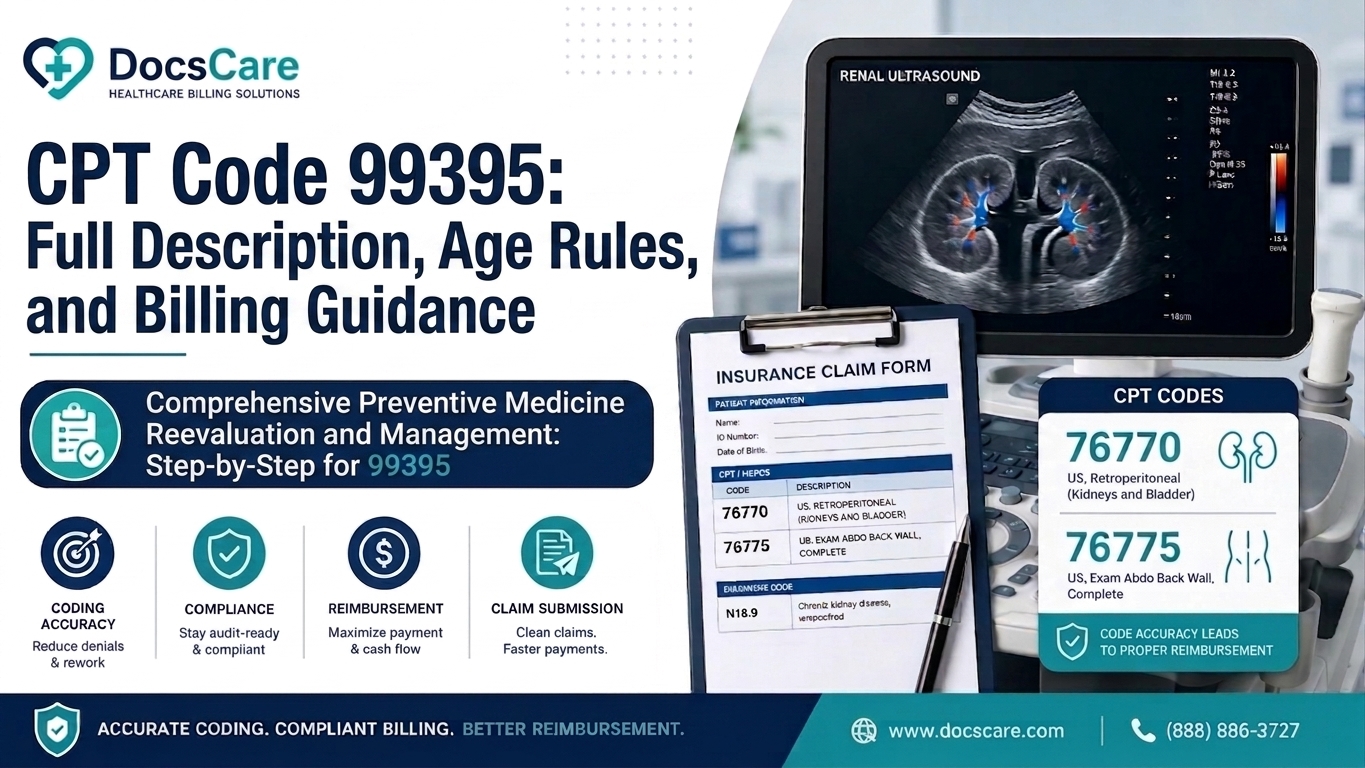
CPT code 99395 reports a periodic, comprehensive preventive medicine reevaluation for an established patient between 18 and 39 years old. The American Medical Association’s official descriptor for 99395 reads: periodic comprehensive preventive medicine reevaluation and management of an individual, including an age- and gender-appropriate history, examination, counseling and anticipatory guidance, risk-factor-reduction interventions, and the ordering of laboratory or diagnostic procedures, for an established patient aged 18 through 39.
Two conditions decide whether 99395 is the right code, and both have to be true on the date of service:
- The patient is established someone the practice, or another provider of the same specialty in the same group, has already seen within the past three years.
- The patient is between 18 and 39 years old on the day of the visit.
Neither medical decision-making complexity nor time in the room affects code selection here. Preventive medicine codes are chosen entirely by patient status and age, which makes them simpler to select than problem-oriented E/M codes — and easier to get wrong when a scheduling system doesn’t flag a patient’s birthday against the visit date.
CPT 99395 vs. 99385: New Patient or Established?
The most frequent 99395 coding error is billing an established patient under the new-patient code, or the reverse. CPT 99385 covers an identical scope of service same age band, same comprehensive exam but for a new patient. “New” and “established” describe the provider relationship, not whether the front desk already has the patient’s chart on file:
- Established patient (99395): seen by any physician of the same specialty in the same practice group within the last three years.
- New patient (99385): not seen by that provider or specialty group in the last three years, even if the patient has an existing account in the practice’s system.
A patient who last visited a different specialist at a multi-specialty group four years ago, or who was previously seen by a nurse practitioner rather than the billing physician, can trip this rule. Confirm the last date of service with that specific specialty, not just the last date the patient walked through the door.
CPT 99395 vs. 99396: Where the Age Line Falls
CPT 99395 and CPT 99396 cover the same type of visit periodic, comprehensive preventive care for an established patient split only by age. 99395 applies through age 39; 99396 takes over at 40. The split isn’t tied to a plan year or a rolling benefit period; it runs off the patient’s age on the actual date of service. A patient who turns 40 the week before a scheduled physical needs 99396, even if the appointment was booked while they were still 39.
That detail matters more than it looks. Billing 99396 for a 39-year-old, or 99395 for a 40-year-old, triggers an automatic, system-level denial on most payer platforms. It isn’t a coverage dispute it’s a straightforward eligibility mismatch that has to be corrected and resubmitted before the claim gets paid.
The Full Preventive Medicine Code Family
CPT 99395 belongs to a seven-code series for established patients, mirrored by an equivalent series for new patients. Seeing the whole family in one place makes an age-band error easier to catch before a claim goes out the door.
| Age Range | New Patient | Established Patient |
|---|---|---|
| Younger than 1 year | 99381 | 99391 |
| 1–4 years | 99382 | 99392 |
| 5–11 years | 99383 | 99393 |
| 12–17 years | 99384 | 99394 |
| 18–39 years | 99385 | 99395 |
| 40–64 years | 99386 | 99396 |
| 65 years and older | 99387 | 99397 |
Family practices and internal medicine offices bill 99395 more than almost any other preventive code, since 18–39 covers the largest single working-age bracket in most adult patient panels.
What’s Included in a 99395 Visit
A comprehensive preventive visit under 99395 covers more ground than a typical problem-focused office visit. The code’s scope includes:
- An age- and gender-appropriate history and comprehensive physical examination
- Counseling, anticipatory guidance, and risk-factor-reduction interventions relevant to a patient in their 20s or 30s
- Ordering of appropriate labs, screenings, or diagnostic tests
- Management of minor, self-limited findings that don’t rise to the level of a separate problem
Coders pairing this visit with a diagnosis code should already be clear on the difference between ICD-10 and CPT codes, since mixing up a preventive Z-code with a problem-based diagnosis is one of the fastest ways to trigger a denial. Anything beyond a minor, self-limited finding a new diagnosis, a medication change, ongoing management of a chronic condition pushes part of the visit into problem-oriented E/M territory alongside the preventive service. That’s where modifier 25 comes in.
Documentation That Supports a Clean 99395 Claim
Preventive visits get audited and denied more often than most other outpatient services, mostly because the documentation doesn’t clearly separate what was preventive from what was problem-oriented. A defensible 99395 note generally includes:
- Confirmed patient status and age established, 18 through 39, checked against the visit date rather than the scheduling date.
- A complete history and exam matching the age- and gender-appropriate elements the code requires.
- Documented counseling topics the specific anticipatory guidance given, not a generic “counseling provided” line repeated across every chart.
- Orders for labs or screenings, or a note that none were clinically indicated.
- A clear boundary between preventive findings and any problem addressed separately, with its own assessment and plan when modifier 25 applies.
Practices that route this review through a dedicated medical coding services team tend to catch mismatched Z-codes and thin counseling notes before the claim ever reaches a payer. Templates that repeat identical counseling language regardless of a patient’s age or risk factors are a common audit trigger, since they suggest the visit wasn’t individualized to the patient in the chair.
Modifier 25: Billing a Problem Visit the Same Day
When a patient comes in for an annual physical and mentions a new issue — persistent headaches, a skin lesion, worsening anxiety that gets meaningfully evaluated, the practice can bill both 99395 and a problem-oriented E/M code (99212–99215) for the same date of service. Modifier 25 goes on the E/M code, not on 99395, and the documentation needs to show that the problem-oriented service was significant and separately identifiable from the preventive exam itself. A single-line mention that doesn’t reflect additional history, exam, or medical decision-making won’t support the modifier if a payer requests records.
Does Insurance Cover CPT 99395?
Coverage for 99395 depends heavily on the payer:
- Traditional Medicare does not cover CPT 99395, or any code in the 99381–99397 preventive family. A statutory exclusion for routine physical exams routes Medicare beneficiaries toward the Annual Wellness Visit codes instead, not toward 99395.
- Medicare Advantage plans sometimes structure preventive-visit coverage differently than traditional Medicare, so verify the specific plan’s policy before scheduling.
- Commercial and ACA marketplace plans generally cover 99395 as a first-dollar preventive benefit, meaning no copay or deductible when the visit is billed correctly with a preventive diagnosis code.
- Medicaid coverage varies by state program, and some states apply a calendar-year frequency limit while others use a rolling 12-month window.
Reimbursement for 99395 follows the relative value units assigned to the code, and many commercial payers benchmark their preventive-visit rates against the Medicare Physician Fee Schedule’s RVU value even though Medicare itself excludes the code from coverage. The exact rate still depends on the individual payer contract and plan type, so check the specific fee schedule rather than assuming one flat number applies across every plan.
Confirming eligibility and benefits before the appointment is typically a job for the front-office or outsourced medical billing team, not something to leave to the coding step alone.
Common Reasons CPT 99395 Claims Get Denied
A handful of avoidable errors account for most 99395 denials:
- Wrong patient status billing an established patient as new, or the reverse
- Age mismatch the patient turned 40 between scheduling and the visit date, but the claim still lists 99395
- Frequency denial a second preventive visit billed within the payer’s benefit period
- Diagnosis mismatch pairing 99395 with a problem-oriented ICD-10 code instead of a preventive Z-code
- Missing or misapplied modifier 25 either omitted when a separate problem was addressed, or attached to the wrong line
- Thin documentation a note that doesn’t clearly support every element the comprehensive descriptor requires
Tracking these denial patterns over time which reasons repeat, which providers trigger them most is really a revenue cycle management workflow question as much as a coding one.
MEDICAL CODING SUPPORT
Coding errors like these are exactly what a trained coder catches before a claim goes out, not after a denial comes back. Docscare’s AAPC-certified coding team reviews every preventive claim for patient status, age band, and modifier accuracy prior to submission, which is part of how we hold a 99% clean claim ratio.
How to Bill CPT 99395 Correctly: A Quick Checklist
- Confirm the patient’s status new vs. established against the specific specialty, not just the practice’s overall patient list
- Verify age on the actual date of service, not the date the appointment was booked
- Pair the claim with an appropriate preventive ICD-10 code, such as Z00.00 or Z00.01
- Document every required element: history, exam, counseling, and orders
- Apply modifier 25 to the E/M code, never to 99395, when a separate problem is addressed
- Check the payer’s frequency limit before scheduling a repeat preventive visit
Getting these checks right consistently is what makes a claim clean on first submission instead of stuck in a denial queue.
Frequently Asked Questions
Is CPT 99395 covered by Medicare?
No. Traditional Medicare excludes CPT 99395 and the rest of the 99381–99397 preventive medicine family. Medicare beneficiaries receive preventive-style coverage through the Annual Wellness Visit codes instead.
What’s the difference between CPT 99395 and CPT 99396?
Both cover the same comprehensive preventive visit for an established patient. 99395 applies to patients 18 through 39; 99396 applies to patients 40 through 64. The split is based on the patient’s age on the date of service, not on a plan year.
Can a practice bill CPT 99395 and a sick visit on the same day?
Yes, when a separately identifiable problem is evaluated during the same visit. Bill the problem-oriented E/M code (99212–99215) with modifier 25 attached to that code, supported by documentation that clearly separates the preventive and problem-oriented portions of the encounter.
What ICD-10 code pairs with CPT 99395?
A preventive Z-code, most commonly Z00.00 for a general adult medical exam without abnormal findings, or Z00.01 when abnormal findings are present. Pairing 99395 with a problem-oriented diagnosis code is a frequent cause of denial.
How often can a patient receive a 99395 visit?
Most commercial payers allow one comprehensive preventive visit per rolling 12-month or calendar-year period, depending on the plan. Confirm the specific payer’s frequency rule before scheduling a repeat visit.
MEDICAL CODING SUPPORT
Preventive-visit denials add up fast when patient status and age bands aren’t checked before submission. Docscare’s medical coding team builds those checks into every claim, backed by AAPC-certified coders and a 99% clean claim ratio across specialties.
Getting CPT 99395 right comes down to two checks every time: patient status and age on the date of service, backed by documentation that matches what the code actually requires. Practices that build both checks into scheduling and coding workflow see markedly fewer preventive-visit denials than those relying on staff to catch it manually, chart by chart.