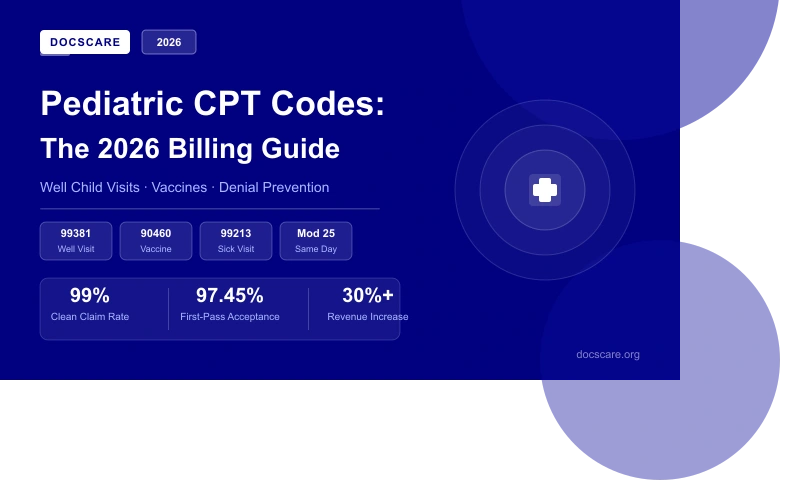
Pediatric claims deny for boring reasons. A 12 year old billed under the wrong age bracket. A vaccine product code submitted with no administration code attached. A sick visit folded into a well child visit with no modifier. None of these are clinical mistakes. They are coding mistakes, and they quietly drain a pediatric practice of thousands of dollars a year.
This guide covers the pediatric CPT codes you bill every day: well child preventive visits, vaccine administration, and same day sick visits. We walk through the 2026 codes, the rules payers actually enforce, and the specific errors that trigger denials. If you run a pediatric practice and your claims keep coming back, the cause is almost always somewhere on this page.
Table of Contents
ToggleWhat Are Pediatric CPT Codes?
Pediatric CPT codes are the standardized procedure codes that translate a child’s visit into a claim a payer will reimburse. Three groups matter most in a pediatric practice: preventive medicine codes for well child visits, immunization administration codes for vaccines, and evaluation and management (E/M) codes for sick visits.
Each group has its own rules. Preventive codes hinge on the patient’s age on the date of service. Vaccine codes require two separate lines on every claim. Sick visits billed alongside a well child visit need a modifier or the second charge gets rejected. Get the code group right and the claim pays clean. Mix them up and you are looking at a denial or a silent downcode.
Coding sits inside a larger billing workflow. If you want the full picture of how coding feeds claim submission and collection, see our medical coding services overview.
Well Child Visit Pediatric CPT Codes (99381 to 99395)
Well child visits use preventive medicine E/M codes, and the code you pick depends entirely on the child’s age on the date of service. Not the day you bill. The day you saw the patient.
New patients use the 99381 to 99385 series. Established patients use 99391 to 99395. Here is the full age breakdown for 2026.
| CPT Code | Patient Type | Age Band |
|---|---|---|
| New Patients — CPT 99381 to 99385 | ||
| 99381 | New Patient | Under 1 year (infant) |
| 99382 | New Patient | 1 to 4 years |
| 99383 | New Patient | 5 to 11 years |
| 99384 | New Patient | 12 to 17 years |
| 99385 | New Patient | 18 to 39 years |
| Established Patients — CPT 99391 to 99395 | ||
| 99391 | Established Patient | Under 1 year (infant) |
| 99392 | Established Patient | 1 to 4 years |
| 99393 | Established Patient | 5 to 11 years |
| 99394 | Established Patient | 12 to 17 years |
| 99395 | Established Patient | 18 to 39 years |
billed under 99393, which covers ages 5 to 11, gets denied because the child has aged into the 99394 bracket. The fix is simple but it has to be systematic: code selection keys off the date of service age, and your charge capture should flag any visit where the patient sits on a birthday boundary.
Documentation also has to support the full preventive service. The note needs the physical exam, the growth and development assessment, anticipatory guidance, and the immunization review. A preventive code without preventive documentation is an audit waiting to happen. For the official age and visit definitions, see the AMA CPT code set.
Free Audit
Want us to review a sample of your well child claims for age band and documentation errors?
Pediatric Vaccine Administration Codes (90460, 90461, 90471, 90472)
Vaccine billing is where pediatric practices lose the most money, and almost always to the same two errors. Every vaccine needs two codes on the claim: the product code that identifies the vaccine, and the administration code that covers giving it. Submit the product code alone and you get a partial or full denial on the administration work you actually performed.
The administration code you choose depends on one thing: whether counseling was documented.
| CPT Code | When to Use It |
|---|---|
| 90460 | First or only component, patient under 19, counseling documented |
| 90461 | Each additional component, patient under 19, counseling documented |
| 90471 | First component, no documented counseling (or patient 19 and older) |
| 90472 | Each additional component, no documented counseling |
Two rules drive accurate vaccine billing. First, the counseling rule. For a patient under 19 where the provider documents counseling, you bill 90460 for the first vaccine component and 90461 for each additional component. Counseling means a real discussion of risks and benefits, documented in the note, not a handout passed across the desk. When counseling is not documented, you drop to 90471 and 90472 regardless of how the visit went.
Second, the component rule. Combination vaccines carry multiple antigens, and each component past the first gets its own 90461. Pediarix has five components. Pentacel has five. Vaxelis protects against six diseases. A practice that bills one administration code for a five component vaccine is leaving four units of payment on the table on every dose. Across a busy immunization schedule, choosing 90460 over 90471 and counting components correctly can mean thousands of dollars a year.
Every vaccine also links to the right diagnosis code, usually from the Z23 series for encounter for immunization. A product or administration code with no matching diagnosis is a clean denial. The CDC vaccine code list tracks current product codes as they change.
Same Day Sick Visits: The Modifier 25 Rule
This is the single most expensive pediatric coding error, because it happens on the busiest visits. A child comes in for a well child check, and the provider also addresses a separate, significant problem: an ear infection, a new rash, worsening asthma. That is two services in one encounter, and both are billable. But only if you code it correctly.
You bill the preventive visit code (99391 to 99395) and the problem oriented E/M code (99212 to 99215) on the same claim, and you append modifier 25 to the sick visit E/M code. Modifier 25 tells the payer the second service was significant and separately identifiable. Skip it, and the payer rejects the sick visit charge as bundled into the preventive visit. You did the work. You just gave it away.
Three quick examples of correct same day coding:
- A 4 year old comes in for a well visit (99392). The provider diagnoses acute otitis media and prescribes an antibiotic. Bill 99392 plus 99213 with modifier 25.
- A 14 year old comes in for a well visit (99394). The provider diagnoses new onset asthma and starts an inhaled steroid. Bill 99394 plus 99214 with modifier 25, with the asthma diagnosis linked to the E/M.
- A 9 month old comes in for a well visit (99391). The provider finds iron deficiency anemia on a hemoglobin screen and prescribes iron. Bill 99391 plus 99212 with modifier 25, with the anemia diagnosis linked to the E/M.
One more linkage rule. The diagnosis codes have to match the service. Linking a preventive CPT code to an acute illness diagnosis (or the reverse) signals a mismatch and triggers a denial. Z00.121 covers a well child exam with abnormal findings. Z00.129 covers one without. The problem visit gets the problem diagnosis. Keep them straight.
See How It Works
Losing same day sick visit revenue to missing modifiers? Our coders catch it before the claim goes out.
The 5 Pediatric Coding Errors That Cause the Most Denials
Coding and documentation problems are the leading denial category across healthcare billing, and pediatrics concentrates them into a handful of repeat offenders. Denial rates industry wide now sit between 10 and 15 percent, and coding inaccuracies plus missing CPT or ICD codes top the list of causes, according to 2026 healthcare denial benchmarks. In our own pediatric claim reviews, these five errors show up more than any others.
- Wrong age band preventive code. Billing 99393 for a child who has turned 12 instead of 99394. Age on the date of service controls the code, every time.
- Missing vaccine administration code. Submitting the product code with no 90460 or 90471 attached. Always send both, on separate lines.
- Under counting vaccine components. Billing one administration unit for a multi antigen combination vaccine instead of one 90461 per additional component.
- Forgetting modifier 25 on same day E/M. Addressing a separate problem during a well visit and failing to flag the sick visit as separately identifiable.
- Mismatched ICD-10 and CPT codes. Linking a preventive code to an acute diagnosis, or a problem code to a well child diagnosis. The codes have to agree.
None of these require better medicine. They require a billing process that checks for them before the claim leaves the building. When denials are a pattern rather than a one off, the cause is upstream in coding and submission, which is exactly what denial management is built to fix.
How Docscare Handles Pediatric Billing
Pediatric coding is its own discipline, and we treat it that way. Our AAPC-certified coders work pediatric claims specifically, so age band selection, vaccine component counting, and the modifier 25 rule are second nature, not a lookup. We review the visit note before coding, verify that product and administration codes both land on the claim, and confirm the diagnosis matches the service before anything goes to the payer.
We are US based in Austin, Texas, fully HIPAA compliant, and we run a 99 percent clean claim rate with a 97.45 percent first pass acceptance rate. For a pediatric practice, that means fewer reworked claims, faster payment, and an end to the slow revenue leak from miscoded well visits and vaccines.
See the full service on our pediatric medical billing services page, or look at how coding fits the wider revenue cycle management workflow.
Free Pediatric Billing Audit
Stop losing revenue to preventable pediatric denials.
We will review a 30 claim sample from your last 90 days and show you exactly where the money is leaking. No cost, no obligation.
Frequently Asked Questions
What CPT codes are used for well child visits in 2026?
Well child visits use preventive medicine codes 99381 to 99385 for new patients and 99391 to 99395 for established patients. The exact code depends on the child’s age on the date of service, not on time or medical decision making.
How do you bill vaccine administration for pediatric patients?
Every vaccine needs two codes: the vaccine product code and an administration code. For patients under 19 with documented counseling, use 90460 for the first component and 90461 for each additional component. Without documented counseling, use 90471 and 90472.
How do I bill a sick visit and a well child visit on the same day?
Bill the preventive code (99391 to 99395) and the problem oriented E/M code (99212 to 99215) on the same claim, and append modifier 25 to the sick visit code. Modifier 25 tells the payer the problem visit was significant and separately identifiable, so both services pay.
Why do pediatric claims get denied most often?
The most common causes are wrong age band preventive codes, missing vaccine administration codes, under counted vaccine components, a missing modifier 25 on same day visits, and mismatched ICD-10 and CPT codes. All five are preventable with a coding review before submission.
What is the difference between 90460 and 90471?
Both are vaccine administration codes. 90460 applies when the patient is under 19 and the provider documents counseling about the vaccine. 90471 applies when no counseling is documented, or when the patient is 19 or older.
“`