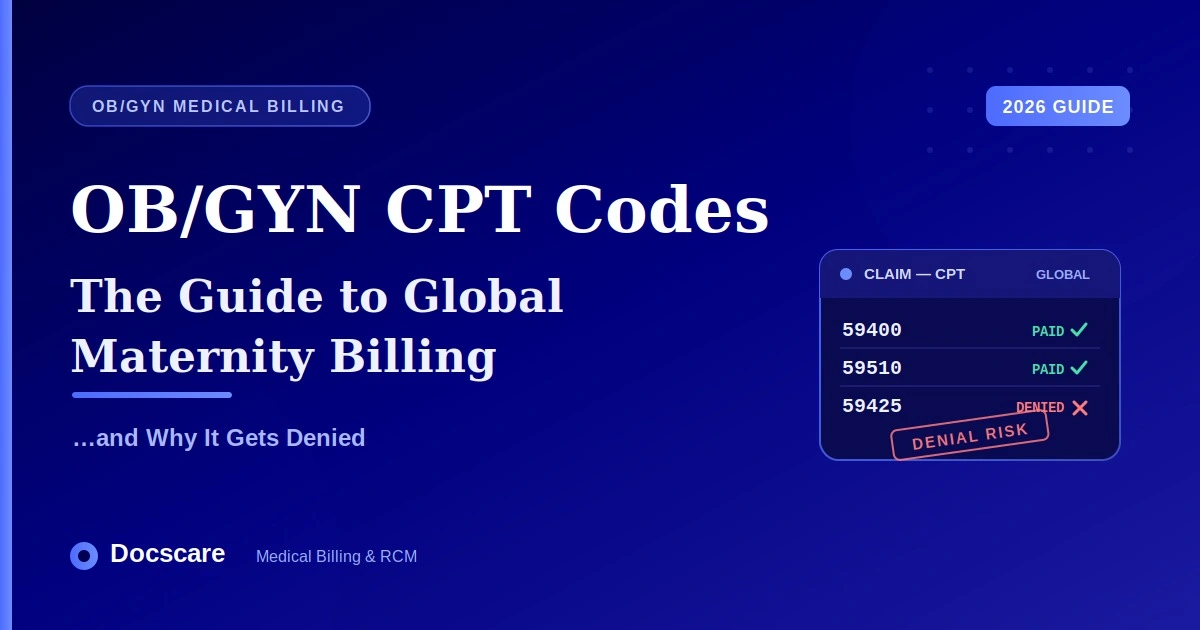
OB/GYN CPT codes determine whether maternity care is billed as a global package, split service, or separately reportable encounter. One miscoded maternity claim can cost an OB/GYN practice several thousand dollars. Bill the global package when care was split between two providers, and the payer claws it back. Bill separate prenatal visits that were already bundled, and you trip a compliance flag. Pick the wrong delivery code for a patient who had a prior cesarean, and the claim denies on a technicality. Maternity is the highest-dollar work an OB/GYN does, and it is also where coding goes wrong most often.
This guide covers the global maternity codes you bill in 2026, what the package includes, when you have to itemize instead, and the specific errors that send maternity claims back. It also covers the change coming in 2027 that every OB/GYN practice needs to plan for now.
Table of Contents
Toggle
What Are the Global Maternity CPT Codes?
The global maternity codes bundle an entire uncomplicated pregnancy into one CPT code: antepartum care, the delivery, and postpartum care. You report a single code after delivery, and the code you choose depends on the type of delivery. There are four.
| CPT Code | Global Package Covers |
|---|---|
| 59400 | Routine obstetric care: antepartum care, vaginal delivery, and postpartum care |
| 59510 | Routine obstetric care: antepartum care, cesarean delivery, and postpartum care |
| 59610 | Routine obstetric care: antepartum, vaginal delivery after previous cesarean (VBAC), and postpartum care |
| 59618 | Routine obstetric care: antepartum, cesarean delivery following attempted VBAC, and postpartum care |
One code, one provider or group under the same tax ID, the whole pregnancy. That is the rule that governs everything else. The moment any part of that sentence stops being true, the global code is wrong and you itemize instead. We cover that below. For how these codes fit your wider claim workflow, see our medical coding services overview.
What the Global OB Package Includes (and What It Does Not)
The package covers routine, uncomplicated maternity care. Knowing exactly where the boundary sits is the difference between a compliance violation on one side and lost revenue on the other. Bill separately for something already inside the package and you have overbilled. Fail to bill separately for something outside it and you have left money on the table.
Inside the global package:
- Roughly 13 routine antepartum visits: monthly through 28 weeks, every two weeks through 36 weeks, then weekly until delivery.
- Initial and follow up prenatal history and physical exams.
- Routine monitoring: weight, blood pressure, fundal height, fetal heart tones.
- Routine dipstick urinalysis (81000, 81002).
- Admission, labor management, vaginal or cesarean delivery, episiotomy, and delivery of the placenta.
- Roughly six weeks of routine postpartum care, hospital and office.
Billed separately, outside the package:
- All obstetric ultrasounds and fetal imaging (76801, 76805, and related codes).
- Lab work beyond routine dipstick urinalysis.
- High risk or complication visits beyond the routine antepartum schedule. Report these at the time of delivery, because only then can you assess how many extra visits occurred.
- Procedures unrelated to routine care, such as amniocentesis or external cephalic version.
A practice that bills routine prenatal visits as separate E/M codes on top of the global package is the single most common compliance error in maternity billing. Those visits are already paid inside 59400 or 59510. Bill them twice and you invite a payer audit.
When to Itemize Instead of Billing Global
Use the global code only when one provider or group provides all three components. When care is split, you itemize. The three most common triggers are a patient who transfers in or out partway through the pregnancy, a change in insurance during the pregnancy, and a different physician handling the delivery. In any of those cases, billing the global code gets the claim denied or recouped.
The itemized codes break the package into its parts.
| CPT Code | Use For |
|---|---|
| 59425 | Antepartum care only, 4 to 6 visits |
| 59426 | Antepartum care only, 7 or more visits |
| 59430 | Postpartum care only (office visits after delivery) |
Delivery itself, when you provide delivery only and no antepartum or postpartum care, uses the delivery only codes:
| CPT Code | Delivery Only |
|---|---|
| 59409 | Vaginal delivery only (no antepartum or postpartum care) |
| 59514 | Cesarean delivery only |
| 59612 | Vaginal delivery only, after previous cesarean (VBAC) |
| 59620 | Cesarean delivery only, following attempted VBAC |
For antepartum only care, the visit count drives the code. One to three visits are reported with the appropriate E/M codes. Four to six visits use 59425. Seven or more use 59426. These thresholds follow ACOG and most payers, but confirm them against each payer’s policy, since a few set the boundary differently. Counting the visits wrong is a quiet but frequent denial cause when a patient transfers care.
VBAC (Vaginal Birth After Cesarean) Coding: The Detail That Trips Up Generalist Billers
A vaginal birth after a previous cesarean does not use the standard vaginal delivery code. It has its own global code, 59610, and its own delivery only code, 59612. If the attempted VBAC ends in a cesarean, you move to 59618 for global or 59620 for delivery only. A biller who reaches for 59400 out of habit on a VBAC patient codes the claim wrong, and the payer notices because the diagnosis carries the prior cesarean history.
This is exactly the kind of specialty specific detail a generalist billing service misses and a dedicated OB/GYN coder catches. The prior cesarean has to drive the code selection, every time.
See How It Works
VBAC and split care claims denying on technicalities? Our OB/GYN coders handle the edge cases. See how our OB/GYN billing works.
The 5 OB/GYN CPT Codes Errors That Cause the Most Denials
Coding and documentation problems are the leading denial category across healthcare billing, and maternity concentrates them onto the highest value claims a practice submits. Denial rates industry wide sit between 10 and 15 percent, with coding inaccuracies and missing codes topping the list of causes, according to 2026 healthcare denial benchmarks. In our own OB/GYN claim reviews, these five errors repeat the most.
- Billing global when care was split. Using 59400 or 59510 for a patient who transferred in or changed insurance mid pregnancy. Itemize instead.
- Double billing routine prenatal visits. Reporting separate E/M codes for antepartum visits already bundled into the global package. A compliance flag, not just a denial.
- Wrong delivery code on a VBAC. Using 59400 instead of 59610, or missing the move to 59618 when an attempted VBAC becomes a cesarean.
- Miscounting antepartum visits. Choosing 59425 when the count supports 59426, or the reverse, on split care claims.
- Failing to separately report excluded services. Folding ultrasounds, non routine labs, or high risk visits into the global code instead of billing them on their own.
None of these are clinical mistakes. They are process gaps that a coding review catches before submission. When denials become a pattern, the cause is upstream, which is what denial management is built to fix.
What Is Changing in OB/GYN 2027 (Plan Now)
The core obstetric codes did not change in 2026. The familiar global maternity codes stay in use. But a significant revision to obstetric coding has been approved for 2027, and it may move maternity billing away from the bundled global package toward itemized, visit by visit billing.
ACOG already recommends that payers begin the transition, using evaluation and management codes for antepartum visits, and advises that the shift start no later than September 1, 2026. For your practice, that means the workflow you use today may not be the workflow you use a year from now. Practices that prepare their documentation and charge capture for itemized antepartum billing now will not scramble when the change lands. See the ACOG obstetric coding guidance for the official position, and the AMA CPT code set for the current definitions.
How Docscare Handles OB/GYN Billing
OB/GYN billing rewards specialists, because the edge cases are where the money is. Our AAPC-certified coders work maternity claims specifically, so the global versus itemized decision, VBAC code selection, and the line between bundled and separately billable services are routine judgments, not guesses. We review the chart before coding, confirm whether one provider delivered all three components, and verify that excluded services are billed on their own.
We are US based in Austin, Texas, fully HIPAA compliant, and we run a 99 percent clean claim rate with a 97.45 percent first pass acceptance rate. For an OB/GYN practice, that protects your highest value claims from recoupment and keeps maternity revenue moving. We are also tracking the 2027 transition so your billing is ready before the rules change.
See the full service on our OB/GYN medical billing services page, or look at how coding fits the wider revenue cycle management workflow.
Free OB/GYN Billing Audit
Protect your maternity revenue. We will review a 30-claim sample from your last 90 days, check global versus itemized accuracy, and show you exactly where claims are at risk. No cost, no obligation.
Frequently Asked Questions
What CPT code is used for global maternity care in 2026?
The global maternity code depends on delivery type. Use 59400 for a vaginal delivery, 59510 for a cesarean, 59610 for a vaginal birth after previous cesarean (VBAC), and 59618 for a cesarean following an attempted VBAC. Each code covers antepartum care, the delivery, and postpartum care under one provider or group.
What does the global OB/GYN package include?
The global package covers about 13 routine antepartum visits, admission and labor management, the delivery itself including episiotomy and placenta delivery, and roughly 6 weeks of postpartum care. Ultrasounds, lab work beyond routine dipstick urinalysis, and high risk visits beyond the routine schedule are billed separately.
When should you bill itemized maternity codes instead of the global code?
Bill itemized codes when one provider or group does not deliver all three components. Common triggers are a patient who transfers in or out mid pregnancy, a change in insurance during the pregnancy, or a different physician handling the delivery. Use antepartum-only codes 59425 or 59426 and postpartum-only code 59430 as the situation requires.
Why do OB/GYN maternity claims get denied?
The most common causes are billing the global code when care was split between providers, billing separate E/M visits for routine prenatal care already inside the global package, choosing the wrong delivery code for a VBAC, and failing to separately report high risk visits or services excluded from the package.
Is the global OB/GYN package changing?
The core obstetric codes did not change in 2026, but a significant revision is approved for 2027. ACOG recommends payers begin transitioning away from global obstetric payment toward E/M based antepartum billing, with the shift starting no later than September 1, 2026. Practices should prepare their workflows now.