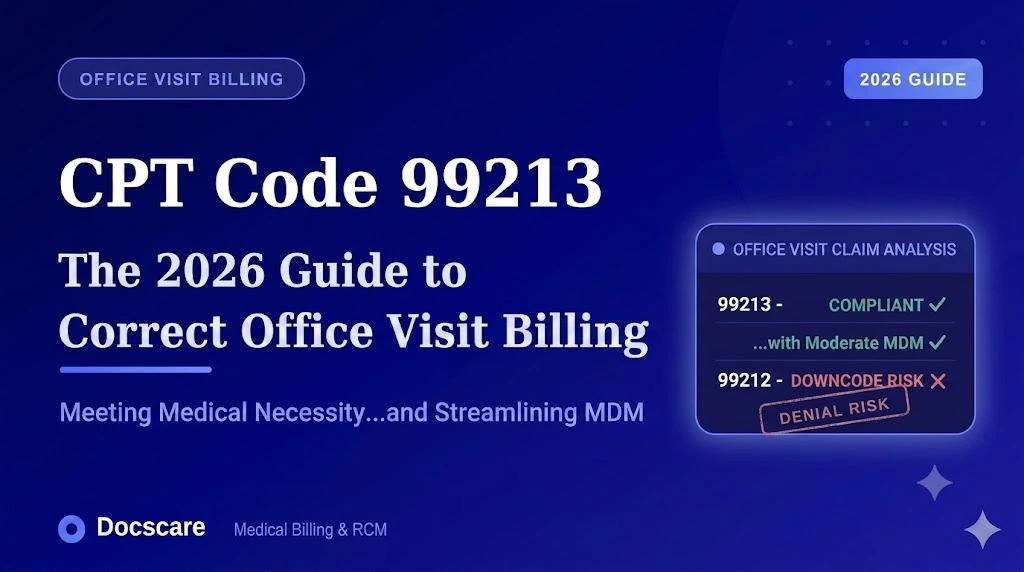
CPT Code 99213 is an office or outpatient visit for an established patient that needs a low level of medical decision making, or 20 to 29 minutes of your total time on the day of the visit. It is the single most billed evaluation and management code in primary care. It is also one of the most audited, and one of the most undercoded. Most practices lose money on 99213 not by billing it wrong, but by billing it when the visit actually supported 99214.
This guide explains exactly what CPT Code 99213 covers in 2026, the two ways to qualify for it, how it differs from 99214, what it pays, and the documentation that keeps the claim clean. It is written for the family medicine and internal medicine practices that bill this code dozens of times a day.
Table of Contents
ToggleFREE CHECK
Wondering if your practice is leaving money on 99213 visits?
What Is CPT Code 99213?
CPT Code 99213 is a Level 3 evaluation and management code for an office or outpatient visit with an established patient. The 2026 descriptor requires a medically appropriate history and examination, and a low level of medical decision making. An established patient is someone your practice has seen within the past three years. You bill the typical 99213 for a routine follow up: a stable chronic condition, an uncomplicated acute problem, or a medication check.
It is the workhorse code of primary care, which is exactly why payers scrutinize it. For how E/M coding fits your full claim workflow, see our medical coding services overview.
The Two Ways to Qualify for CPT Code 99213
Since the 2021 E/M overhaul, you reach 99213 by one of two independent pathways. You meet one or the other. You do not need both.
Pathway 1: Time. Spend 20 to 29 minutes of total provider time on the date of the encounter. That total includes the face to face visit plus same day work like chart review, ordering tests, and documentation. The time table for established patients runs as follows.
| CPT Code | Total Time on Date of Encounter | MDM Level |
|---|---|---|
| 99212 | 10 to 19 minutes | Straightforward MDM |
| 99213 | 20 to 29 minutes | Low MDM |
| 99214 | 30 to 39 minutes | Moderate MDM |
| 99215 | 40 to 54 minutes | High MDM |
Pathway 2: Medical decision making. Reach a low level of MDM. MDM is built from three elements, and you need two of the three at the low level to qualify.
| MDM Element | Low Level Threshold for 99213 |
|---|---|
| Problems addressed | Low: one stable chronic illness, or one acute uncomplicated illness or injury |
| Data reviewed | Limited: review of a test, or one external note, or an independent historian |
| Risk | Low risk of complications from the problem and the management decided on |
Here is the practical rule. Most established patient visits qualify more naturally by MDM, because the clinical picture fits low complexity. But when a visit runs long on counseling while staying clinically simple, time is your friend. A 25 minute prediabetes counseling visit where the only decision is to continue diet and exercise is a CPT Code 99213 by time, even when MDM alone would only support 99212.
CPT Code 99213 vs 99214: The Difference That Costs You Money
This is the comparison every coder and physician asks about, because the line between the two is where revenue is won or lost. CPT Code 99213 is low complexity or 20 to 29 minutes. 99214 is moderate complexity or 30 to 39 minutes. The clinical work decides it, not habit.
The jump from CPT Code 99213 to 99214 usually turns on three things: a more severe or less stable problem, more data reviewed (multiple tests, an external record, an independent historian), or higher risk in the management decision (prescription drug management, for example, often pushes a visit to moderate). A physician who defaults to CPT Code 99213 for a visit that involved adjusting two chronic medications and reviewing recent labs is undercoding, and on a high volume code that habit costs a practice real money across a year.
The reverse is also a risk. Billing 99214 when the documentation only supports CPT Code 99213 is upcoding, and it invites audits. The answer to both is the same: code to what the visit and the record actually support, and document specifically enough to prove it.
What Does CPT Code 99213 Pay?
Medicare reimburses CPT Code 99213 in the range of roughly 63 to 110 dollars per visit, depending on the MAC locality and facility, and commercial payers use it as a baseline for established patient care. Confirm the exact figure against the current year Medicare fee schedule, because the rate updates annually. The number itself is modest. The volume is not. A primary care practice bills this code so many times a week that a small, consistent accuracy improvement, catching the visits that should have been 99214, adds up to a meaningful revenue swing over twelve months. That is why E/M accuracy is one of the highest leverage projects in primary care billing.
Documentation That Keeps a CPT Code 99213 Claim Clean
Coding and documentation problems are the leading denial category across healthcare billing, with denial rates industry wide sitting between 10 and 15 percent, according to 2026 healthcare denial benchmarks. For 99213, denials and downcoding almost always trace back to documentation that does not match the code. These are the records that survive an audit.
- Name the problem and its status. Spell out the condition and whether it is stable, worsening, or improving. “Stable hypertension, controlled on current dose” supports low MDM clearly.
- Data you reviewed belongs in the note. If you looked at labs, a prior record, or a history, write it down. Reviewed but unrecorded is reviewed but unpaid.
- Coding by time? State it plainly. Write “Total time on date of encounter: 24 minutes, including visit, medication review, and documentation.” Vague phrases like “extended time” do not survive review.
- Finally, match the diagnosis to the work. Your ICD-10 codes should reflect the problems you actually addressed. A mismatch between diagnosis and service is a fast denial.
Three quick examples of clean 99213 visits, with the diagnosis that supports them:
| Visit | ICD-10 | Why It Is a 99213 |
|---|---|---|
| Stable hypertension follow up | I10 | BP check after a med adjustment, home log reviewed, one medication change |
| Uncomplicated URI | J06.9 | Sore throat and congestion, focused exam, symptomatic treatment, return precautions |
| Hypothyroidism dose change | E03.9 | Follow up with a thyroid replacement dose change after reviewing an abnormal TSH |
| Stable asthma follow up | J45.909 | Reviews a recent chest X-ray, confirms stable control, adjusts the maintenance inhaler |
| Medication side effect visit | T43.205A | Established patient reports side effects, provider lowers the dose and revises the plan |
When 99213 denials become a pattern rather than a one off, the cause is usually a documentation or coding workflow gap, which is exactly what denial management is built to fix.
Does CPT Code 99213 Need a Modifier?
Not by default. You bill most CPT Code 99213 visits clean, with no modifier. Three situations call for one. Append modifier 25 when you bill CPT Code 99213 alongside a separate, significant service on the same day, such as a minor procedure. Append modifier 95 for synchronous audio video telehealth where the payer requires it. Append modifier 24 for an unrelated E/M visit during a procedure’s global period. A modifier explains the billing context. It never raises the level of the visit. For the official rules, see the CMS E/M documentation guidelines and the AMA CPT 99213 descriptor.
How Docscare Helps Primary Care Practices CPT Code 99213 Right
CPT Code 99213 accuracy is a volume game, and volume is where small errors compound. Our AAPC-certified coders review established patient visits against both the time and MDM pathways, so your practice captures the 99214 visits it earns without drifting into upcoding. We document to the standard auditors look for, match diagnoses to the service, and catch the patterns that trigger downcoding before the claim goes out.
We are US based in Austin, Texas, fully HIPAA compliant, and we run a 99 percent clean claim rate with a 97.45 percent first pass acceptance rate. For a family medicine or internal medicine practice billing this code all day, that accuracy turns a routine code into recovered revenue.
See how we support family medicine billing services and internal medicine billing services, or how coding fits the wider revenue cycle management workflow.
FREE E/M CODING AUDIT
Find out how much your practice loses to undercoded 99213 visits. We will review a sample of your established patient claims and show you exactly where the level was left on the table. No cost, no obligation.
Frequently Asked Questions
What is CPT code 99213 used for?
CPT 99213 is an office or outpatient evaluation and management visit for an established patient that requires a low level of medical decision making, or 20 to 29 minutes of total provider time on the date of the encounter. It is the most common E/M code for routine follow ups of stable chronic conditions and low severity acute problems.
What are the requirements for CPT Code 99213 in 2026?
You qualify for 99213 one of two ways. By medical decision making, the visit must reach a low level: one stable chronic illness or one uncomplicated acute problem, limited data review, and low risk. By time, you need 20 to 29 minutes of total provider time on the date of service. You meet one pathway or the other, not both.
What is the difference between CPT Code 99213 and 99214?
99213 reflects low complexity medical decision making or 20 to 29 minutes. 99214 reflects moderate complexity or 30 to 39 minutes. The jump usually turns on the problem severity, the data reviewed, and the risk of the management decision. Coding 99213 when the visit supports 99214 is undercoding, and it quietly loses revenue on high volume visits.
How much does Medicare reimburse for CPT Code 99213?
Medicare reimburses 99213 in the range of roughly 63 to 110 dollars per visit, depending on the MAC locality and facility, and commercial payers use it as a baseline for established patient visits. Because it is billed in such high volume, small accuracy gains across a practice add up to meaningful revenue over a year.
Does CPT Code 99213 need a modifier?
Not by default. Add modifier 25 when you bill 99213 with a separate, significant service on the same day, such as a minor procedure. Add modifier 95 for synchronous audio video telehealth where the payer requires it. Modifiers explain billing context, they do not raise the level of the visit.